
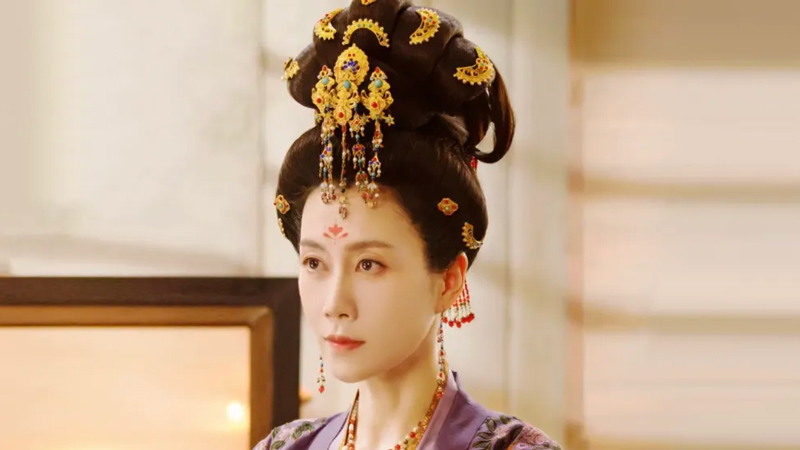
When actress Wen Zhengrong (温峥嵘) appeared in the television series Love's Freedom (许我耀眼), audiences immediately noticed something unusual about her character's appearance. Portraying the mother-in-law to the protagonist played by Zhao Lusi (赵露思), she sported an intricate hairstyle that sparked widespread curiosity online. Viewers quickly compared the towering, layered bun to a freshly baked croissant, flooding social media with questions about its origins and meaning. The style is not a modern stylist's invention but a deliberate revival of a specific aesthetic from China's past. Its presence in today's media highlights a continuing fascination with the Tang Dynasty and its bold approach to personal adornment, serving as a starting point for exploring how ancient beauty standards resonate in the present day.
Historical Roots
The distinctive hairstyle worn by Wen Zhengrong finds its direct inspiration in a specific type of coiffure popular during the Tang Dynasty, particularly from the mid to late period into the Five Dynasties era. Known as Congji (丛髻), which translates roughly to "thicket bun" or "cluster bun," this style was characterized by multiple small coiled buns, or Huanji (鬟髻), piled atop one another to create a voluminous, textured effect. It was not merely a single uniform look but existed on a spectrum of complexity, with some versions appearing looser and more dispersed, while others were compact and dense, earning the alternative name Yunji (云髻) or "cloud bun" for its broad, cloud-like silhouette. The construction could involve the wearer's own hair, but historical evidence suggests the frequent use of pre-made false pieces for convenience and dramatic impact, allowing for rapid transformation and consistent appearance.
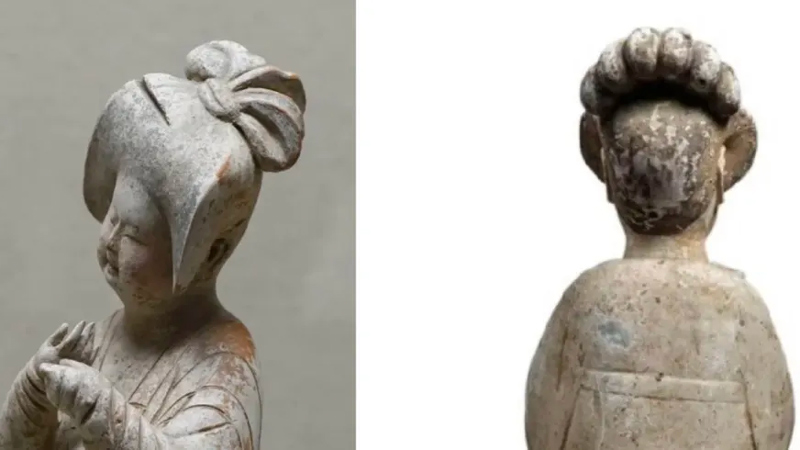
Literary records from the era provide vivid descriptions that bring these hairstyles to life. The poet Yuan Zhen (元稹) referenced a "hundred-leaf bun" in his work, a likely descriptor for a variation where numerous coiled layers resembled overlapping leaves. Another poet, Li He (李贺), wrote with playful exaggeration of women styling "eighteen buns" so heavy they supposedly induced fatigue, a testament to the era's embrace of maximalism. While eighteen coils were likely poetic license, surviving art and texts confirm that five or six layers were not uncommon for affluent women attending court functions or festive gatherings. This trend toward complexity was part of a broader cultural shift where hairstyles became a primary canvas for displaying status, wealth, and artistic sensibility, moving far beyond simple, functional designs.
The creation of a Congji was an exercise in architectural balance. It merged the romantic, flowing quality of looser buns with the structured neatness of more formal styles, achieving a look that was ornate without being overwhelmingly ceremonial. This made it suitable for a range of occasions, from daily wear for the elite to more staged performances. Its layered nature served a practical purpose beyond aesthetics: it dramatically increased the surface area of the hair, creating a sturdy foundation for an elaborate display of hairpins, combs, flowers, and other precious ornaments. A woman's coiffure was, in effect, a public statement of her taste and social standing, and the Congji provided the perfect framework for such declarations.
Stylistic Variations
Beyond the general Congji, several distinct subtypes existed, each with its own name and character. One notable variation was the Bacongji (拔丛髻), or "disheveled thicket bun." Described in texts from the late Tang, this style embraced a deliberate artfulness of disorder. Hair was arranged to appear loosely gathered and was often allowed to fall casually across the forehead or to one side, creating an impression of effortless elegance. This "bedhead" chic was considered a fashionable, almost rebellious, style in its time, reflecting changing social attitudes during a period of political uncertainty. It was part of a larger trend in makeup and dress known as the "fashion of the age," which sometimes incorporated mournful or melancholic expressions into beauty ideals.
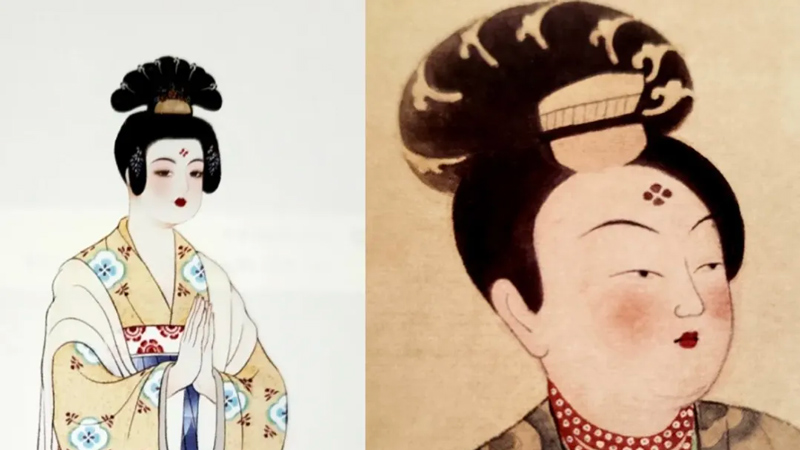
Another specialized form was the Baiyeji (百叶髻), or "hundred-leaf bun." While its exact visual form is lost to time, its name suggests a complex interweaving or stacking of hair coils that resembled the layers of a flower or plant. Poetic descriptions hint at its use in particularly refined or romantic contexts, often accessorized with specific types of shoes and luxurious fabrics. The common thread among all these variations was the fundamental principle of accumulation and texture. Whether tightly wound into a solid "cloud" or artfully loosened into a "disheveled" state, the hairstyle was a composite of smaller units, a testament to the skill of the hairdresser and the patience of the wearer.
Modern Revival
The reappearance of the Congji in a 21st-century television series like Love's Freedom is part of a broader cultural phenomenon. Costume designers and directors, aiming for visual splendor and historical depth, increasingly mine the Tang Dynasty for inspiration. This era is often romanticized as a peak of Chinese cultural confidence and cosmopolitanism, and its fashions offer a rich vocabulary for signaling a character's personality, status, or the specific historical context of a story. When a modern audience sees Wen Zhengrong's character with this hairstyle, it instantly communicates a sense of tradition, authority, and connection to an opulent past, even if the drama itself is set in a different time period.
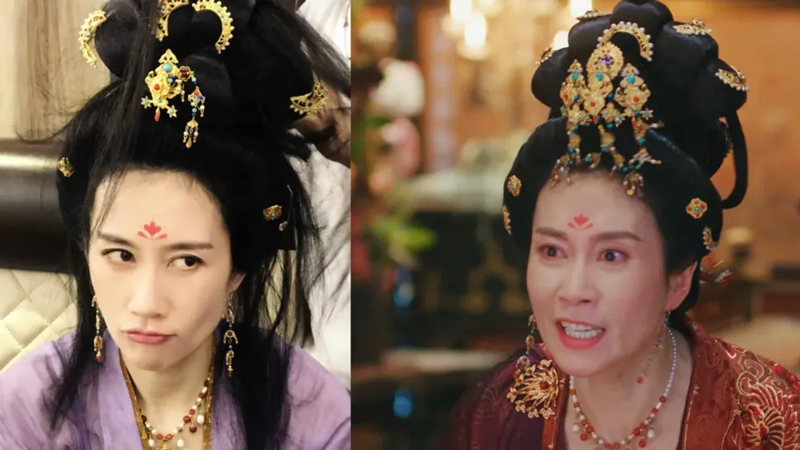
This modern adaptation is not a perfect archaeological replica but an interpretive translation. Contemporary makeup artists use advanced materials and techniques to recreate the silhouette of the Congji while ensuring it withstands the demands of long filming schedules and high-definition cameras. The choice to use this specific style, out of the dozens available from historical records, is significant. Its structured yet organic form is visually striking and photographs well, providing a strong, memorable visual anchor for a character. It serves as a shorthand for "traditional elegance" that is immediately recognizable to a domestic audience familiar with these cultural touchstones.
The journey of the Congji from a Tang Dynasty court to a modern television screen underscores a dynamic relationship with history. It is not treated as a static museum piece but as a living element of design that can be adapted, reinterpreted, and injected with new meaning. The online buzz generated by Wen Zhengrong's "croissant" hair demonstrates a public appetite for this kind of cultural engagement. It transforms a historical artifact into a topic of conversation, inviting viewers to ask questions and look closer. In this way, a hairstyle becomes more than a costume element; it becomes a bridge, connecting contemporary pop culture with the enduring allure of a bygone age's aesthetic imagination.
