
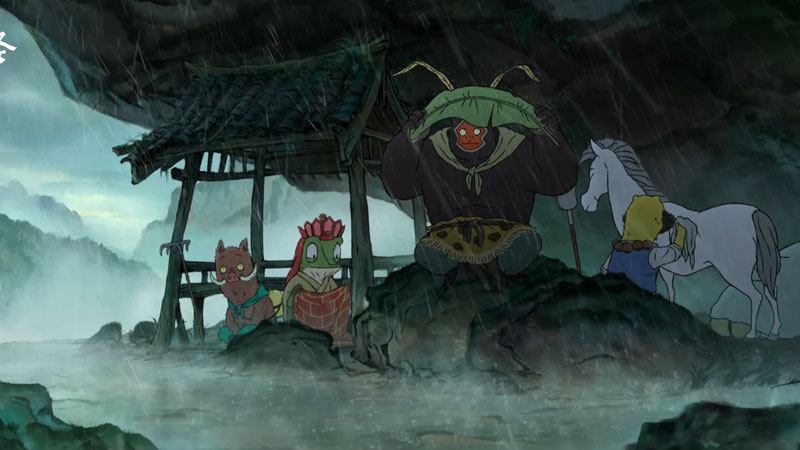
The little pig demon, down on his luck, teams up with a toad spirit, weasel spirit, and gorilla monster. Together, they pretend to be the legendary Tang Monk and his disciples, setting off on a pilgrimage to the West. That little pig who dreamed of leaving Langlang Mountain behind – did he finally get his wish?
Director Ang Lee once said, "Whenever something becomes concrete on screen, it often loses its mystery. The more vivid it is, the less refined it becomes. No matter how fresh or risky the concept is, in the end it needs to land—and that landing is usually both wonderful and a little cliché." That pretty much sums up NOBODY.
It's a journey that's both absurd and familiar. This time, the classic Journey to the West story doesn't center on legendary heroes saving the world. Our knock-off team doesn't even get a clear glimpse of the real monk and his disciples—just a blurry silhouette in the distance. Like a video game render that didn't load.
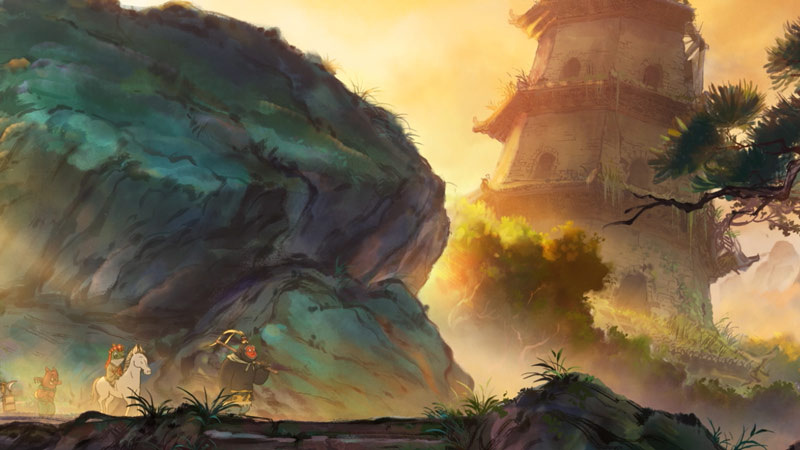
And yet, for all its novelty, the film still borrows the same template used by generations of storytellers: a personal quest set against a backdrop of something bigger than you. That narrative trick's been done by Yang Jie (1986's Journey to the West), Stephen Chow, Tsui Hark, and even the game Black Myth: Wukong.
So yes, it's cliché. But that's kind of the point. The mundane stuff—struggle, regret, missed chances—is what most of us actually live. If the '80s gave us reform-era optimism, and A Chinese Odyssey in the '90s reflected the rise of self-awareness, then Langlang Mountain feels like it belongs to the post-pandemic, post-hustle generation. A quiet sort of peace with being… average.
Because every generation has its own scriptures to fetch—even if they're not sacred.
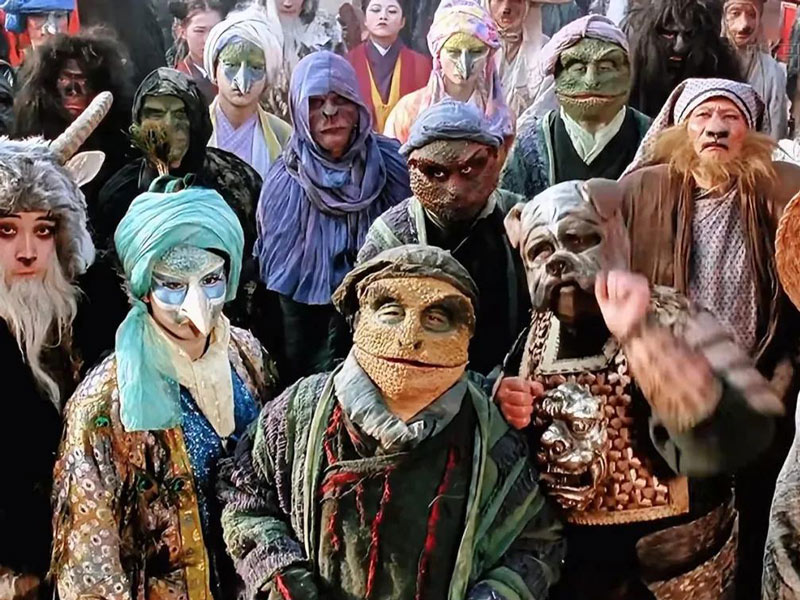
The idea that four low-tier demons could go on their own pilgrimage would've been unthinkable in past adaptations. Go back to A Chinese Odyssey II (1995), and the frog demon's most memorable line is literally yelling "I object!" at Bull Demon King's wedding announcement.
 Do Minor Demons Even Get to Seek Enlightenment?
 Do Minor Demons Even Get to Seek Enlightenment?
In 2023, Yao – Chinese Folktales, an animated anthology with a distinctive hand-painted style, became a surprise hit. Its breakout short The Summer of the Little Monster was a quiet, emotional tale about a pig demon stuck in a dead-end job at a low-ranking demon outpost.
Two years later, that short got a feature-length upgrade. NOBODY takes that same pig demon and gives him a bigger stage—and more reasons to want out. Fed up with dead-end tasks and life under the "system," he's ready to leave Langlang Mountain and start fresh somewhere far away.
The film expands on the short without ruining it. What was once a satirical sketch now becomes a bittersweet adventure that hits surprisingly hard.
Before I saw it, I worried it'd be a bit heavy—like the original short. But to my relief, the film opts for a more playful tone. Kids in the theater giggled their way through it, while their parents quietly wiped away tears behind their 3D glasses. You wouldn't know this film hits that hard unless you're old enough to get the punch.
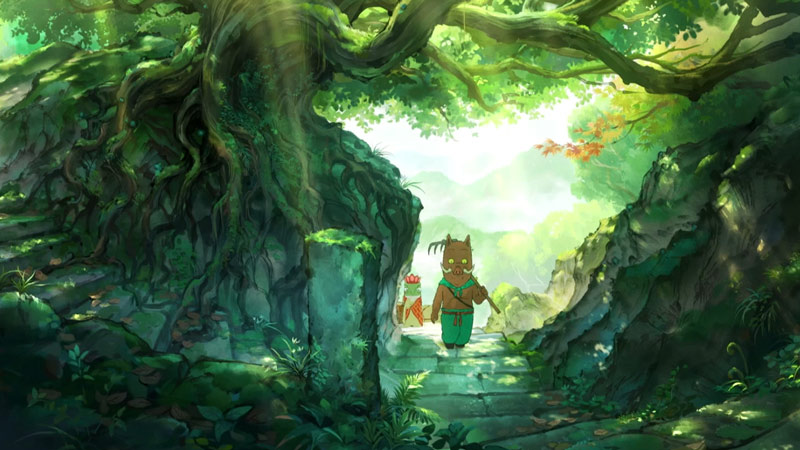
No need to pull out tired phrases like "you understand it only when you've lived it." But it's true: different audiences see different stories here. For kids, it's a goofy buddy comedy about four losers who slowly become a real team. For adults, it's about the quiet heroism of trying your best in a world that feels rigged. It says: you don't have to be born a monk or a monkey god to deserve a shot at your own pilgrimage.
Not everyone gets to fetch the scriptures.
The core fantasy of our little monster crew gets ruthlessly dismantled by the leopard demon of Little Thunder Monastery, who lays it all out like a pro at power games:
"You think just anyone can go on a scripture quest? Sun Wukong has known the Buddha since 500 years ago. Pigsy and Sandy are literal deities in disguise. Tang Monk was the golden cicada in his past life and now he's sworn brothers with the Emperor."
This is textbook early-stage Journey to the West conspiracy lore—let's call it "Westward Journey Relationship Mapping." One of its champions is Wu Xianyun, who popularized classics like: "Li Shimin's nightmare was actually a trap set by Guanyin," "Tang Monk is secretly the child of the bandit who assaulted his mother," and "Every monster on the road symbolizes the Buddhist-Taoist turf war."
The more grounded version of this theory—though no less cynical—goes something like: "Monsters with connections survive; monsters without, get whacked."
For a while, people genuinely believed Journey to the West was a corporate survival manual. It got to the point where literally everything became metaphor:
Like how Buddha gave Guanyin three golden rings, but she only used one on Monkey King and quietly kept the other two for herself. Misuse of designated funds? Maybe. But since the job still got done, leadership looked the other way.
Thankfully, the film doesn't wallow in this brand of Machiavellian reading. Instead, it moves through a quiet but important shift: from "Let's play the part of scripture seekers" to "Let's find our own scripture to seek."
The former is still about wearing masks to meet others' expectations. The latter is where the performance stops, and you start being real with yourself. You're not the Buddha's old pal or the Emperor's sworn brother—and that's fine. You can still walk your own path.
The road to scripture isn't just external—it's also about internal transformation. At first, the cosplay had purely selfish motives:
Piggy had quit his stable job and was forced to freelance (下海, literally "go to sea," slang for entering private business after leaving the system). The toad wanted immortality. The weasel just needed to eat. And the gorilla got roped in by accident.
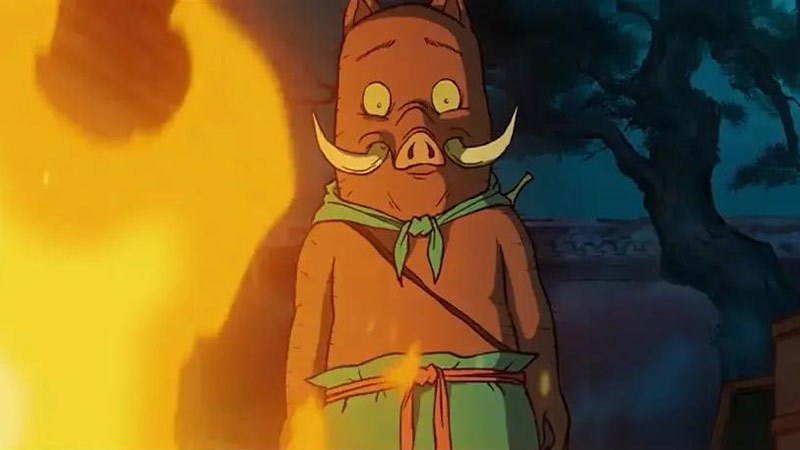
But later, they're all willing to give up decades of hard-won spiritual power to save a bunch of random village kids. By the end of the film, the villagers from back then are literally worshipping them like gods.
It started out as just a way to scam free food—posing as monks to eat without paying. But then, their spiritual hunger crept in, too. They began to ask what it was all for.
This journey from self-interest to self-sacrifice is surprisingly moving.
Most of us are ordinary people—flawed, self-serving, tired—but even so, there are moments when we can be kind, or noble, or brave just once. And maybe that one time is enough.
The Dark Humor of Four Monsters in Costume
 The Dark Humor of Four Monsters in Costume
"Daddy, they're really starting to act like the real thing!" A kid behind me said that halfway through the film. She wasn't wrong.
It sounded eerily close to those REDnote girlboss posts about manifesting—you know, "To become something, you have to believe you already are." Say it, act it, believe it—and one day, it'll be true.
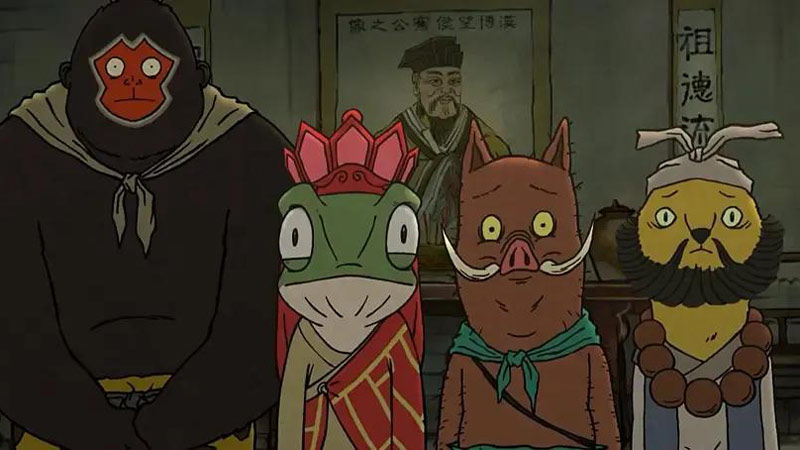
At the beginning, these four looked nothing like pilgrims. I mean, since when does Tang Monk have green skin? Was it a side effect of too much tofu and vegetarian hot pot? Sandy talked non-stop, like a wannabe livestreamer with no mute button. And the gorilla—he had none of the chaos energy of a true Monkey King. As Fu Hang might say, he had zero passion.
But as the four monsters heard more and more stories about the real pilgrims, they started upgrading their appearances to match.
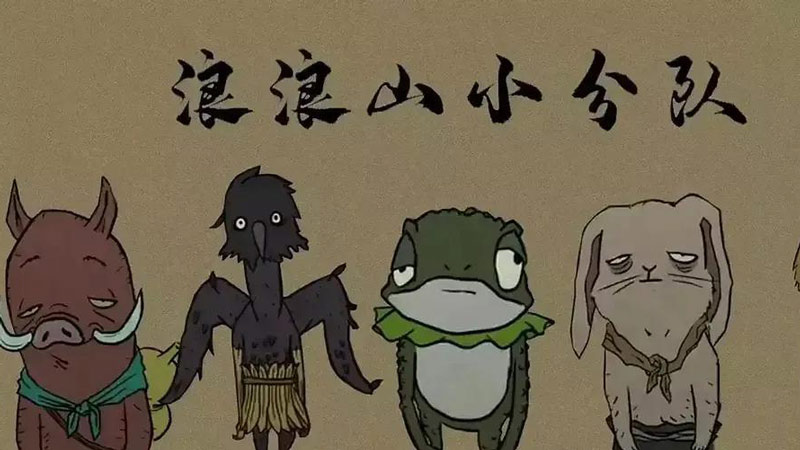
The toad demon scored a monk's robe; with his bulging eyes and that tight-lipped silence, he really began to resemble a very drained, very done-with-life version of Tang Monk.
The weasel glued on a massive beard and, to suppress the urge to speak, took to grinding his monk staff on a whetstone every day.
The gorilla got a shiny feathered crown. The piglet picked up a rake and started acting like he was born to swing it.
The piglet even got his hands on a script of Sandy's lines from a traveling storyteller. He told the weasel:
"You're only allowed to say two things. One: 'Big Brother, Master's been taken by demons.' Two: 'Big Brother, Master and Second Brother have been taken by demons.'"
Ah, stereotypes—they kill nuance quicker than a demon's club.
The Legend of Sealed Mountain pokes fun at these fossilized images of the pilgrim crew. And in doing so, it lightly deconstructs a truth we rarely question: our mental image of these characters has already been shaped—if not outright hijacked—by decades of TV and film.
Not only do depictions vary from version to version, they're often inconsistent within the same franchise.
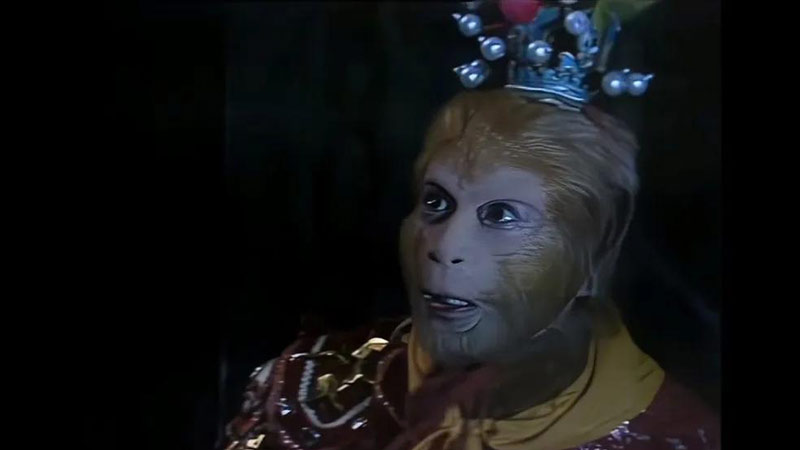
In the 1986 series directed by Yang Jie, Pigsy had actual bristles on his face—kinda like our piglet here—useful for scrubbing pots.
But by the 2000 sequel, Pigsy's face had become smooth and round, like he'd undergone some serious laser hair removal.
This sort of "cutesy processing" isn't limited to Pigsy, either. The leopard, lion, and white elephant demons in the same show were all redesigned with a kind of playful charm—utterly at odds with their original character as bloodthirsty predators.
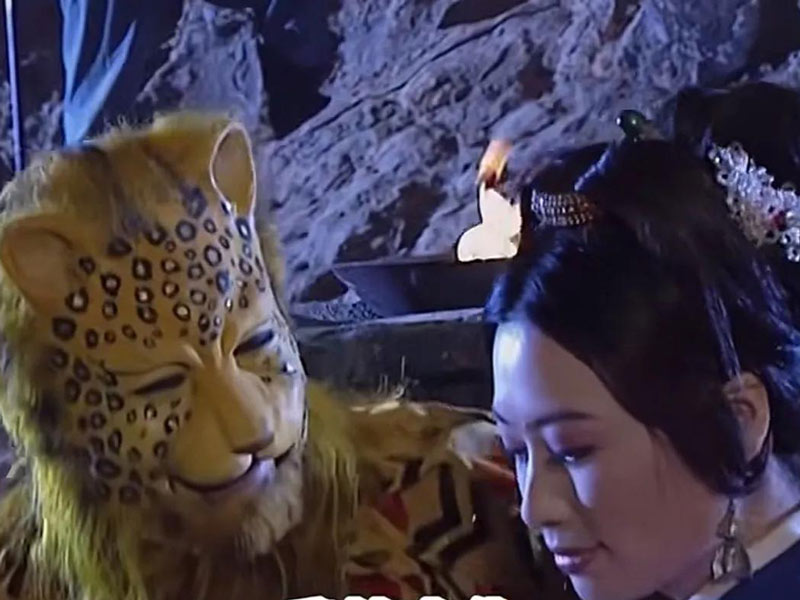
The leopard demon in Sealed Mountain, for instance, is respectful to the human bride he kidnaps and downright polite to the sacred monk he captures. Unsurprisingly, he's developed a bit of a following online among viewers who love a courteous villain.
A lot of the film's humor comes from this dynamic of "faking it until you almost believe it"—blunt, but very effective.
Sometimes it feels like the filmmakers are doing spiritual kung fu in a teacup, but every now and then, they really do manage to pull off a clever twist.
Once the audience starts accepting something as "true," it's surprisingly easy to rationalize the absurd.
When the frog gets caught by the dog demons of Double Dog Cave, he tries to talk his way out of being eaten by pointing out a wart on his back—"See? I'm not the monk!"
But the dog demon just yells, "Nice try—this is one of Monkey King's illusions!"
So pure. So sincere. No wonder the dog boss ends up getting bludgeoned to death by the real Monkey King. And the second-in-command, miraculously spared, walks away believing he's achieved immortality from bathing in the monk's bathwater.
Honestly, that entire "Double Dog Cave massacre" sequence by the real pilgrimage team feels pretty tongue-in-cheek. In the original text, countless nameless demons are casually slaughtered, and Pigsy, that loveable rascal, is constantly setting fire to enemy lairs. Just because the scripture crew has Buddhist PR doesn't mean they don't get their hands dirty. There's very little actual compassion for lower-level demons.
Outside the Main Quest & The Generational Evolution of the Journey IP
 Outside the Main Quest & The Generational Evolution of the Journey IP
In the climax, the four little monsters pull off a dramatic fusion attack to take down the seemingly invincible Yellow Brows Demon, reducing him to his original toddler form.
Watching him kneel humbly before the Buddha Maitreya, you realize: to the little monsters, Yellow Brows was the ultimate boss. But to Maitreya, Yellow Brows is just another peon. Sometimes, the boss you've been grinding your whole life to defeat... is just someone else's side quest.
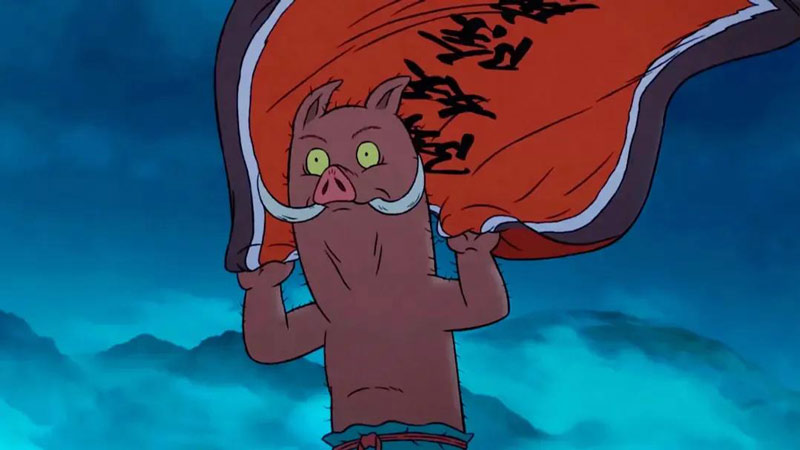
The English title is "Nobody", which spells out the film's core idea loud and clear: even a nobody can become a somebody. The hairs from Sun Wukong and the villagers' ritual at the end leave the film on an open note. Whether these four monsters stay as animals or rekindle their spiritual path through cultivation—it doesn't really matter anymore.
Unlike most previous Journey to the West adaptations, which insist on dragging their protagonists into epic destiny-type storylines, this one keeps its crew almost entirely outside the main plot.
Their biggest contribution to the so-called "arc of history"? Giving Maitreya Buddha a chance to gaslight Yellow Brows: "Your magic sucks."
Then he hands Yellow Brows two divine artifacts—the Seed Pouch and the Golden Cymbal—and assigns him the "project" of tormenting the Tang Monk and his disciples. And you know what? That tracks. Had Yellow Brows received those artifacts from the start, the little monster squad would've stood no chance.
Maitreya comes across like that senior manager who demands results but gives zero resources. The kind of boss everyone makes skits about online: "Go get me Jack Ma." "I want a partnership with TikTok." "I'm meeting Elon Musk tomorrow."
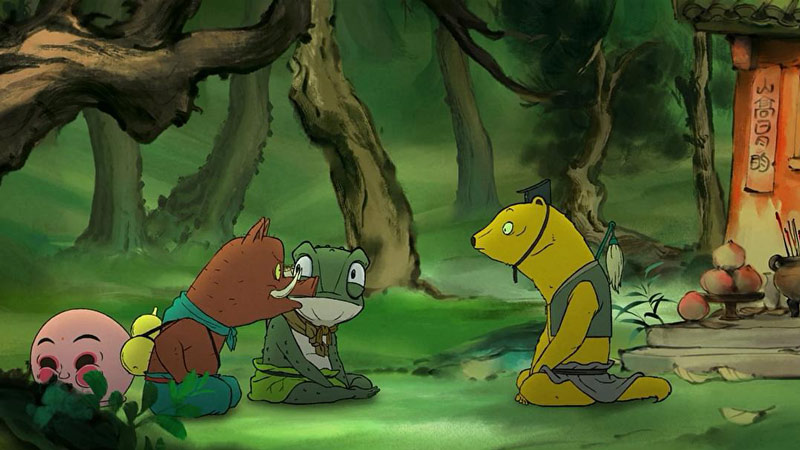
Bruh, if I could do all that, would I still be working for you?
Over the past forty years, Journey to the West adaptations have basically served as a living map of shifting social moods.
The 1986 series had a distinctly pioneering spirit. Director Yang Jie and her crew were out there, literally hiking mountains and crossing rivers to shoot the show, mirroring the hardship and devotion of the pilgrims themselves.
The theme song was bold, even politically charged—"Dare I ask where the road leads?" became a rallying cry of the Reform and Opening Up era, a soundtrack for collective ambition.
By the time we got to the 2000 sequel, the tone had mellowed. The story opens with the quartet returning to Chang'an, enjoying the Tang emperor's hospitality. Most of the plot consists of flashbacks, plugging gaps left by the original series.
It feels a bit like a panel of retired heroes reminiscing on a CCTV variety show, cued along by a host like Zhu Jun, recounting their glory days.
Of course, the updated CGI and cute-ified animals are nice, though the editing sometimes veers into fever dream territory—reminiscent of Journey to the West: Aftermath, where half the time you're wondering if you're watching a story or a PowerPoint animation.
Once the revolutionary narrative faded out, the Journey to the West IP was sucked into the black hole of romantic fantasy.
Chinese Odyssey gave us the tragic love of Joker and Zixia. Wukong had Monkey in a tortured romance with Ah Zi. Journey to the West: Conquering the Demons paired Tang Monk with Duan Girl.
Most absurd of all?
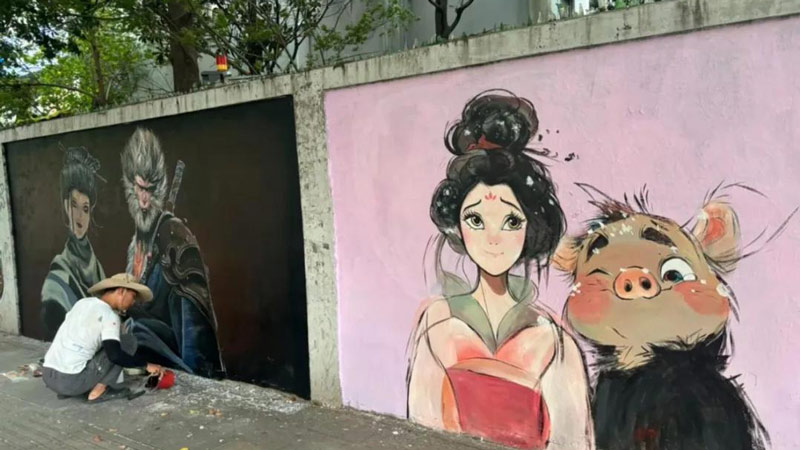
In The Monkey King, Wukong falls in love with the White Bone Spirit. Right up there with it: Black Myth: Wukong, where Pigsy gets shipped with the Spider Spirit. Apparently, only the "spider" truly "knows the pig" (a pun in Chinese: "zhi zhu" sounds like "zhi zhu"—"knowing the pig").
The latest turn—the wage slave fable—is something of a rebuttal to both the revolutionary and the romantic arcs. In the original short, the piglet's mother just wants him to land a stable job in the Demon King's cave. It's classic East Asian parenting: subtle guilt wrapped in concern.
In the film, the toad's refusal to let go of his "9981" ID badge (a play on 996: the Chinese overwork culture) symbolizes his inability to quit the corporate grind. This is decentralization in narrative form.
Where once Journey to the West parodied social class through the eyes of gods and monsters (Surprise! being the classic loser-era satire), Nobody goes further—it flips the table on the entire system.
That said, we're now deep in the margins. We've pretty much mined Journey to the West for every bit of subversion it can handle. At some point, maybe it's time to stop flipping and start rebuilding. Start again, from the beginning.
Because while the classics age quietly in memory, and even the Zhejiang remake is now fifteen years old—maybe, just maybe, it's finally time for a proper remake of Journey to the West.