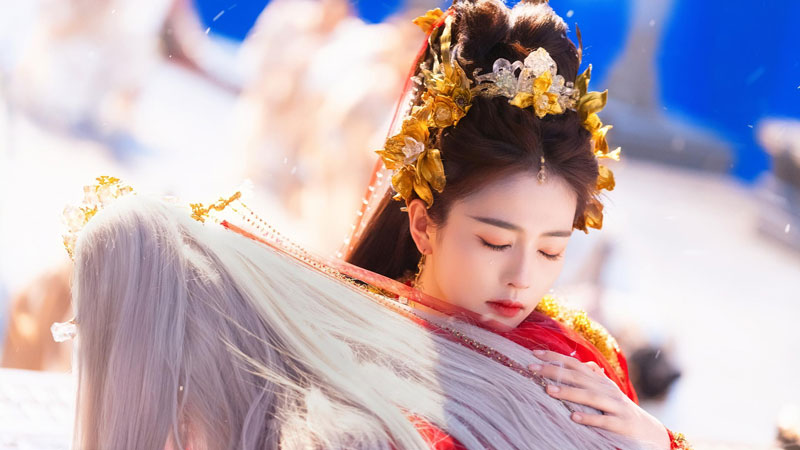
Finally! The moment we've all been waiting for—the grand finale of The Feud aired!
All the suspense and anticipation exploded in Episode 32. When Hua Ruyue travels back through parallel timelines, showing her mortal self everything Bai Jiusi has done... even though the past can't be undone, isn't making amends its own kind of perfect ending? That moment when they declared, "Never to be parted again, in heaven or on earth," melted away all those lingering "what ifs" for the audience!
This xianxia series, built on "cross-temporal storytelling," shattered the usual BE (Bad Ending) vs. HE (Happy Ending) mold. The Feud pioneered its own PE (Perfect Ending) path. It's like finding a key to unlock emotional knots—not obsessing over philosophical questions of karma, or wrestling with clear-cut notions of right and wrong. It finds wholeness within regret, showing viewers that the courage to reconcile with yourself is the real power that transcends time and space.
The finale's explosive buzz? That energy built up for weeks. Before launch, it smashed past 4 million advance viewers on just one platform. Once it aired, it broke records: "Highest premiere day heat ever on iQiyi (2025)," "Fastest to hit 100 million bullet comments," and more. Its broadcast index started strong and stayed strong, setting 2025's highest premiere record for a costume drama, holding above 9000 for days and peaking near 9600. Current projections put it solidly in the "S+" tier.
But behind those tangled timelines… How did the show weave the "three marriages and three divorces" cycle? How did it nail the complex, multi-threaded story atmosphere? How did it make us feel its emotional heartbeat so deeply? We sat down with director Guo Hao to pull back the curtain on this unique suspense-fantasy.
01: Love, Hate & Suspense: Xianxia's New Blend
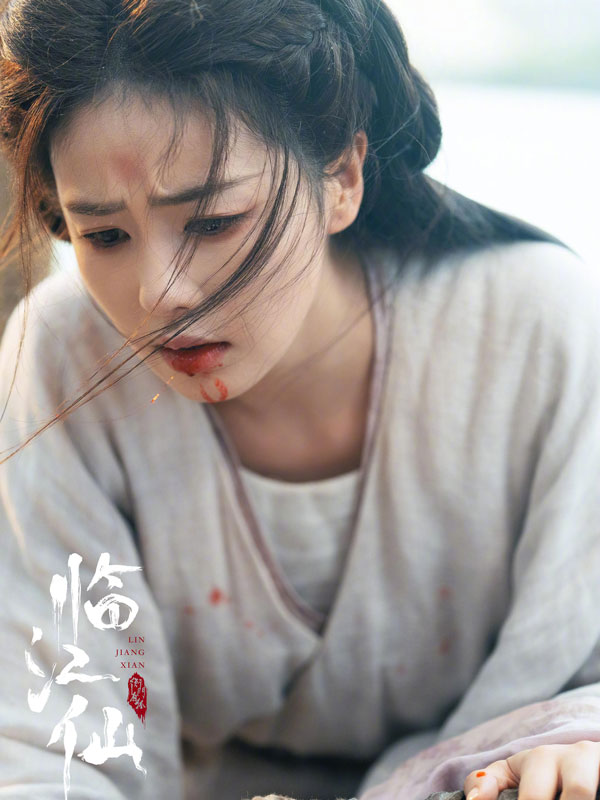
The Feud's breakout success wasn't luck.
Director Guo is clear: "I've always believed a great story rests on three things: narrative tension, visual atmosphere, and emotional drive." The show's initial hook—the "divorce xianxia" setup—was its boldest, most innovative signature.
Traditional xianxia often leans on sweet romance, tragic love, or reincarnation tropes. The Feud took a big swing. Using the three-life bond between Hua Ruyue and Bai Jiusi, it introduced the "divorce xianxia" twist. Guo Hao explains: "The 'divorce xianxia' concept completely flipped audience expectations for xianxia romance. It was the core hook that grabbed people right away." Their back-and-forth "three marriages, three divorces" felt like a brutal battlefield of love—hitting viewers right in the feels, sparking curiosity, and mirroring real-life relationship complexities. Everyone could find their own "emotional resonance" in it.
The big question driving the whole show: Hua Ruyue and Bai Jiusi—was it love or hate? Guo Hao breaks it down: "Early on, maybe it felt like 70% love, 30% hate. Later, it might seem like 90% hate, only 10% love. But if you look at the core, both emotions reached 100% intensity. As the show says, 'Hate is love pushed to its limits.' Only that level of hate and love could create this pair, bound by fate to both clash and coexist. That conflict is the engine driving the whole story."
Character twists kept viewers guessing. Episode 1's seemingly lovestruck, useless junior sister, Li Qingyue? Actually a master manipulator playing the long game ("white cut black" schemer). And Bai Jiusi's flashbacks of Hua Ruyue? Layers of love and hate built over lifetimes. It took years of "emotional experience packages" in the mortal realm for him to finally grasp the vastness of human love.
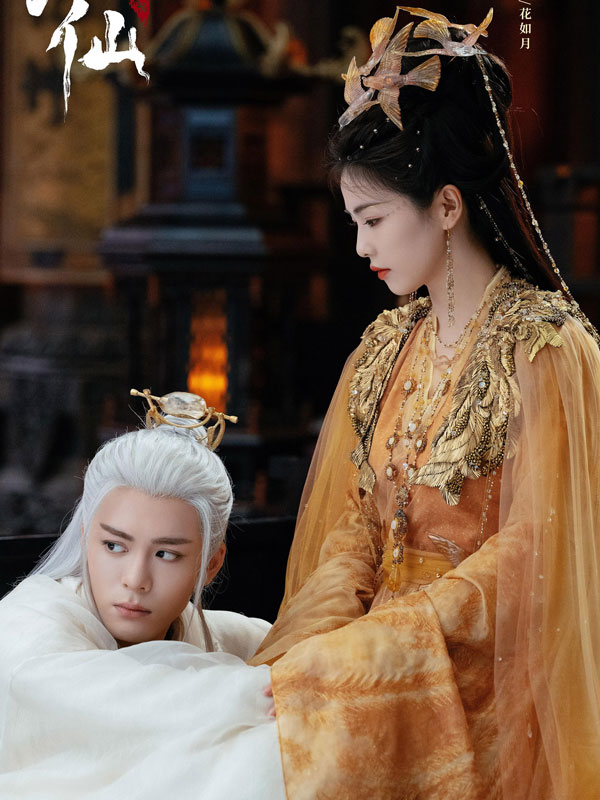
Guo Hao digs deeper: "The Hua-Bai cycle is about the lasting coexistence of love and hate. What we hoped to convey: Hate is personal, targeted. But love? It's vast, expansive, crossing gods, immortals, humans—all species and time itself. Love in this world ultimately outweighs hate. So whether it's love or hate, it's all valid; you can let time soften it. But more importantly, we hope people learn to love others, love the world, and love themselves."
The show's non-linear storytelling leaves the "love or hate" answer to time. It seems unresolved, but holds a deeper wisdom, creating a uniquely layered feel. It doesn't shy away from love's brokenness. Instead, it uses that to tackle impossible choices like "save one life or save the many?" confronting the core contradictions of human nature. This focus on coexistence and universal love injects fresh philosophical depth into xianxia.
The blend of suspense and xianxia became another major draw. Every character felt like a puzzle; viewers became detectives solving the mystery. Watching felt like a mass-participation murder mystery game. Hashtags like #WhyDoesThisXianxiaFeelLikeAnExam and #LiQingyueLiedButItsFine racked up millions of views. Guo Hao says: "Mixing suspense into the xianxia genre was our key innovation."
Building a mystery maze within the xianxia world, with timelines nested within timelines, constantly surprised viewers. The tension between surface appearances and hidden truths reflected complex humanity and the unpredictability of fate, carving out a new path for genre-blending in xianxia.
Driven by the sparks of "love-hate coexistence" and "suspense xianxia," The Feud's buzz just kept growing.
Analysis of the show's buzzwords shows emotional terms like "love," "seal," "oath," "sweet moments" resonating with mystery terms like "plot," "truth," "confusion," "puzzle," creating a powerful interactive experience for fans.
02: Unpredictable Turns, Karmic Cycles Across Lifetimes
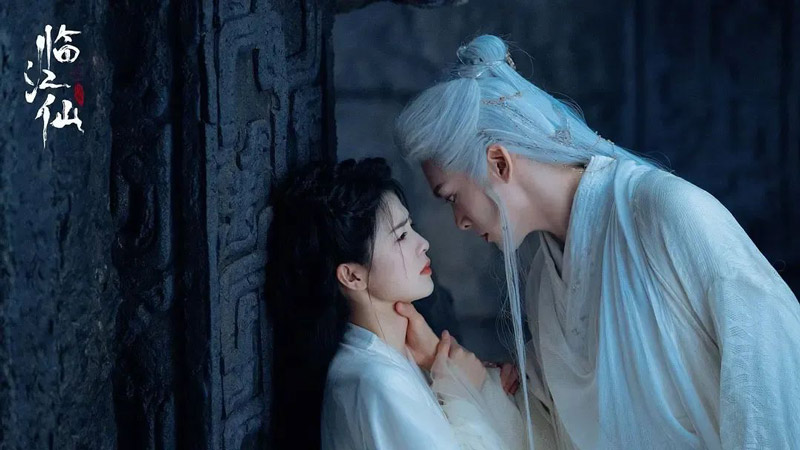
The love-hate saga spanning three lifetimes, the journey through time to mend regrets—each episode packed with suspense, and more importantly, unpredictability.
Within this karmic cycle, identities shifted. Hua Ruyue, operating under the guise of hatred, meticulously crafted her "soul-crushing trap" while disguised as Li Qingyue. This identity puzzle ran through the entire series, flawlessly executed. Buzzwords around the character show "karma," "scheming," "seal," and "true nature" dominated discussions about Li Qingyue/Hua Ruyue. Bai Lu's layered portrayal, especially, made this "deception" a major talking point.
Struggling between love and hate, loyalties also transformed. Hua Ruyue's goddess-like act of defying heaven to save lives moved countless viewers. Bai Jiusi's journey was equally profound: starting from rigidly upholding "the Way of Heaven," wrestling with the coldness of his divine nature against human compassion, until willingly joining the game to share the agony of losing a child. Only then did he see through the hypocrisy of the gods and choose to "defy heaven for love." Bai Jiusi's buzzwords—"oath," "confusion," "Way of Heaven," "chess game"—powerfully expressed his love-hate struggle from start to finish.
This complex ensemble, all players in the grand scheme, blurred the lines between illusion and reality. Their interconnected choices wove the tapestry of karmic destiny, conveying a timeless message: universal love for all beings remains the constant.
Director Guo Hao found ingenious ways to express love and righteousness. A fixed "pseudo-single-take" shot masterfully connected "Meng Chi's lifetime outside the window" with "the fleeting moment of Hua and Bai inside." Seasons changed, decades passed for mortals—mere seconds for an immortal god. Yet, despite his brief life, Meng Chi spent it all fulfilling a promise. Mortals, seemingly insignificant, still possess immense love and righteousness. This moment, where "the ephemeral becomes eternal," brought instant tears to viewers' eyes.
"Joy feels fleeting; sorrow feels eternal." These few words perfectly capture the changing constants within the karmic wheel.
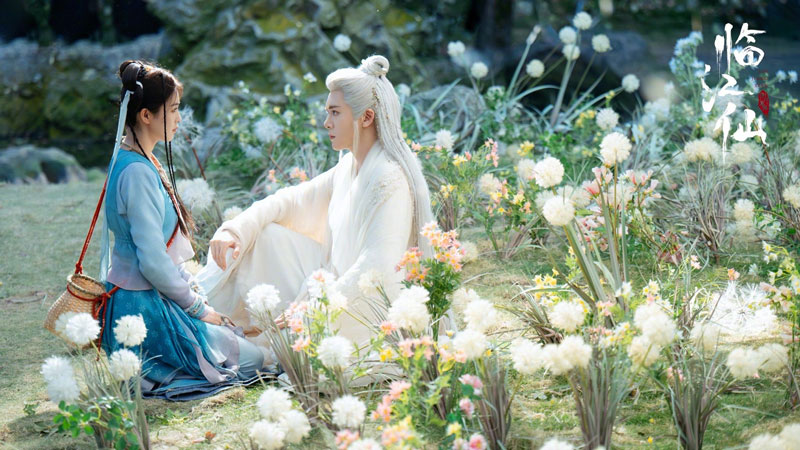
The actors' deep performances etched Hua and Bai's weary journey across lifetimes into our hearts. The scene Director Guo remembers most vividly is their first meeting on Little Qiu Mountain—Li Qingyue and Bai Jiusi's initial encounter. Looking back, it still moves him deeply. The challenges were immense: shooting outdoors at 44°C (111°F), the complex camerawork for the kiss amidst dandelions, the precise execution of the underwater explosion sequence. Every detail was crafted with care. "Especially in that brutal heat," Guo Hao recalled, "to save time and get the best shot, both leads chose to stay harnessed in wires above the water for over five hours straight. That's how we captured that classic first moment of fateful rescue." He added, "Without the actors' incredible commitment and the whole crew's effort, we could never have achieved it."
Speaking of Bai Lu (who played Hua Ruyue/Li Qingyue), Director Guo noted their prior collaboration (like Arsenal Military Academy): "The Bai Lu today is confident, radiant, yet still down-to-earth. What hasn't changed is her absolute dedication—she internalizes the script, it's truly admirable." He highlighted the scene where Hua Ruyue is sealed in the mortal realm: filmed with a shoulder-mounted camera, Bai Lu's nuanced, layered performance drew viewers deep into the tumultuous emotions, making us feel the heart-wrenching pain and soul-shaking despair alongside her. Guo Hao especially admired that "Bai Lu barely held a script on set. She'd memorized everyone else's lines too. Beyond her natural memory, it speaks volumes about her hard work and seriousness as an actor."
Guo Hao was also thrilled by Joseph Zeng's (Zeng Shunxi) near-perfect embodiment of Bai Jiusi: "Joseph practically became Bai Jiusi—the conviction in his eyes, the uncertainty in his love-hate choices, he breathed life into the character's deeply hidden passion and restraint." This incredibly complex, contradictory role stepped right off the page through Zeng's performance.
One set a trap in the name of hate; the other willingly walked into it for love. Behind their intertwined, shifting fates lay the ultimate clash: Heaven's Way versus Human Nature. This, Director Guo Hao believes, is the most powerful force The Feud delivers to its audience.
03: The Art of "Concealment": Emptiness in Chinese Aesthetics
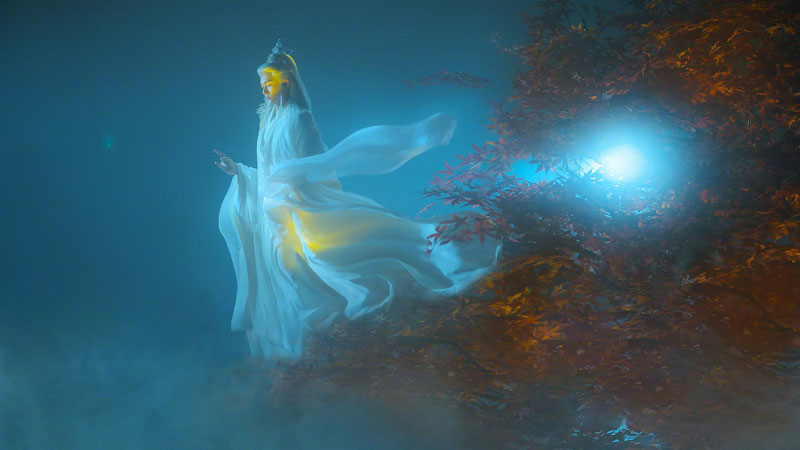
For The Feud, director Guo Hao's first venture into xianxia, he built upon the narrative mastery seen in his previous works like Ruyi's Royal Love in the Palace, Story of Yanxi Palace, and Amidst a Snowstorm of Love. Grounding the fantasy in a relatable world ("earthbound xianxia"), he continued exploring the unique allure of Chinese aesthetics. Guo Hao reflects: "Past projects gave me a solid foundation in composition, performance control, and emotional arcs. But with The Feud, there was more room to experiment with mood. Breaking down and reassembling reality within a single space, weaving dynamic elements like wind, rain, lightning, water, mist, and flower petals into static frames—these were new, challenging frontiers for me personally."
Beyond his own style, Guo Hao drew inspiration from the cinematic language of directors King Hu and Hou Hsiao-hsien. He shares: "These masters often used a 'contemplative gaze.' They buried dramatic conflict and character psychology within fixed, framed shots kept at a distance from the actors, inviting the audience to guess, search, and ponder. Inspired by this, 'concealment' became our key visual concept for The Feud."
What is "concealment"? How do you achieve it? This single word captures the profound subtlety of Chinese aesthetics.
The ethereal beauty of xianxia relies heavily on panoramic atmosphere, letting the setting embody emotion. And as a hybrid genre blending fantasy and suspense, it needed to hide clues within layers of foreshadowing, slowly pulling back the curtain to immerse the viewer.
In this grand play, no single entity reigns supreme—only overlapping timelines and karmic cycles. Therefore, Guo Hao emphasizes: "Compared to other xianxia dramas, The Feud uses far fewer direct, in-your-face close-ups on eyes or gestures. Even medium shots are often framed from one character's perspective, looking at another. We avoided the creator's subjective viewpoint, opting instead for objective cuts that naturally present the 'players within the game' and the 'play within the play' through the characters' own eyes."
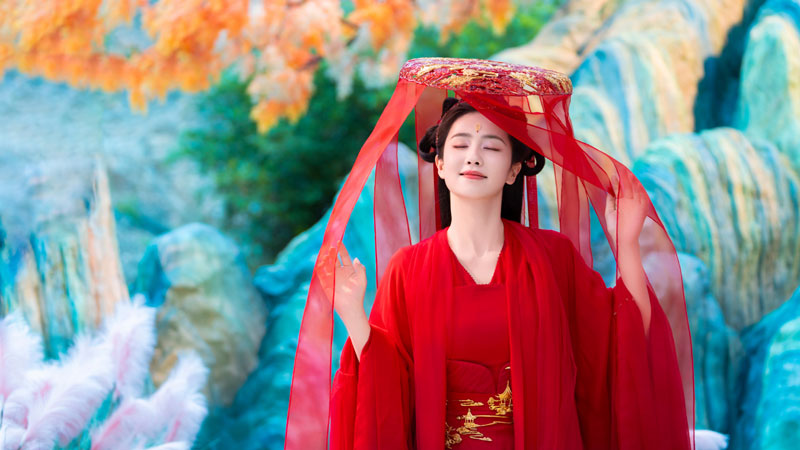
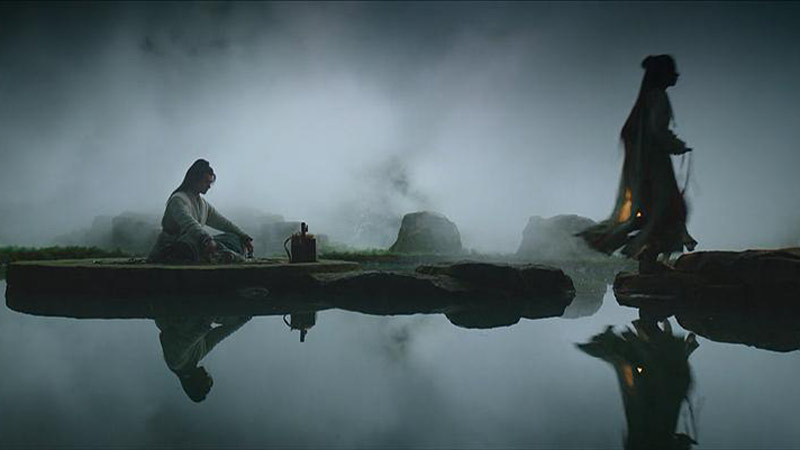
Guo Hao elaborates: "Through expressions and sound design, it's easier for viewers to share a character's joy. But when a character is shattered by deep sorrow, the camera deliberately pulls away—sometimes capturing only their back. This 'viewing from afar' technique doesn't show their raw pain clearly, but it opens up space for imagination. Paradoxically, this can stir a stronger emotional resonance and deeper ache in the audience's heart."
Indeed, "emptiness" is a particularly moving brushstroke in The Feud. A single line of dialogue, a solitary figure seen from behind—each becomes a poignant reflection of fate. The line, "He died. On his way to take up his post," brushes past Scholar Kong's death without elaboration, yet speaks volumes about life's cruel absurdity. Or when the aged Meng Chi collapses under candlelight, his lonely shadow falling silently, ending over twenty years of master-servant devotion. Light and dark, warmth and chill—the audience understands: the candle offers feeble warmth, but the world remains bitterly cold.
Seasons shift; light narrates fate. This use of lighting to externalize destiny became even more systematic across Hua and Bai's "three marriages, three divorces."
Li Qingyue's Innocent Phase: Bright light amplified youthful vibrancy.
Mortal World Bond: Their tender past love, though beautiful, was memory. Blending warm Japanese-style yellows with base whites and milky hues created a hazy, authentic "recollection texture."
After Shi'an's Death: Hua Ruyue, heart turned to ash, consumed by icy despair. Stark white light forced viewers to viscerally feel the hatred, grief, and hopelessness.
Cool tones amplified desolation; soft light hid lingering affection. Light acted like an inker's brush, adding emotional footnotes to each turning point in their fates, etching tangible glimmers of humanity onto the screen. Colored light, like the flavors of life, gave the xianxia culture a palpable, real-world warmth.
Yet throughout, Chinese aesthetics remained the core foundation. Production design rooted in Lingnan architecture and ancient painted structures, costume inspiration drawn from classical murals, and signature compositions using symmetry, framing, and central placement—all uniquely embodied Eastern visual principles. This visual system, merging classical charm with innovative beauty, resonated deeply with Chinese aesthetics. There's a specific beauty in this intentional emptiness. The blank spaces within the frame sparked endless audience imagination, proving far more moving than any detailed depiction ever could.
Closing Thoughts
Guo Hao states frankly: "Audiences today crave diversity and have higher expectations. Relying solely on a single narrative thread, no matter how literary or deeply rooted in a character's growth through time, isn't enough to sustain the core pull of a long-form story."
In this creative landscape, The Feud boldly adopted a "suspense + xianxia" hybrid model. It acted like a prism, refracting the complex base colors of human nature directly before the audience's eyes. It satisfied the desire for fantastical xianxia spectacle while using suspense's tension to pull viewers deeper, unraveling the story's profound layers.
We see, delightedly, how The Feud's approach—weaving the main arc with segmented narratives—almost breaks long episodes into shorter, impactful segments. It delivers densely packed emotional moments, offering a fresh viewing experience. Only by rooting itself in real emotion and innovating in narrative expression can xianxia drama potentially reshape its emotional destination and redefine the empathetic power its fantasy worlds hold over our reality.