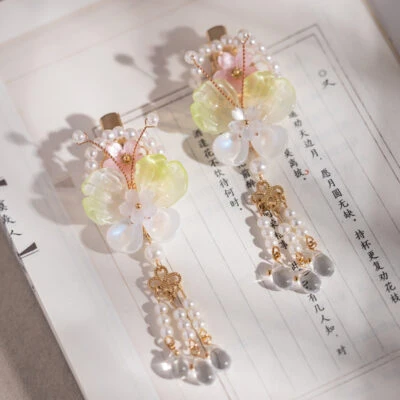
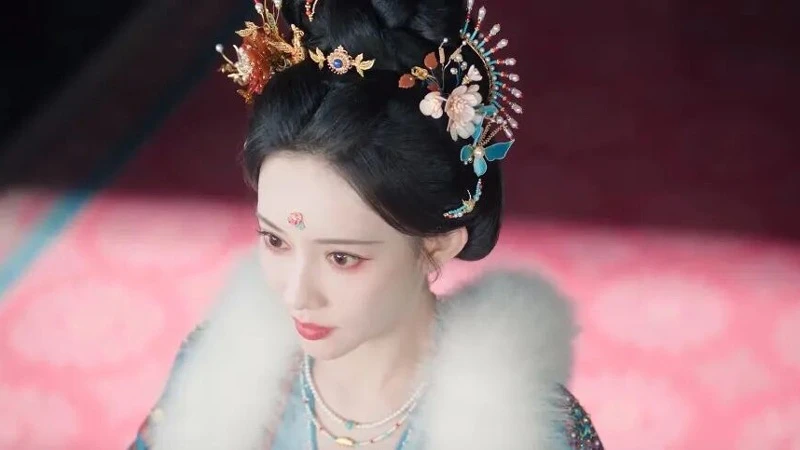
Meng Ziyi (孟子义) spends much of Tigers Sniff the Rose (尚公主) in a high bun, gold dangling ornaments, and formal robes. One piece on her left temple is quieter: an arc base covered with small pearls, opening like a half fan against her hair. It does not shout, yet it changes her face. The shape widens the side profile and makes the cheek line look relaxed. Viewers asked a fair question: is this just a costume invention, or does it have a real source? The answer sits in an older accessory called the bridge hairpin. Its story mixes hair control, metalwork, and camera-friendly design.
What Is It?
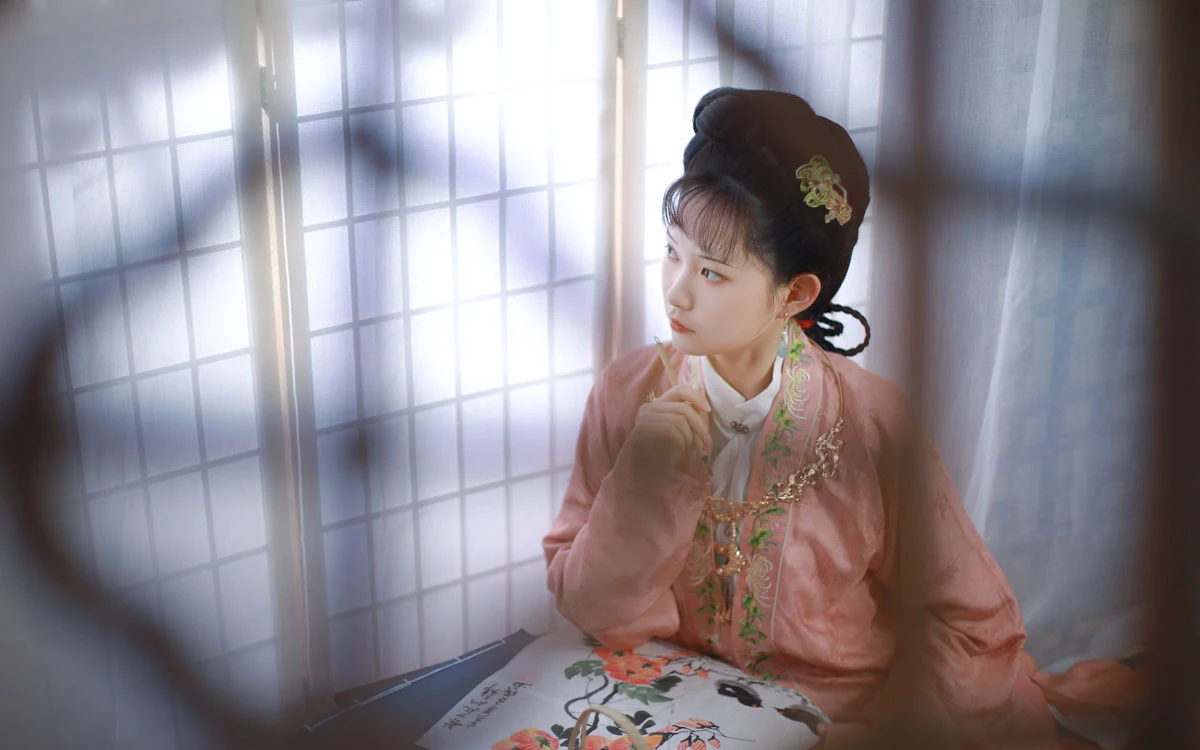
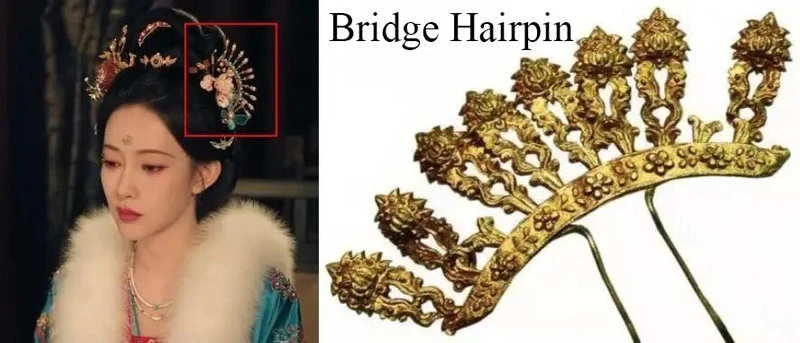
The bridge hairpin is a single hairpin that behaves like a row. Its main beam arches like a stone bridge. Along that beam sit several flower heads, sometimes a few, sometimes more than thirty. Each head may carry a thin sheet of metal or a chased pattern. Below, the structure closes into a pair of feet. Worn across the bun or at the back, it gives a wide, fan-like outline. The side view is the best view, because the arched row spreads outward and catches light. It can hold loose hair near the temple and cover an empty patch in a large updo. That double duty made it useful, not merely pretty.
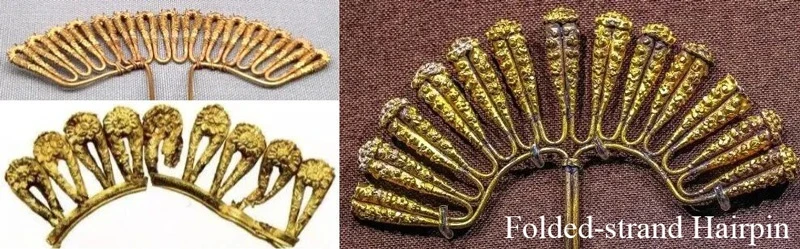
Its family tree starts with the folded-strand hairpin. A metal wire was bent in half to make two prongs. Women in the Southern Dynasties liked to insert rows of these simple pins. A southern court poem mentions the crowded look. By the Song dynasty, craftsmen solved the clutter. They joined the visual effect into one object: an arched beam, a continuous line of folded-style heads, and one pair of feet. One pin now did the work of many. That compact design is the bridge hairpin. It was not a rare court toy. Tombs in eastern China have yielded examples, which suggests women across a wide area wore it.
The fashion lasted into the Yuan dynasty with little structural change. Later, Ming women favored a structured headdress set with named parts for the front, side, and center. That system left little room for a broad side pin. The bridge hairpin did not vanish from memory, but it lost its everyday role. For a costume team, this history is a gift. The object has a clear silhouette, a practical job, and a date range. It can signal “old” without looking vague. It also offers a strong side shape, which matters on screen.
Why It Works
Her face is long and fine. A vertical ornament can make that line feel even longer. The bridge hairpin pushes sideways. Its pearl arc adds width at the temple, so the face reads as more balanced. The open fan shape also softens the edge of the cheek. Because the piece is built from small pearls and thin plates, it looks light. A solid gold slab of the same size would pull the eye down and make the head look heavy. Here, the white fur collar and formal gown carry the weight. The hairpin adds a noble air without turning into armor.
Camera work explains the second reason. Many historical dramas give side ornaments tiny footprints. In a profile shot, they disappear. This pin owns the side view. Its horizontal spread is easy to read even when the frame is tight. Pearls and flower plates break light into small points. When the actor turns or walks, those points shift. The effect has layers, unlike a flat metal plate. Under warm indoor light, the glints sit near the brow and eye. The audience looks at the expression, not at a distracting prop. The design serves the face and the lens at once.

There is also a balance between decoration and control. A large updo needs support. The arched beam can press against the hair, while the feet anchor the piece. That makes the ornament believable as part of dressing, not a random sticker. The wide row fills space that would otherwise look empty above the ear. It does not need extra ribbons or dangling chains. The result is clean. For a character with authority, that cleanliness matters. The pin says “formal” through structure, not through noise.
Screen Makeover
The team did not copy a museum piece. It took the bridge shape and rebuilt it for fiction. Ancient examples were mostly metal and rather rigid. The screen version uses softer materials and pearl accents. That choice lowers the cold shine of metal. The outline stays precise, but the surface feels gentler. The arch and the horizontal row remain. Without them, the reference would collapse. With them, the piece still reads as a bridge hairpin even after the material changes. This is adaptation by structure, not by decoration.
That method is common in good costume design. A historical object offers a skeleton: a curve, a row, a pair of feet. The show can change weight, color, and finish to fit a character. Here, the change helps her aristocratic role. The pin looks rich, but it does not overpower her. It also gives the side camera a clear landmark. Viewers may not know the term “bridge hairpin,” yet they can feel that the shape is deliberate. The fan-like look is not a random fantasy. It is a compact answer to hair, face shape, and framing.
So the next time the pearl arc appears near her temple, look at its job. It holds the bun. It widens the face. It catches warm light. It also carries a long design memory from folded pins to Song metalwork to a modern screen. The show keeps the arch and drops the stiffness. That small swap makes the past usable. The hairpin looks like a fan because a bridge, a row of flowers, and a pair of feet were turned into one elegant tool. Its mystery is not magic. It is careful shape.