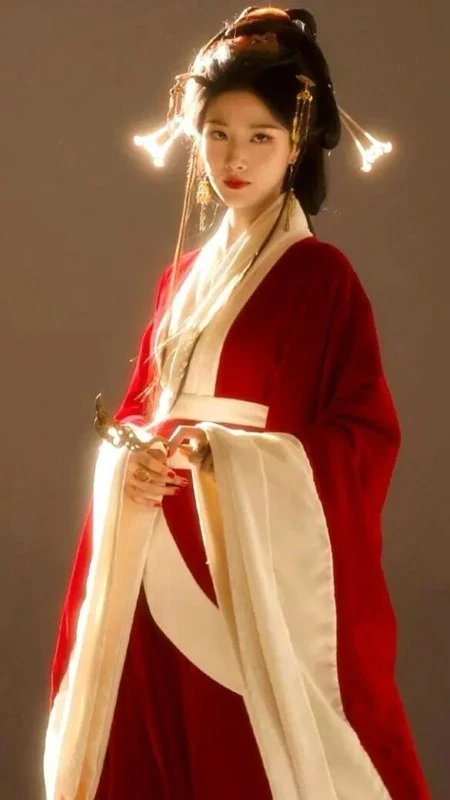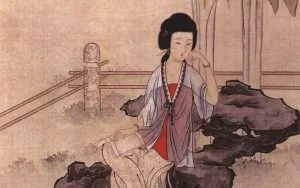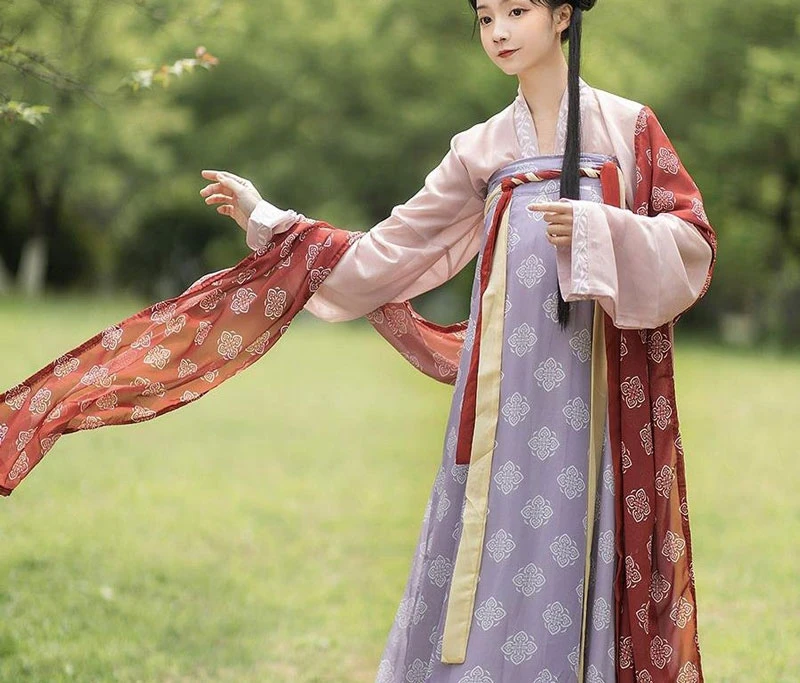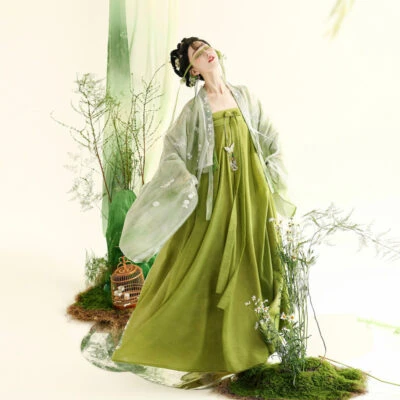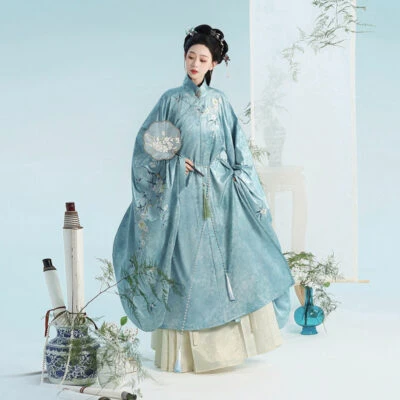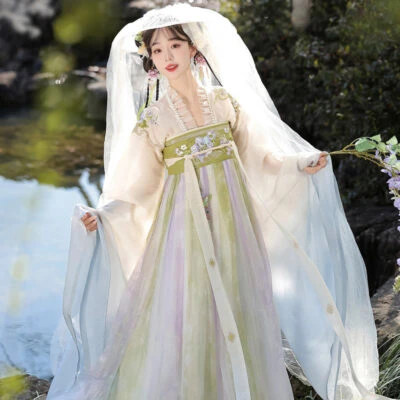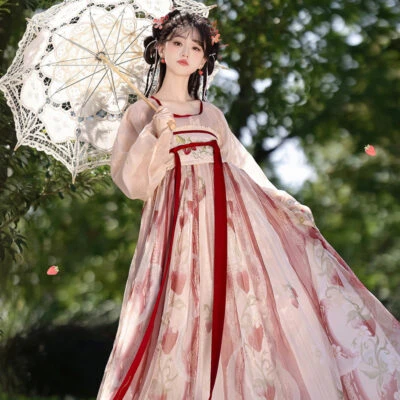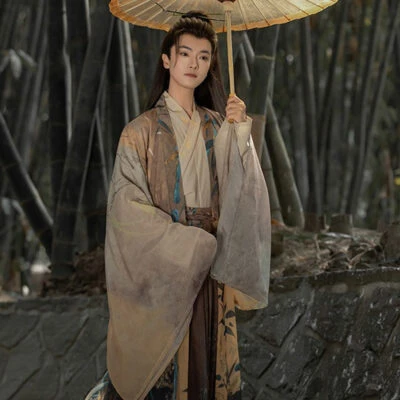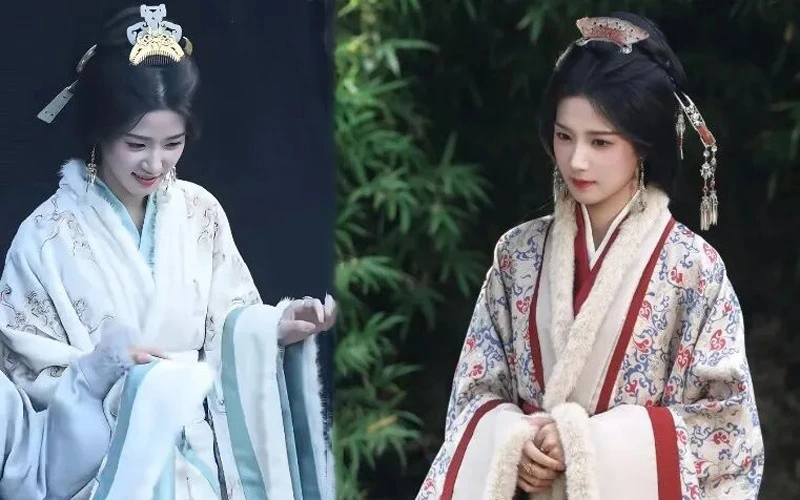
Recent behind-the-scenes photos from Ci Tang (刺棠) show Lu Yuxiao in several costumes whose lower parts do not fall in the usual straight skirt. Instead, fabric layers cross the body on a slant, then gather at the waist. The shape can look odd at first glance, almost like a styling mistake or a rushed fitting. Yet the design has a real reference: an old Chinese garment form that wrapped the body before belts and trousers became everyday solutions. That history matters because the costume is not random. It is a modern screen version of a practical idea from more than two thousand years ago, and the strange angle is the point.
Old Pattern
The reference is the curved-hem deep robe, a one-piece long garment rather than a top plus skirt. A deep robe covers the torso and legs in one continuous line. On the curved-hem version, the left front edge is extended into a triangular panel. When worn, that panel travels from the right side around the back and across the front, sometimes once, sometimes twice. A belt holds it in place. The visible result is a set of diagonal layers, exactly the “sideways wrap” that puzzles viewers. Wooden figurines from the Mawangdui Han Tomb (马王堆汉墓) show a related silhouette, which gives the screen design a solid anchor. The garment is not a skirt tied on in a hurry; it is a full robe whose excess cloth creates the pattern.
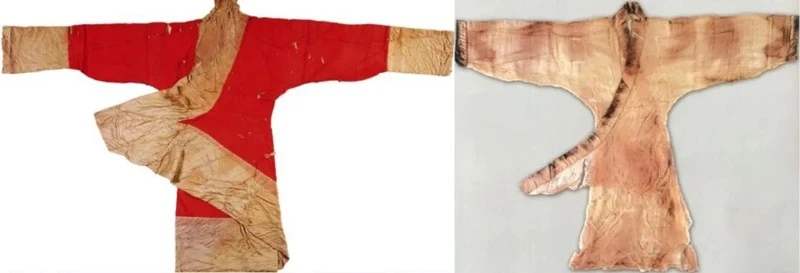
Earlier deep robes from the Western Zhou mostly used a straight hem. Book of Rites (礼记) records rules for that form. But early trousers could be two separate legs without a crotch, and closed-crotch trousers were not yet common. People therefore used the wide fabric of a robe to wrap the body more securely. Extra cloth circled the waist and covered the lower body. This wrap-around robe was not universal; straight-hem robes existed at the same time. The two habits sat beside each other, one practical, one formal, and both visible in surviving evidence. The wrap did not begin as decoration. It answered a clothing problem: how to stay covered and modest with the garments then available.
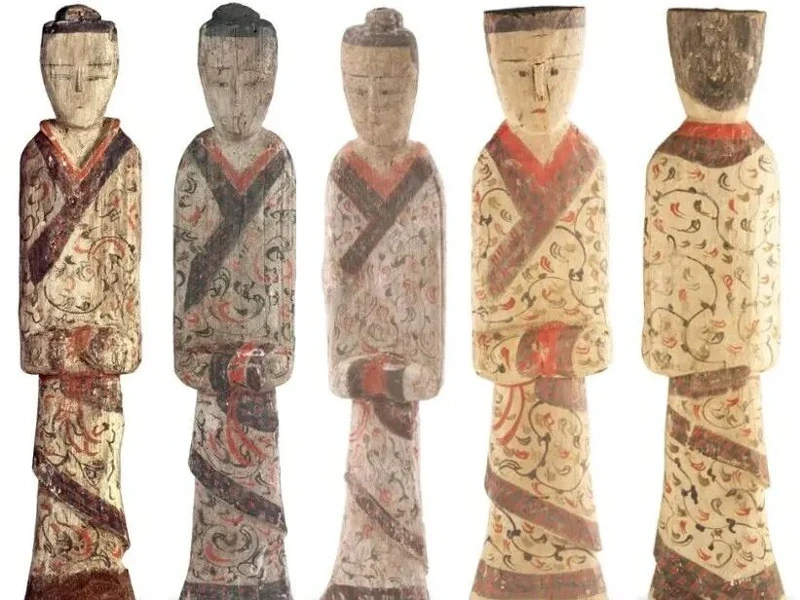
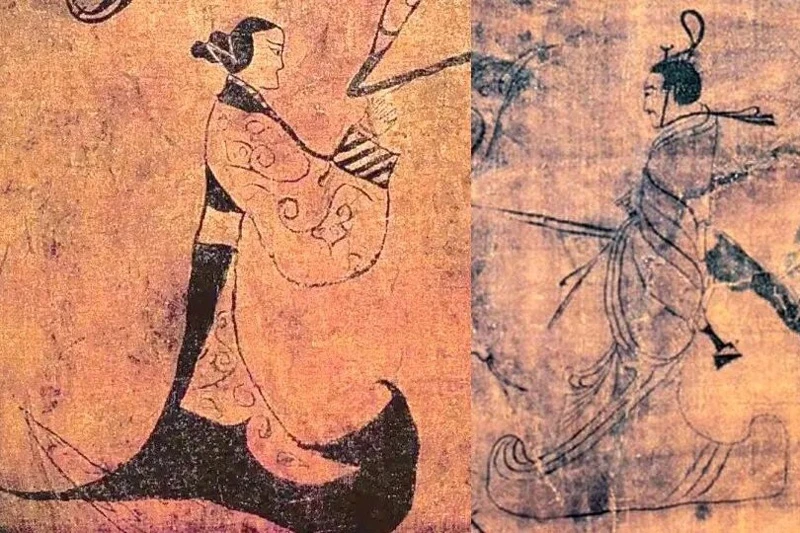
During the Warring States and Western Han, the curved-hem deep robe grew out of that wrap-around practice. Its triangular panel had a fixed angle and a fixed landing point, so it stayed tidy and covered the body with less risk of loosening. A wrap-around robe left more room for error; surplus cloth could bunch at the waist and look heavy. Murals in Changsha (长沙) Chu (楚) tombs show figures in curved-hem robes, yet the earliest surviving examples come from Mawangdui. Robes from Hubei (湖北) Chu tombs are straight-hem. That gap fuels debate: did Chu people wear only wrap-around robes, or had they already made the curved-hem version? The simpler explanation is that they had it. The change was not technically hard, and Mawangdui, an early Western Han site, carries strong Chu style in its burial goods and rites.
Screen Changes
By the Eastern Han, the curved-hem deep robe lost favor. Closed-crotch trousers became common, and taste moved toward wide sleeves and broad hems. A straight-hem robe was easier to put on, easier to walk in, and better suited to that looser look. In the Wei-Jin period, large-sleeved shirts and long skirts took over, and the old wrapped shape almost disappeared from daily dress. So the costume in Ci Tang is not a portrait of one fixed era. It borrows a historical logic and then adjusts it for camera work and character presence. That adjustment is normal in screen costume; a faithful museum copy can look stiff on a moving body.
The production does not copy museum pieces exactly. In one light-fabric look, the lower part becomes a curved cut piece, which is easier to move in during shooting. The waistband is widened, a small change that improves body proportion and makes the figure look more upright. A winter version adds a fur collar, heavier fabric, and edging. Those choices answer weather, texture, and form at the same time. The diagonal layers remain readable on screen, but they no longer carry the full weight of a reconstructed ritual garment. The team keeps the visual signature and drops the parts that would slow an actor down. That is a sensible trade, not a careless shortcut.
That is why the costume can feel strange and convincing at once. The eye sees a slanted wrap, not a neat vertical skirt, and asks what went wrong. The answer is that nothing went wrong. A practical wrapping method, later refined into a stable robe, has been trimmed, lightened, and reshaped for a drama. The result keeps the old diagonal line while serving a modern actress and a modern camera. Once viewers know the reference, the odd shape becomes a clue rather than a flaw. It also shows how costume can teach history without a lecture: one angled seam invites a question, and the question opens a door to two thousand years of dress.