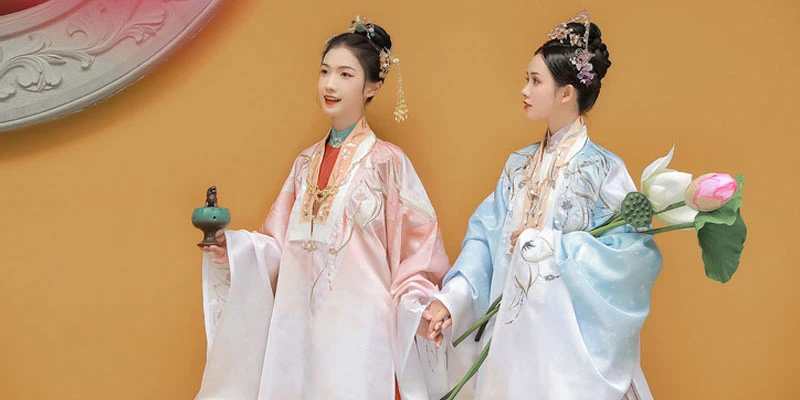
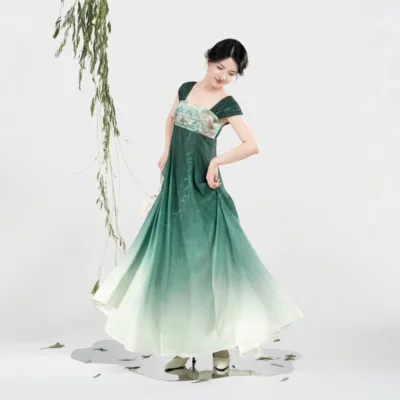
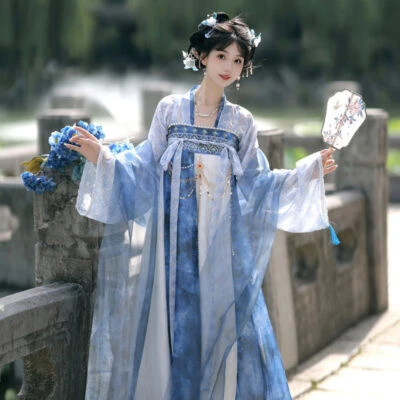
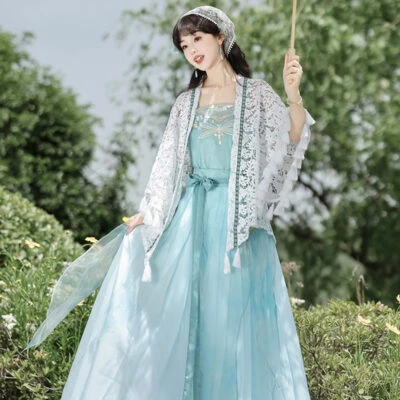
A Banbi is a short-sleeved upper garment built to be a layer rather than an outfit: the sleeves stop at the elbow, the body at the waist, and it goes over a blouse or under a robe, seldom on its own. Shen Congwen, whose 1981 survey of Chinese dress still sets the terms of the discussion, described it as a collarless or turn-down-collared short outer coat with a front opening or a pull-over neck, developed out of the upper ru of the Wei and Jin periods. The name is older than the garment’s Tang fame. The Eastern Han glossary Explaining Names already glosses a half-sleeve as a jacket whose sleeve is cut to half length.
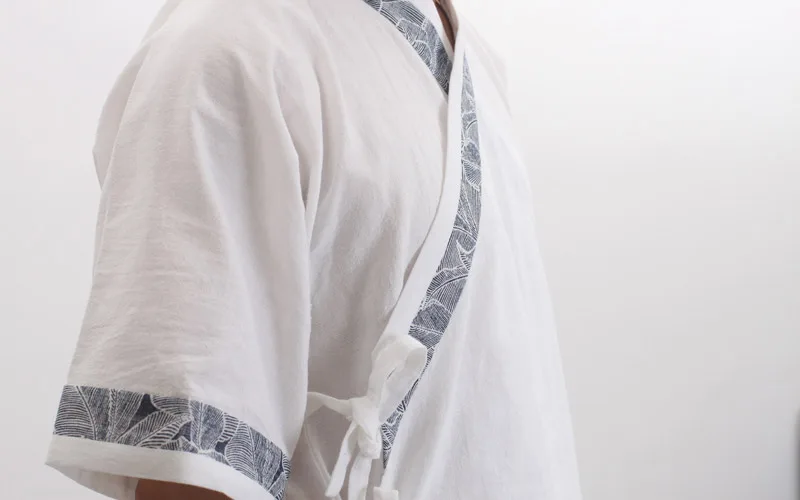
Construction explains most of what follows. The body is cut flat in a cross shape, front and back in one piece, without a shoulder seam. Collars run through four families: a wide U, a V, a round neck, or a crossed collar tied to the right. Sleeves are either broad or narrow. Closures are two: ties at the chest for a front-opening version, or a pull-over neck that needs no fastening at all. Because nothing is tailored at the shoulder, the same pattern serves a dancer’s fitted layer and an official’s under-robe, and the visual result depends almost entirely on the garment underneath.
A cross-cut body carries one further consequence that the Tang silhouette makes visible. On a hand loom the width of the cloth sets the span across the shoulders, so a body cut in one piece without a shoulder seam has a fixed maximum reach at the arm. Short sleeves are therefore a matter of what the loom could supply rather than a preference for bare arms, and the finished sleeve follows the width of the bolt as much as any rule about rank. Looms of the period produced cloth in narrow widths, and a garment cut flat from such cloth keeps the sleeve ending near the elbow, which is precisely the measurement every definition of Banbi repeats.
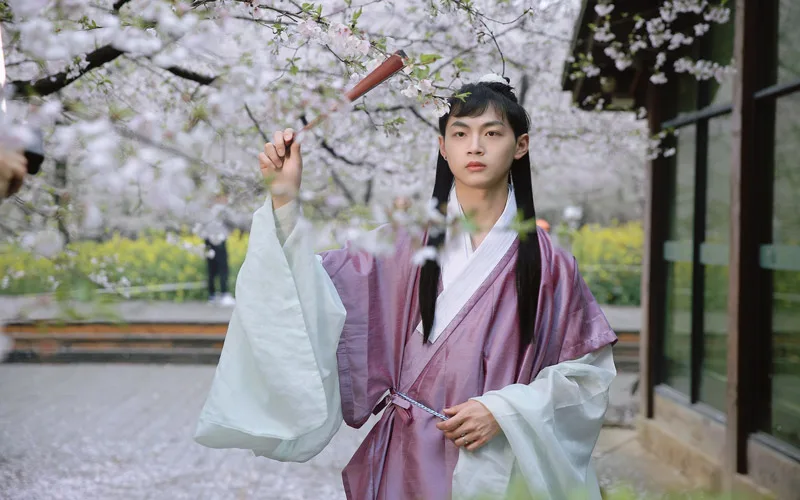
Below the waist a Banbi could carry a contrasting hem band, a strip of different colour running from waist to knee so that the whole reads like a short skirt. Tang inventories call this band a Lan (襕), and Dunhuang documents list such pieces by colour and weave, among them a green damask lan. The band is the reason the garment photographs so differently from a waistcoat: it lengthens the torso in one block of colour and separates the sleeve line from the skirt line. Classification by collar and cut, rather than by period, remains the working system on Hanfu styles reference pages today.
Sun Ji dated the first appearance to the Three Kingdoms, placed its rise in the Sui, its peak in the early Tang, and its decline from the mid Tang onward. That curve is worth holding onto, because it does not track the garment’s usefulness. It tracks the width of everything worn with it.
What the Tang Court Code Calls a Banbi
Read the New Book of Tang and a small puzzle appears: the chapter on carriages and dress never uses the word Banbi. The matching term is banxiu, half-sleeve. Under the heading of dress for titled women, the code states that the half-sleeved skirt-and-blouse is the everyday duty dress of the female scribes of the Eastern Palace, listed in the same register as public-service robes, with the inner shift, knee cover, and broad sash removed. In other words, the earliest firm placement of the garment in Tang regulation is not leisure wear but a workplace uniform for palace record-keepers.
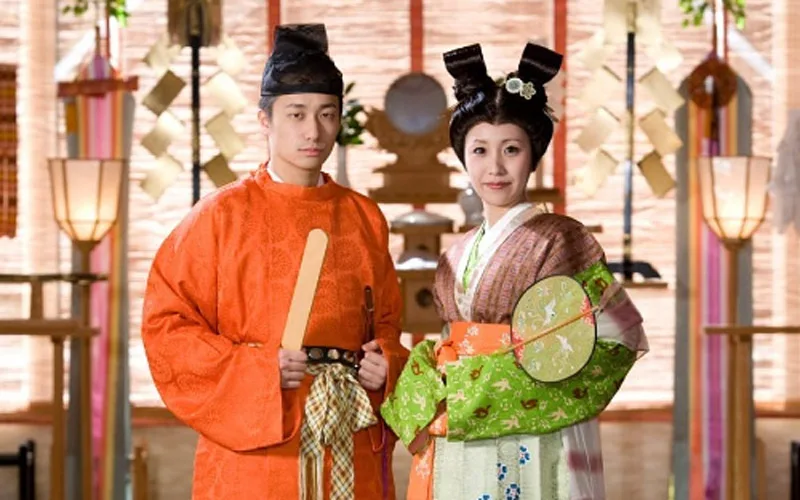
That line runs back to the first Tang reign. The Martial Virtue statutes issued under Emperor Gaozu require female scribes to wear the half-sleeved skirt and blouse, wording the later chapter carries forward almost unchanged. What this establishes is a sequence. The Banbi entered the Tang system as occupational dress for inner-court officials, then moved outward to aristocratic households and finally to ordinary women, and the movement is visible in the way the sources stop describing it as an office and start describing it as a fashion. Readers who want the wider wardrobe of the period will find the robe and skirt layers set out on our Tang dynasty clothing guide.
Ma Zhou’s memorial, quoted in the same chapter, asks the throne to add hem bands, sleeve treatments, cuffs and edging to the plain shirt so that it can serve scholars as upper dress, and names the slit-sided version as the shirt for commoners; the emperor approved, and Zhangsun Wuji then proposed adding a hem band to robes. A later compilation, the Comprehensive Institutions of the Tang, records a requisition of one hundred bolts of Banbi brocade, which tells us what the garment was made from rather than what it looked like. The ritual warrant came separately: an earlier-fifth-century compilation quotes Ma Zhou asking that a Banbi be added over the inner shift so that dress would conform to propriety, with a matching request to distinguish civil and military officials by robe length.
Put those two records together and the early Tang use becomes specific. The Banbi sat over the shift and under the robe, which means its job was structural: it squared the shoulder line and thickened the upper body under an outer layer. That is why the better ones were cut from stiff patterned silk rather than soft gauze. Not everyone approved. Fang Guan, a chancellor under three mid-eighth-century reigns, treated the Banbi as frivolous dress and wrote a ban on wearing one into his family rules, which is the earliest sign that the garment had acquired a social meaning beyond warmth.
Three Burials That Kept the Evidence
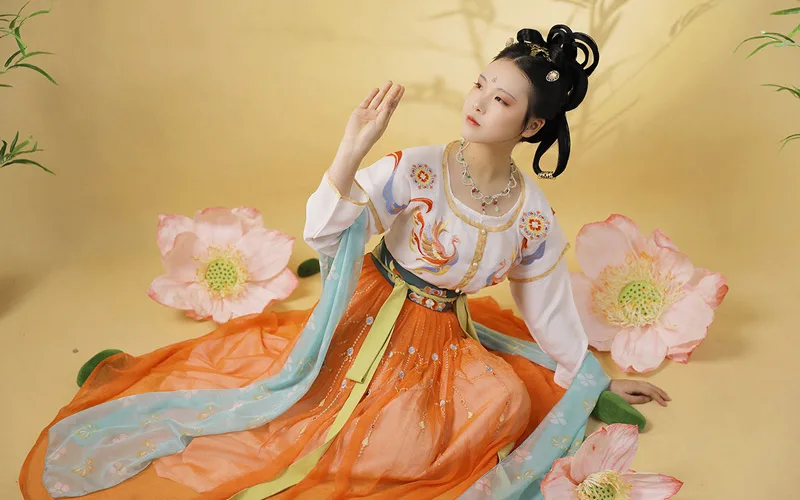
The object most often cited was excavated in 1973 from Astana Tomb 206 at Turpan in Xinjiang, the joint burial of Zhang Xiong, a left guard general of Gaochang, and his wife, nee Qu. The burial goods are unusually fine and largely of Central Plains manufacture, with a pronounced high-Tang character. Among them is a painted wooden-core silk-dressed female dancer: a carved and painted head on a wooden post, arms of twisted paper, hair in a high coil, a floral mark painted on the brow. She wears a damask Banbi patterned with paired magpies inside linked pearl roundels, a yellow-ground white-flowered gauze stole over the shoulders, a floor-length skirt of alternating red and yellow vertical panels pieced from silk and damask, a blue transparent outer skirt of gauze, and a Kesi silk tapestry belt at the chest.
What the figure fixes is a combination rather than a garment. Banbi, stole, panelled skirt, transparent overskirt and belt appear together at one dated site, which lets the layer order be read directly instead of inferred: V-neck, front opening, sleeves exactly half the arm, a close fit, worn outside a narrow-sleeved short jacket, hem tucked inside the skirt waistband. The find also explains why the garment travelled so well along the corridor. Turpan’s days and nights diverge sharply in temperature, and a short outer layer that can be added or removed without disturbing the blouse beneath answers that problem better than any coat.
Two later finds widen the evidence. The cache sealed at Famen Temple in 874, opened in 1987, contained a miniature Banbi of purple silk gauze with gold-couched embroidery: body 6.5 centimetres, sleeves 4.1 centimetres, worked with twisted gold thread couched into flowering sprays, a scale made for offering rather than wearing. The thread itself is the technical fact worth keeping, at roughly three thousand turns of gold wound onto each metre of silk. At Murong Zhi’s tomb in Wuwei, Gansu, a Wu Zhou period burial yielded several Banbi cut from damask and brocade, one of them a deer-pattern brocade, together with two nearly complete purple damask robes whose bodies are a large-pattern confronted-bird damask and whose hems carry a horizontal band.
| Evidence | Date and place | Key data | Construction |
|---|---|---|---|
| Painted wooden-core silk-dressed female dancer | Early Tang; Astana Tomb 206, Turpan, Xinjiang; excavated 1973 | Damask Banbi with paired magpies in linked pearl roundels | V-neck, front opening, sleeves to mid-arm, close fit, worn over a narrow-sleeved short jacket |
| Gold-couched Banbi, purple silk gauze ground | Late Tang, 874; Famen Temple crypt, Shaanxi; excavated 1987 | Body 6.5 cm, sleeves 4.1 cm | Miniature offering garment; twisted gold thread couched into flowering sprays |
| Deer-pattern brocade Banbi | Wu Zhou period; Murong Zhi tomb, Wuwei, Gansu | Two purple damask hem-banded robes in the same burial | Cut from damask and brocade, worn as a set with the banded robe |
| Winged-beast and phoenix brocade Banbi | Tang; Tuyuhun royal burials, Qinghai | No published dimensions | Brocade face, winged-beast and phoenix motifs |
| Red-ground confronted-bird roundel Banbi | Tang; Gansu Provincial Museum | Sogdian brocade collar and sleeves, yellow-ground rosette roundels | Roundel-patterned brocade, imported cloth reserved for collar and cuffs |
| Pale-ground floral brocade Banbi | Tang; Haixi Prefecture Museum, Qinghai | Found with a Tibetan green-ground deer-roundel vest at Dulan | Floral brocade, short sleeve, front opening |
A Garment the Censors Called Improper
Official dress codes were not the only reception. The Book of Jin, in its treatise on the five elements, records that Emperor Ming of Wei appeared in a half-sleeved shirt and was rebuked by the minister Yang Fu as freakish dress, a category reserved for garments that inverted proper form. The Records of the Three Kingdoms gives the scene more detail: Cao Rui received ministers in an embroidered cap and a pale blue damask half-sleeve, and Yang Fu asked to his face under what rule of ritual such a garment qualified as ceremonial dress. The emperor said nothing, and afterwards did not wear it in his presence. The objection was not to short sleeves as such but to their appearance in a formal setting.
Later compilations push the origin further back. The Origins of Things traces a short-sleeved shirt to a Qin edict of the second emperor, and a lacquered garment from the Warring States Chu tomb at Mashan in Jiangling already shows a long sleeve that ends at the elbow. By the last years of the Sui, palace women wore Banbi widely, and the Tang made the garment general because women’s dress of the period was cut narrow. When the female silhouette widened after the mid eighth century, the short close sleeve lost the shape it had been designed to sit over, and frequency drops in the record rather than the garment changing.
The double role is easiest to see in painting. At Mogao Cave 116 a male donor wears a Banbi beneath his robe; Cave 220 shows a reborn child in a Banbi and short trousers. Murals in the tombs of Princess Yongtai and of Li Zhen include figures in the garment, and a sancai-glazed standing female figure from the tomb of Crown Prince Jiemin at Fuping, Shaanxi, pairs a Banbi with a blouse and high-waisted skirt. Poetry carries the same object in another register: Du Fu’s Ballad of Beauties names gold-couched peacocks and silver qilin, and Li He writes of a silver bird flashing on a Banbi. None of these sources describe the cut; all of them assume the reader knows it.
Later Descendants in Silk and Felt
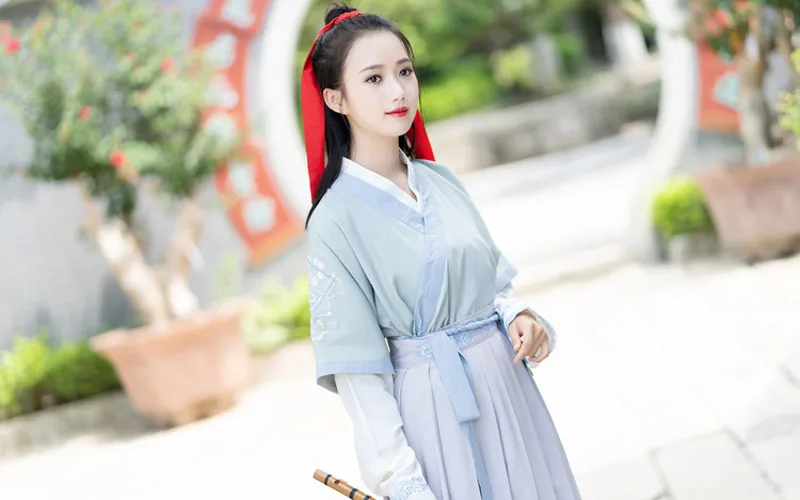
After the Tang the garment did not disappear so much as divide. Song men wore it under other layers and Song women over them, and the name shifted to banbei. Liao, Jin and Yuan burials continue the type, with a fur and leather version called dahu entering the vocabulary, and the decorative repertoire moving toward printed, gilded and applied gold. The Ming descendant is the bijia, a sleeveless front-opening overgarment favoured by younger women, and the Qing majia or kanjian carries the same logic into a shorter vest. The long-sleeved Beizi that later became a category of its own also traces part of its ancestry to the short-sleeved Banbi.
Fabric is the other half of the story. Tang Banbi were usually cut from brocade, which is why the phrase brocade Banbi turns up so often in Tang sources. The geography chapter of the New Book of Tang lists Banbi brocade among Yangzhou’s tribute goods, and Yangzhou appears to have woven it specially. Better pieces combined Shu brocade with Sogdian cloth, and designers set the two traditions side by side on one garment. The court designer Dou Shilun created the Lingyang Gong pattern in the early Tang, and the baoxiang rosette, a composite flower assembled from lotus and peony elements rather than drawn from a single plant, became the standard roundel motif of the period’s silks.
Household documents show how far down the garment reached. A Dunhuang register dated to 793 records gifts of clothing made to a monastery by local families, and among the entries is a black damask Banbi with a green damask hem band, listed with its colour and weave like any other item of value. That is a garment in ordinary circulation, not a court relic. Read together, the five sections above support one judgement: the Banbi’s elasticity was structural, not stylistic. Sleeve length, collar type and closure could each vary without redesigning the pattern, which is why a single garment type served a palace scribe’s duty dress, an officer’s under-layer and a village woman’s summer outer coat within three centuries.
Anyone reading the Banbi as a pattern rather than a costume will find the object record settles an argument the picture record cannot. Painted figures show colour and proportion; they do not show layer order, closure type or the stiffness of the cloth, and those are the variables that decide whether a modern reconstruction hangs correctly. A figurine from a dated tomb, a sealed offering cache and a named burial with its robe set each supply one of them: the first fixes the combination, the second fixes the scale of a technical achievement, the third fixes what the garment was worn with. Remove any one and the reconstruction has to guess.