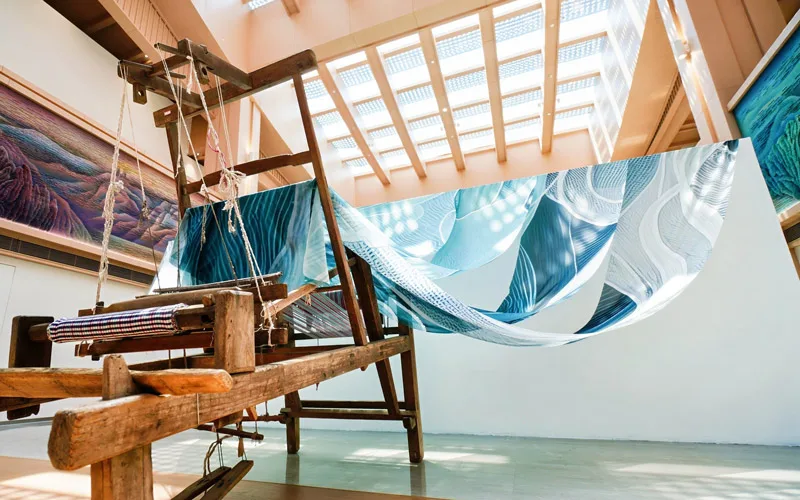
Two large jacquard brocades from Songjiang in Shanghai went on show at the Carrousel du Louvre in Paris on the evening of 23 October, opening with the Art Shopping contemporary art fair and running to 25 October. The works, a hanging scroll of the God Who Adds Fortune and a woven Map of Songjiang Prefecture, represent a local weaving technique with a seven-century record, and this is its third appearance in a Paris exhibition venue in two years.
| Dates | Opened the evening of 23 October 2026, runs to 25 October |
|---|---|
| Venue | Carrousel du Louvre, Paris, within the Art Shopping contemporary art fair |
| What it is | Two jacquard brocades showing Songjiang jacquard weaving from Shanghai |
| Scale | Fortune scroll 1.5 by 1.9 metres, 230 million warp-and-weft intersections, eight colours, 47 processes; the prefecture map shown alongside |
| Maker | Designed by craftspeople at the Dingtian Jacquard Museum, woven on Dingtian’s digital jacquard looms |
| Elsewhere | Dingtian Jacquard Museum, Songjiang, Shanghai: open since April 2025, free by reservation, more than 3,000 jacquard pieces in collection |
Two Hundred Thirty Million Intersections
Nothing in the fortune scroll was painted, and no part of its pattern was generated automatically. The hanging contains 230 million intersections of warp and weft, eight colours across the two thread systems, and 47 separate processes; every one of those intersections was positioned by a senior craftsperson at the Dingtian Jacquard Museum working through the motif, the colour layering and the weave structure by hand, after which digital looms wove it pick by pick. The hand comes first and the machine supplies precision, not invention.
That order determines how the surface behaves. Each gradation and each gold line is a physical structure formed where threads cross, not pigment laid on cloth or stitching applied over it, and under raking light the weave rises like relief in a way neither printing nor painting reproduces. Three former heads of state, Christian Wulff of Germany, Rosen Plevneliev of Bulgaria and Yves Leterme of Belgium, have collected earlier pieces from the same workshop. The second work shown in Paris turns the technique on a city: the walls, lanes, watercourses and government offices of Ming and Qing Songjiang are woven into one bolt of cloth.
A Loom Language Older Than Software
Songjiang’s textile base is a cotton story. The 1637 survey Tiangong Kaiwu records that cotton cloth was woven everywhere and that the weaving was best at Songjiang, and seven centuries ago Huang Daopo taught the local weavers a set of techniques for matching coloured yarns and threading heddles to raise patterns, which carried Songjiang cloth across the maritime silk road and left traces in European textile collections from the eighteenth and nineteenth centuries.
The route back has been literal. In February 2025 the technique appeared at Première Vision in Paris as fabric; in September 2026 a large jacquard re-creation of a Southern Song Kesi tapestry, Ducks in a Lotus Pond, was exhibited in the city, rebuilt from 666 million weave points; in October it entered the Carrousel du Louvre as an artwork. Chai Fangjun (柴方军), who chairs the Shanghai Dingtian Fashion Technology company and founded its museum, has put 450 million yuan into research and development since settling in Songjiang in 2001, work that has produced 150,000 jacquard products and more than a million copyrighted patterns, and an archive of over 2,000 traditional motifs digitised as weave data.
Just before the Paris opening, Chai was admitted as a member artist of La Maison des Artistes, the French society founded in 1901, an unusual position for a practitioner whose working language is weaving rather than paint or clay. His explanation of why a woven hanging belongs in a contemporary art fair is technical rather than promotional: jacquard, he said, was the first programming, since Songjiang weavers seven hundred years ago encoded pattern as instructions for warp and weft, and a piece with 230 million intersections is a sequence of instructions executed 230 million times.
What the Museum Keeps Behind the Scroll
That framing explains why the technique transfers so easily into digital manufacturing. Once a motif is written as weave structure it can be reused, scaled and recombined, so the 2,000-odd patterns in the archive function as a library of parts rather than a record of the past. The prefecture map makes the point in a single object: the lines of a city and the structure of a cloth are the same data at different scales.
The museum itself sits on Dingyuan Road in Songjiang and has been open since April 2025, free to visit by appointment, with more than 3,000 jacquard pieces in its collection. Chai’s own summary of the work keeps to a plain register. Weaving good fortune into cloth and weaving home into cloth, he said, is what Songjiang weaving is, adding that the aim is to let audiences abroad see a craft that is still growing rather than a specimen under glass.
For viewers outside China the offer is not exotic pattern but verifiable difficulty: the quality of a hanging can be read from the number of intersections, the count of colours in the warp and weft, and the number of processes in the sequence, and those figures hold in any language. A woven map of a prefecture is a useful test case, because the viewer already knows what a map is supposed to do and can judge how faithfully a loom has done it.