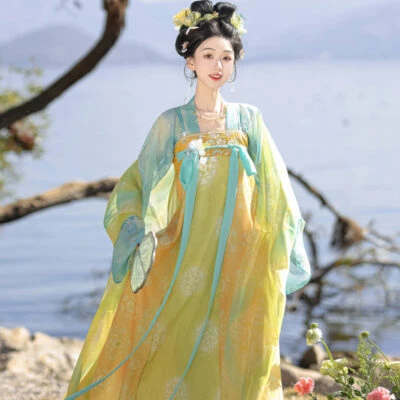
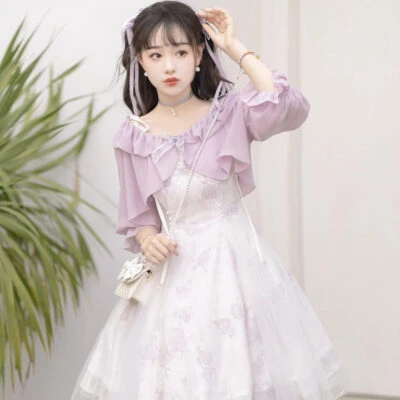
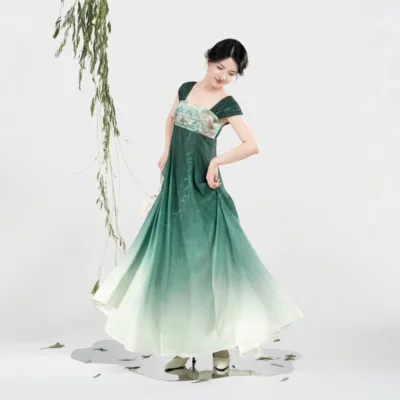
Autumn-winter 2026 collections in the Neo-Chinese category changed their specification sheets before they changed their patterns. The Mamianqun hem moved from ankle to mid-calf, the standing collar came down to three or four centimetres, and the Pankou left the placket as a detachable module. Read as styling, these look like taste. Read as production documents, they are the reason the styling exists at all: the parameters moved first, and retail selection followed.
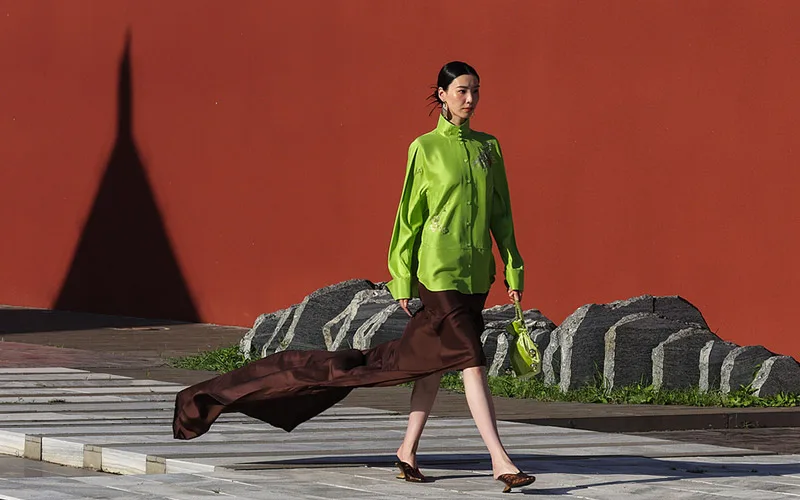
The Parameter Reset Behind the Mamianqun and the Mandarin Collar
The AW26 reset is a change in measurable garment specifications rather than in decoration. Textile-industry observers describe the season’s main line as de-ritualisation: keep the cultural signal, lower the threshold for wearing the piece. Five parameters were rewritten explicitly enough to be written into contracts.
| Item | Spring-summer 2026 | Autumn-winter 2026 | What it means upstream |
|---|---|---|---|
| Mamianqun length | Ankle to floor-sweeping | Mid-calf | Single or double lightweight construction replaces heavy gold-thread and multi-layer pleating; works with ankle boots and thick-soled loafers |
| Standing collar height | Stiff, full-height Manchu-style collar | Three to four centimetres, slightly loosened | Back-neck curve follows the cervical spine, so a turtleneck or scarf can layer underneath |
| Pankou | Visual lead, functional closure | Detachable decorative module | Smaller format, tonal satin or matte metal, added or removed by occasion |
| Fabric | Synthetic jacquard, metallic thread | Acetate satin, cupro, recycled nylon jacquard | Silk-adjacent lustre at 30 to 50 per cent lower cost, machine washable |
| Lead time | 30 days | 15 to 20 days | Scheduling and acceptance standards have to be rewritten together |
All five are interlocking rather than parallel. A higher hem is what allows the Mamianqun construction to sit over boots; a lower collar is what makes layering under a hood, a lapel or a scarf physically possible; a detachable Pankou is what lets one garment cover commuting, a light social occasion and travel, which raises the per-item usage rate that buyers now write into their assortment plans.
Why the Mamianqun Skirt Got Shorter and Who Decided
Nothing in the reset originated on a runway. The spring-summer 2026 demand surge had already forced a round of equipment replacement: pleat-setting machines and automated Pankou sewing units became standard, and pleat consistency rose from roughly 70 per cent under hand pressing to above 95 per cent. Entering autumn, buyers cut the delivery clause from 30 days to 15 or 20, and moved pleat setting and Pankou stitching acceptance criteria into the contract so that rework could be charged back.
Capacity now draws the boundary of the design. A parameter that cannot be produced stably at volume does not stay in the range. Small-batch rapid-response lines take orders from 50 to 100 pieces and serve buyer showrooms and e-commerce test drops; whether a style survives is settled at the factory before it is settled in a lookbook.
Single-focus design follows from the same constraint: one core element per skirt, either a pleated placket, a side Pankou, or a tonal jacquard, but not all three. The pressure comes from return rates. Several brands saw return rates climb in spring-summer 2026 on element-heavy pieces, with ankle-length hems catching underfoot on a commute and stiff collars reading as uncomfortable in air-conditioned offices. One buyer’s internal red line is concrete: above a 15 per cent return rate on a Mamianqun style, the hem length and pleat weight get re-examined for interference with walking.
Fabric Substitution and the Mamianqun Fabric Question
Traditional Mamianqun construction depends on brocade and silk, which are expensive and hard to care for. Autumn orders moved to acetate satin, cupro and recycled nylon jacquard, which read close to silk in lustre at 30 to 50 per cent below the price and survive a washing machine. Processing has to change with the fibre: acetate and cupro need pre-shrinking, or the finished garment will move more than 3 per cent after the first home wash.
Colour turned with the cloth. Spring pastels and mint green are out; deep indigo, sandalwood brown, smoky violet and ink black are the base range, which suits the weight of winter cloth and makes Pankou and piping legible. In pattern, tonal jacquard and same-colour embroidery replaced high-contrast metallic yarn, on the argument that stage lighting is exactly what the category is trying to leave behind.
There is a second ledger. Substituted fabric lowered the entry price of Neo-Chinese clothing and, in doing so, brought export orders within reach. Polyester jacquard and metallic yarn fell sharply as a share of autumn bookings; buyers began asking for silk blends, wool blends, recycled polyester and bio-based nylon. On export orders, recycled fibre is now close to mandatory, and the share of European buyers requesting GRS or an equivalent certificate keeps rising. That is a specification question before it is a marketing one: certification has to be secured at the mill, before the order is confirmed.
Mills Onstage, and the Demand Base Underneath
Supply has also changed who stands in the photograph. At China Fashion Week, which opened on 3 September with more than 220 brands showing, the signal was a shift of Guochao weight upstream: textile firms from Keqiao put recyclable and seaweed-blend fabrics on the catwalk and took credit alongside the designers. The reversal is literal. Designers used to choose fabric; now the mill and the designer take the bow together. Our earlier report on how Neo-Chinese came to lead the Beijing season traces that shift across the full schedule.
Numbers behind it are more concrete than the staging. At the Keqiao showcase on 4 September, all fabric for 50 looks came from ten mills in the district’s preferred-supplier programme: Zhejiang Dongjin New Materials supplied recyclable outdoor fabric, Zhejiang Shengran Fashion Technology blended seaweed fibre with other fibres, and Zhejiang Zhenzhen Textile treated acetate filament with warp-knit grid structures and air-flow dyeing. In Xucun, Haining, three labels showing that week were all run by people who also hold mill positions, which is why the fabric decision and the design decision arrive in the same meeting.
Capacity underneath is not small. Xucun’s party secretary, Xu Xinfeng, put the town at more than 8,000 garment businesses and 2.4 billion pieces of annual capacity, with yarn, trim, garment making, dyeing and logistics inside one ecosystem and as little as 24 hours from design to a store refresh. Designer Wu Xuewei, a Golden Top Award winner, noted that his generation chose French, Italian and Japanese fabric by default, and that Chinese fabric is now a serious option for reasons beyond the cloth itself.
Demand supports the investment. Industry reporting puts Guochao at roughly 15 percentage points of share gained in apparel and footwear over five years, close to 40 per cent of the category; the Guofeng clothing market has passed 300 billion yuan, Neo-Chinese womenswear is growing above 15 per cent a year, and more than half of spending comes from buyers under 25. The China National Textile and Apparel Council’s reading is that Guofeng clothing has crossed 300 billion yuan with Neo-Chinese close to 250 billion of it. Policy is following: a joint guidance issued by the Ministry of Industry and Information Technology and five other departments sets targets of 50 leading enterprises above 10 billion yuan each, 100 recognised Chinese consumer brands, and several 100-billion-yuan industrial clusters by 2028, with a further goal of moving these heritage industries into the higher-value segment of global chains by 2030.
What Buyers Should Check, and Why the Returns Line Rules
Export demand is splitting in two directions. European buyers prefer minimal modified pieces such as a standing-collar wool coat or a Pankou blazer; North American e-commerce wants value knit sets, for example a standing-collar cardigan with matching wide-leg trousers priced between 80 and 150 US dollars to fit promotion calendars. Southeast Asia and the Middle East are accepting modified collars and Pankou faster, with Malaysia and the United Arab Emirates leading on e-commerce, and buyers there favour washable acetate satin and recycled nylon jacquard to lower the care burden on the consumer.
One operational detail is worth recording for anyone shipping the category. On customs paperwork, avoid “costume” and “traditional dress” and describe the goods as contemporary womenswear with a mandarin collar; the wording affects whether a consignment is classified as stage dress and charged at a higher tariff. The product side carries a matching discipline: overseas markets do not always want the heaviest national symbol, and the pieces that travel best are the ones where the collar does the work and the embroidery stays quiet. The naming question around closures is covered separately in our piece on who gets to name the Pankou.
Buyer profile moves with the parameters. Spring-summer 2026 buyers were mainly urban women aged 25 to 35 pairing a Mamianqun with a blazer or knit cardigan; for autumn the core widens to 35 to 45, a group that asks about wrinkle resistance, lining comfort and whether a piece will work under a coat they already own. Students aged 18 to 24 keep growing but skew to entry items such as a Pankou sweatshirt or a standing-collar fleece. Both groups are readable as consequences of a specification change rather than a change of taste, which is also how the wider move toward a more minimal Neo-Chinese wardrobe should be read.
Return rates remain the dividing line, and fit is the reason. Misjudged silhouette, not dislike of the style, is the main cause of Neo-Chinese returns running above the womenswear average, which puts the fix in sizing systems and in fabric information that a shopper can actually use. Once hem length and pleat weight are written into acceptance standards and reviewed in return analysis, assortment decisions acquire something they did not have before: a checklist that can be verified item by item. That is the least glamorous and most durable part of this season’s de-ritualisation. For the fabric and form framework behind it, see our 2026 Neo-Chinese market overview.