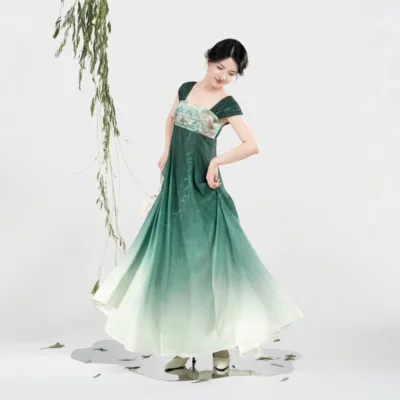
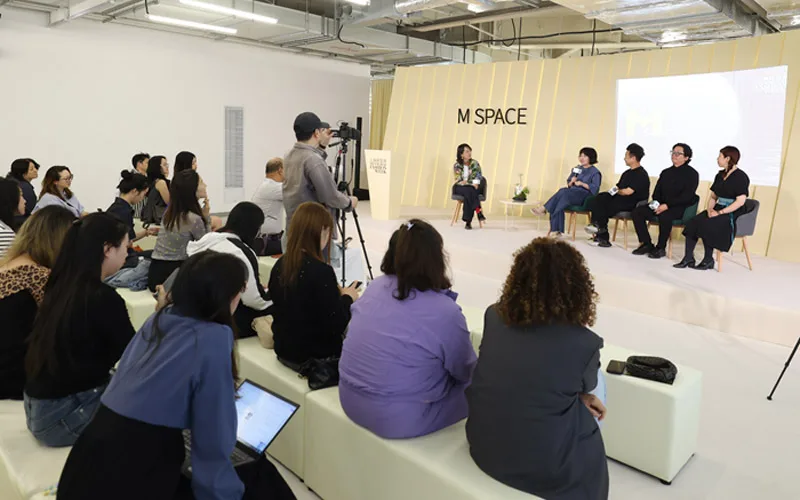
A leather bag is a poor place to start a lecture on the Central Plains. That, in short, is what one Chinese label learned in Paris. On 10 October, inside the M SPACE talk programme at Shanghai Fashion Week, a forum convened by Yicai gathered three brands from unrelated corners of the market, a bag maker, a down-jacket house and a fragrance platform, to describe what going overseas actually costs. The season itself began on 8 October; the forum ran as part of the MODE trade show’s industry programme.
A Bag That Explains Itself Before the Culture Does
Shanxia Yousong (山下有松) has held a themed exhibition in Paris during fashion week for three consecutive years, drawing on local material culture such as the wind bells hung from old pagodas in Shanxi and turning craft into contemporary design. It has not built an overseas store network. There is one slow pop-up in Thailand, and yet its domestic stores now receive a steady foreign clientele, while the brand’s own site and social accounts have accumulated users worldwide. Overseas prices sit about 30 per cent above domestic ones, and a reverse proxy-buying trade has appeared among foreign customers.
Marketing director Guo Jiale said the first approach was to transplant the domestic narrative wholesale, which failed quickly: most overseas audiences have no handle on the concept of the Central Plains, let alone the history behind it, and leading with an abstract cultural claim only creates distance. The second approach started from objects audiences already recognise, the packhorse bags and camel bells of the Silk Road, and let the culture sit underneath the product, waiting to be found. The Moon Curve bag, shaped around the phases of the moon, sells in Europe at 339.95 euros, weighs under 800 grams and moves between a workday handbag and an evening clutch, which suits social lives that change venue often. It became a light-luxury hit without the brand explaining moon phases or mortise joints first.
The founder’s design rule is blunt: no beautiful useless things. Utility comes first, and the eastern logic inside the structure is explained once social media has already taken an interest. What follows is harder than the launch. Colour, leather preference, lifestyle and habit now diverge across Southeast Asia, Europe, North America and the Middle East, so a domestic bestseller does not travel automatically, or the reverse. Adaptation, on this account, is the permanent job.
Building a Third System From Down Fabric
RAXXY took the opposite route and attacked the terms of the conversation. Founder Shen Weilian studied mathematics and comes from Pinghu, a down-jacket supply-chain centre. The brand showed on the Great Wall in 2021, entered the official Milan Fashion Week schedule in 2023, priced itself against international luxury down houses, and reached 19 countries and more than 80 high-end stockists in its first commercial year.
His argument is that respect does not follow from exporting local symbols. Material systems, as he describes them, have numbered two: knitting, which interlaces yarn in one dimension, and weaving, which cuts cloth in two. RAXXY attempts a third by cutting down fabric into pieces and assembling them the way paper-cutting and braiding assemble strips, so the surface pattern changes as the pieces shift; the Great Wall pattern came out of that method. The cost was concrete. Nearly five years passed before overseas channels came good, early years ran on negative equity, and a seasonal product with a new construction language carries a heavy market-education bill. He turned down collaboration offers that would have eased the cash pressure, on the reasoning that the brand value being built is the only asset that survives.
What the White Paper Says About Trust
Scent Shanghai went the platform route instead of the single-brand route. Its first edition in 2024 occupied the Shanghai Dome Art Center and filled a gap as the country’s first high-end commercial platform devoted to fragrance; a three-year strategic partnership with Shanghai Fashion Week followed in 2025, alongside participation in Messe Frankfurt’s global exhibition network. That year it also ran a first Paris-Shanghai perfume exhibition that took more than 20 Chinese fragrance houses abroad, and in 2026 it organised an Asian perfume fair in Paris, moving from a trade fair towards an industry hub.
Fragrance has a structural handicap that apparel does not: it sits in the cosmetics category and travels as a flammable good, so both samples and bulk shipments cost more and carry more risk. The April Paris pop-up answered part of that objection. With no advertising and only street traffic, it sold well enough that Parisian perfume shops began approaching the organisers about stocking Chinese brands, and some participating labels now have larger fan bases and sales abroad than at home. Dubai follows in January, then San Francisco. Founder Wu Yue’s framing is that culture is not only inherited elements: contemporary life, city experience and the moods of younger consumers are also material, and what matters is whether a brand has its own way of saying things rather than how many symbols it can attach.
The commercial case was set out by Yao Beibei, vice president of Yingfan Technology, presenting the 2026 white paper on Chinese fashion consumer brands going overseas. The pattern has moved past isolated cases into collective category breakouts across beauty, apparel and designer toys, with Pop Mart trading on an emotion economy and Flower Knows taking a girlish fairytale aesthetic into Japan and Korea at 1.5 to 2 times domestic prices. Overseas shoppers, in that reading, have shifted from seeking value to re-pricing value: appearance, function, emotional experience and brand trust decide the purchase, and much of that judgement is settled before a product page is ever opened.
Peng Jia, deputy director of Yicai’s global centre, named the gap that no amount of logistics solves. Chinese manufacturing is now a quality label, but the narrative authority has not caught up. Overseas audiences still tend to read Chinese design as oriental exoticism, heritage craft and cultural texture are difficult to transmit through commercial channels, and Chinese founders are often reserved, fluent in presenting a product and much less so in presenting the intention behind it, while their overseas counterparts volunteer a philosophy unprompted. The shared difficulties remain the translation of cultural symbols, a shortage of localised talent, thin channel-operation capability and intellectual property protection. Wu Yue’s closing position was that genuine exchange is not a brand entering a market but two markets learning from each other, and that a company keeping its own character, making good products for years and finding real fans abroad is already a result worth having.