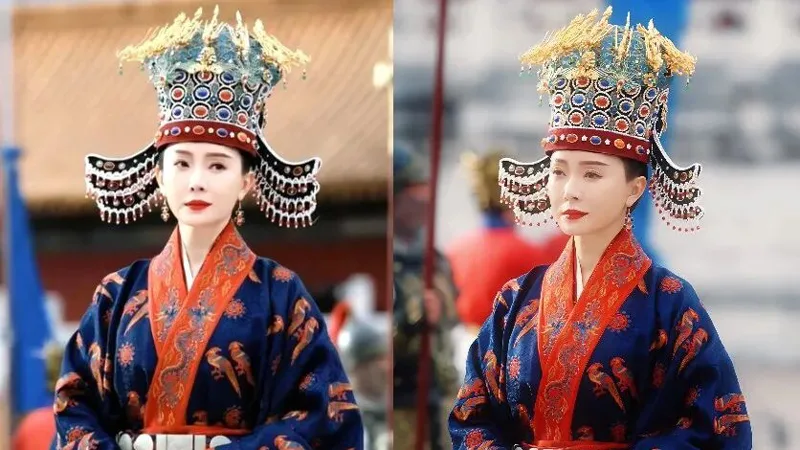
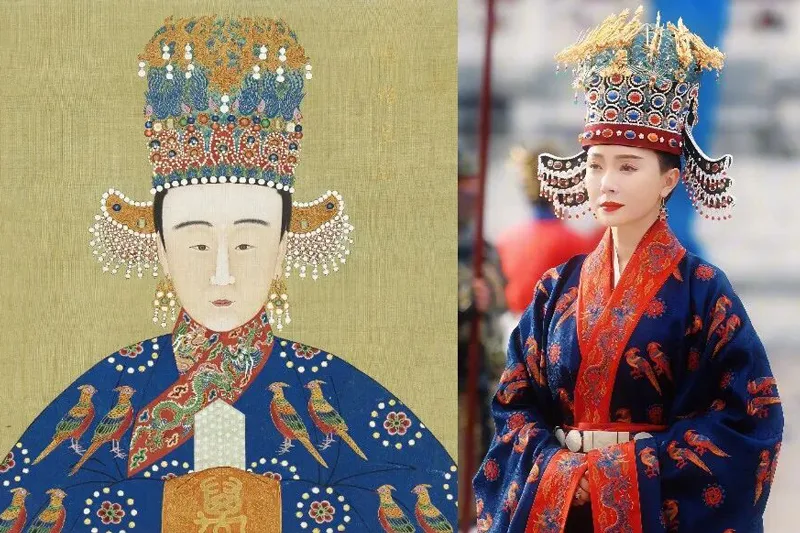
When Chen Shu (陈数) appears in Liang Jing Shi Wu Ri (两京十五日) as Empress Zhang (张), mother of Zhu Zhanji (朱瞻基), she does not look like a modern actress trying on old clothes. She looks like a woman who belongs to the Ming Dynasty court. Leaked set photos show her in a dragon-and-phoenix crown and a deep-blue ceremonial robe. Online viewers say she seems to have stepped out of a history book. That reaction is not only about beauty. Chen has played legendary women, historical romantics, and modern professionals, but this imperial image lands differently. It comes from specific choices: the crown, the robe, the belt, and the way she holds herself. This article examines those details and asks why this look feels so convincing.
Crown and Robe
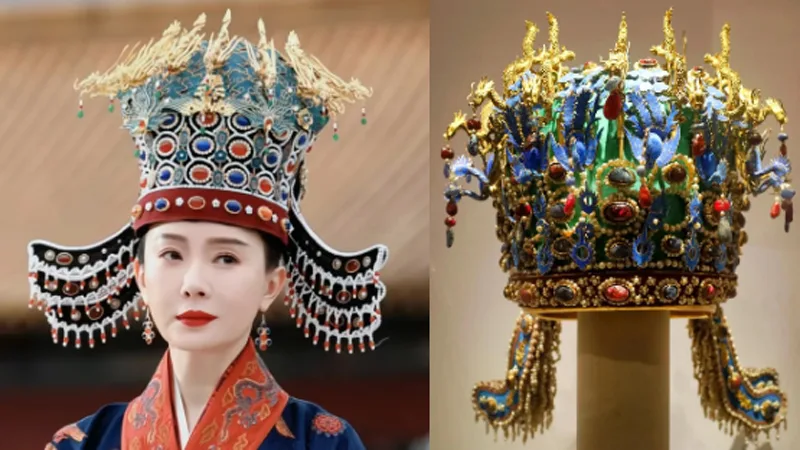
The crown is the first signal. Chen wears a dragon-and-phoenix crown, not the smaller Yanju crown (燕居冠) used for daily palace life. The ceremonial crown has a larger body, a blue base, more gold dragons and phoenixes, and dense gemstone and kingfisher-feather decoration. A Yanju crown usually carries one dragon and two phoenixes, fewer jewels, and bead pendants on both sides. That difference matters. One belongs to ritual; the other belongs to private rooms. Ming court records list a nine-dragon, four-phoenix crown for the empress in early rules. Excavated crowns show other counts: twelve dragons and nine phoenixes, nine dragons and nine phoenixes, six dragons and three phoenixes. The series chooses nine dragons and four phoenixes, simplifies some stones, yet keeps the scale and authority. The blue base makes the gold and gems stand out, and the whole crown reads as ceremony, not ornament.
The robe is equally deliberate. Chen wears the Diyi (翟衣), a deep blue crossed-collar robe with broad sleeves. Pheasant patterns cover the fabric in neat rows. Red dragon borders trim the lapels and cuffs. This is not generic royal costume. The Diyi and the emperor’s ceremonial attire belonged to ritual systems that reached back to ancient times. Earlier empress portraits often show this robe. Ming rulers kept it in official codes. A portrait of Empress Xiaoke (孝恪) shows a similar dress. On screen, the color, pattern, and cut do not read as fashion. They read as rank, distance, and duty. The pheasant pairs also suggest order and movement, which fits a woman standing beside a new emperor.
The belt completes the silhouette. Around her waist sits a white jade-inlaid leather belt, called Yuge Dai (玉革带), tied over the Diyi. It pulls in the loose fabric, prevents the robe from looking bulky, and straightens the body’s proportions. Its form traces back to the Diexie belt (蹀躞带) of northern nomadic groups, which was used to hang tools and personal items. That belt entered central plains culture during earlier dynasties. It became a jade belt, entered ritual in later imperial codes, and continued through several dynasties. The Ming period was its high point. Two systems existed: ceremonial belts for emperors and empresses, and public-service belts for officials. The Dingling (定陵) Tomb yielded examples for both. Without the belt, the robe might hang like a curtain; with it, the waist becomes a firm pivot.
Why It Works
One reason the look convinces is accuracy. Many costume dramas treat all royal clothing as one category. They mix ceremonial robes with casual crowns. Some even pair a Ming empress’s Diyi with a Yanju crown, which is a clear error. In Liang Jing Shi Wu Ri, the team adjusts details for camera, but the main rule stays: dragon-and-phoenix crown with deep-blue Diyi. The shape, layers, and colors follow Ming ceremonial logic. That structural respect matters more than expensive embroidery. When the pieces agree with one another, viewers sense order even if they cannot name it. The costume feels borrowed from records, not invented for television. People may not know the old statutes, but they notice when crown, robe, and belt speak the same language.
Another reason is the fit between actor and role. Empress Zhang lived through the Hongwu (洪武), Jianwen (建文), and Yongle (永乐) reigns and beyond. She was not a fragile woman hidden in the inner palace. She was steady, practical, and strong-willed. She helped her son secure the throne. Chen Shu brings a calm, grounded presence that suits that history. She does not play the empress as delicate or coy. In heavy ceremonial dress, she stands straight, keeps her expression composed, and lets the clothing carry weight without being crushed by it. The role and the performer meet on common ground. Zhang’s political survival required patience and nerve; Chen’s restrained face suggests both.
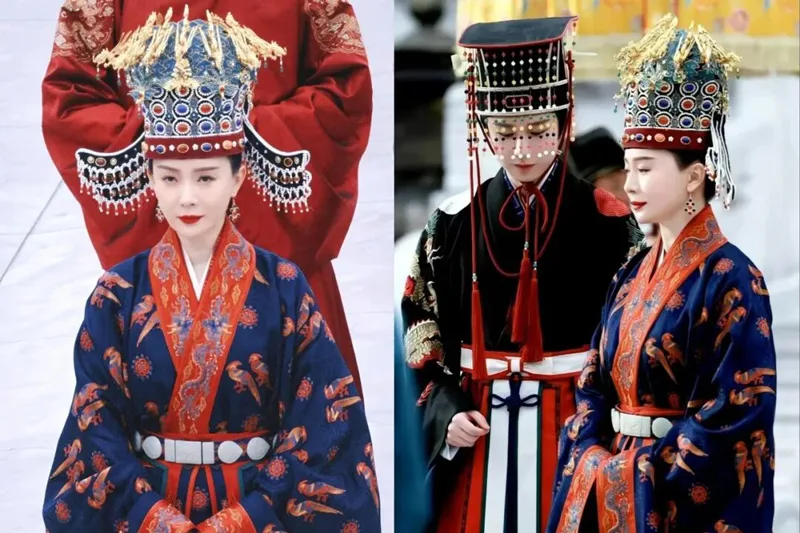
The final effect comes from mutual support. The crown and robe announce rank. The jade belt gives the body a firm center. Chen’s posture gives the outfit life. The garment makes the character look dignified; the character makes the garment look believable. That balance explains why so many viewers respond with the same phrase: she looks as if she walked out of a history book. It is not nostalgia. It is the quiet power of correct details, worn with confidence. If a costume only looks rich, it can still feel empty. Here, body, cloth, and history line up. Do you think this look works?