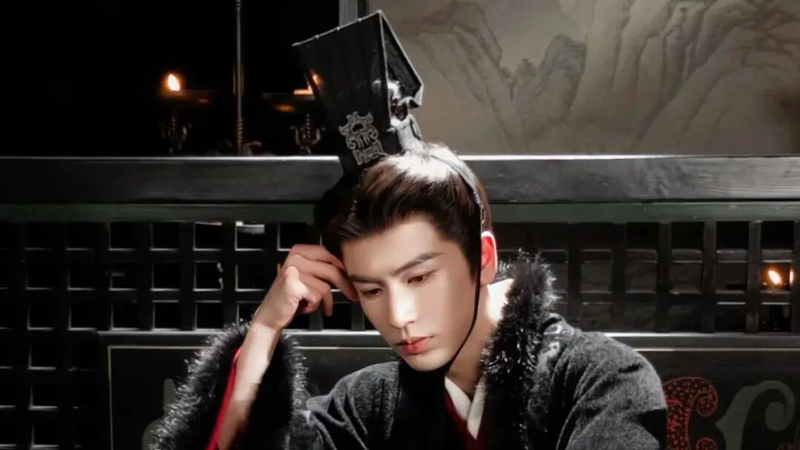
Recently, Revenge (刺棠) began filming. Zhang Linghe (张凌赫) plays Song Ling (宋泠), a crown prince who is attacked, fakes his death, changes his face, and returns as a powerful minister seeking revenge. The plot alone sounds intense. Yet many viewers are stuck on one detail: his black robe and that upside-down triangle hat. It feels familiar, like something from much older television. What is it called? The show is set in a fictional dynasty, so the costume does not need to match any real court. That freedom is fine. Still, the hat has a source. It points toward Han official dress, where a cap could show rank from across a hall. That is where the fun begins.
Han Roots
The poster cap likely borrows from the Jinxian Guan (进贤冠), or “cap for advancing worthies.” It was a signature headpiece for Han civil officials. Its front had a raised section called the Zhanyong (展筩). Older adaptations of Romance of the Three Kingdoms often put such caps on scholars and ministers. Hou Hanshu (后汉书) says the Jinxian Guan came from an ancient black cloth cap worn by Confucian students. By the Han period, it had become a formal official cap. Cai Yong (蔡邕), a Han scholar, made the point plainly in Duduan (独断): this was what civil officials wore. The cap did not begin as a fantasy prop. It began as a tool for reading a room.
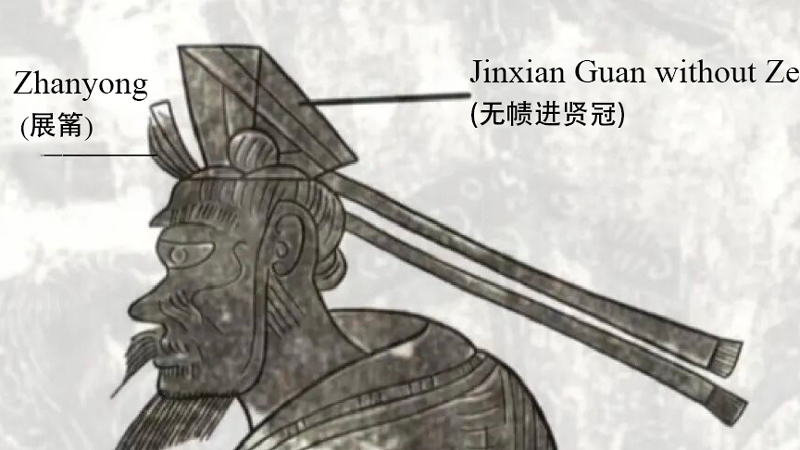
Its measurements carried meaning. The front stood seven cun (寸) high, the back three cun, and the length was eight cun. Front high, back low. Vertical lines ran down the middle. Those lines were called Liang (梁), or beams. In Han practice, beams worked like rank bars. More beams meant a bigger office. Three beams sat at the top and were reserved for dukes and marquises. A Han marquis needed a solid noble title to wear three. Two beams belonged to middle officials, from the full two-thousand-bushel rank down to Erudites. A Nine Minister earned about one hundred eighty hu (斛) a month, close to a modern ministry-level post. Erudites taught classics at the Imperial Academy. Members of the Liu (刘) royal clan could add one beam, a custom called “added attire,” a polite nod to imperial dignity.
One beam was the basic grade. It covered Erudites, minor clerks, and private students. Cai Yong again linked salary and display: below one thousand bushels, one beam. Later dynasties changed the shape. Eastern Han added a cloth wrap called Ze (帻), so the cap covered the forehead. Most later versions copied that fuller Eastern Han look. The Ming dynasty used the most beams. The common term became Liang Guan (梁冠). Court dress followed a strict ladder: first rank wore seven beams, each lower rank wore fewer, and the eighth and ninth ranks had only one. In a fictional drama, rules can bend. The source remains visible.
Prince’s Other Hat
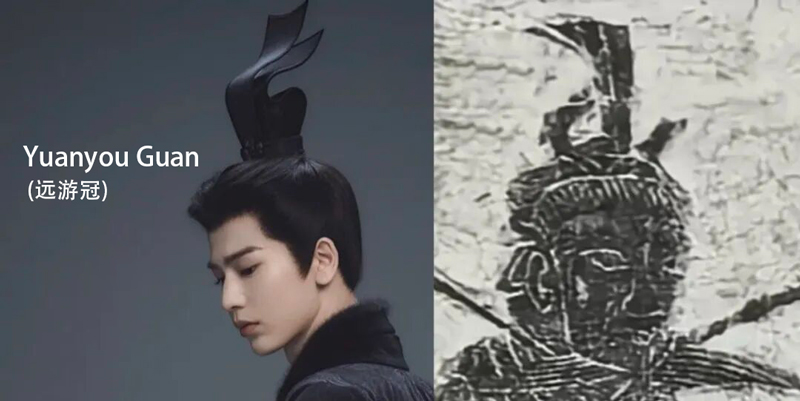
The poster also shows a second, stranger cap. It echoes the Yuanyou Guan (远游冠), a Han ritual crown. It looks close to the Tongtian Guan (通天冠), but its status was lower. Crown princes and vassal kings wore it for court meetings and temple ceremonies. In Revenge, Song Ling moves from heir to hidden avenger to minister. A crown that belongs to a prince can mark that shift. This design leaves out the front Zhanyong, so it is only a reference, not a reconstruction. Still, the choice is not random. It tells viewers that his place in the court is changing before the plot explains it.
Why does the look feel so old? Many current costume dramas flatten history into black robes, long hair, and vague palaces. This cap has a visible ladder. You can count beams. The inverted triangle shape is not just decoration. It compresses Han official dress into a simple silhouette. Even in a made-up dynasty, designers need roots. Roots give cloth weight. They also explain an old saying: one rank higher can scare people below. A single beam could separate a clerk from a minister. The gap was designed to be seen from far away, before anyone spoke.
Next time a historical drama appears, look at hats before swords. Count the beams. Notice whether a character wears one, two, or three. Ask where the scene takes place: court, temple, study, or street. The answers often match power. You do not need to treat fiction as an exam. Treat it as a game. The hat can be a small Easter egg hidden in plain sight. So, does Zhang Linghe’s new look in Revenge work for you? That odd triangle may be the most interesting thing on the poster.
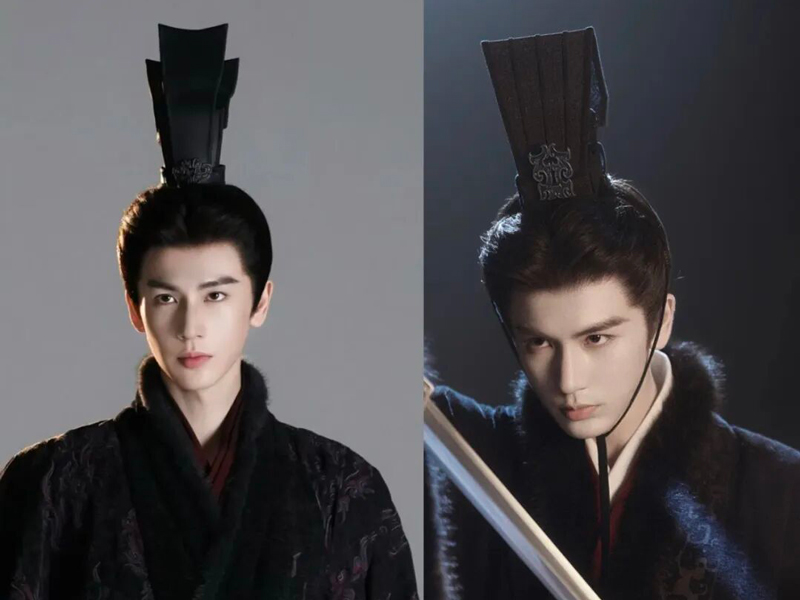
Fiction still needs rules. If the show invents a court, the audience reads power through shape, color, and height. A low cap can make a man look young; a high front can make him look formal. Beams add order. The black robe in the poster may signal mourning, danger, or secrecy. The triangle cap pulls the eye upward, so the face becomes a target. These are design choices, not history lessons. Yet they work better when they borrow from real forms. The Jinxian Guan and Yuanyou Guan give the image a memory. That memory is why the look feels ancient even before the first episode airs.