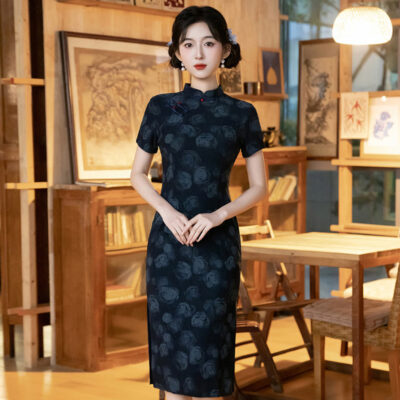
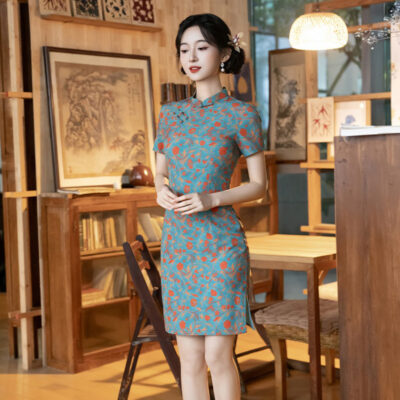
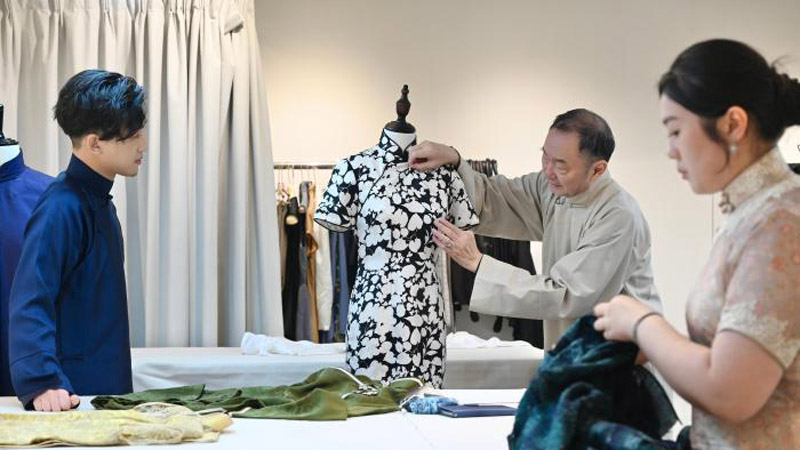
A wide worktable takes up nearly half the office of the Hong Kong Cheongsam Association, in a corner of Central where the traffic noise runs under the window. Liu Anqing (刘安庆) bends over the table pressing cloth. He is 78, and he has been at this work for more than sixty years.
His trade is the changshan, the Chinese long gown, and the workshop he keeps is one of the last places in the city where the whole garment is still made by one pair of hands.
A Craft With a Cinema Credit List
Liu’s client list has run from political and business figures in Hong Kong to collectors of Chinese dress overseas. It also includes a run of films that made the cheongsam a global image. Wong Kar-wai, Stanley Kwan and other directors worked with him, and his qipao costumes appear in In the Mood for Love, The Grandmaster, Everlasting Regret and Blood Brothers. For a garment whose reputation rests on how it moves on screen, the tailor behind the wardrobe rarely appears in the credits.
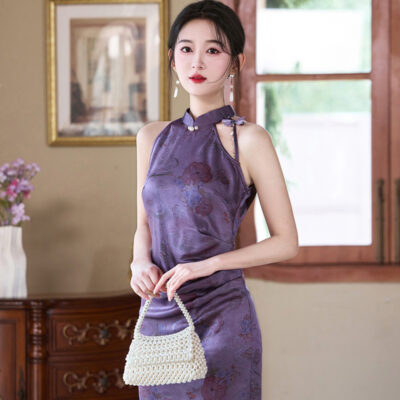
The changshan, worn by both men and women, took hold from the early years of the Republic of China. The women’s version is also called qipao. In Hong Kong newspapers of the early twentieth century, men in changshan were described as elegant young gentlemen and proud in bearing, and the garment became a mark of learning and standing. From the 1930s, the qipao settled into ordinary wardrobes as daywear for women across the city.
Skilled Hands in Central
Its boom came after the Second World War, when large numbers of tailors left Shanghai and Guangdong for Hong Kong to take up work and train apprentices. Wu Guoxi (吴国禧), a director of the Hong Kong Cheongsam Association, dates the golden age to the 1950s and 1960s, when a qipao served as both everyday dress and working dress for women. The 1970s brought ready-to-wear clothing, which cost far less than a made-to-measure gown. The changshan slipped out of most wardrobes, custom orders contracted to buyers with the means to keep them, and the tailoring trade began to shrink.
“Only in the past few years, thanks to heritage protection, have the craft and the human value behind it come back into public view,” Wu said.
Liu arrived in Hong Kong from Jiangsu during that earlier boom and entered the trade as an apprentice. His account of the work is plain. “Changshan making rests entirely on hand skill and on judgement built from experience. You cannot work from a fixed pattern, because bodies differ, and the garment has to follow the client’s own proportions,” he told China News Service. In the Hong Kong tradition, a maker masters measuring, cutting, making, altering and pressing, and one person carries the garment through every stage. Made well, a changshan holds its shape for years.
Passing the Needle On
Recognition arrived from the state. In 2021, the Hong Kong Chinese changshan-making technique was added to the fifth batch of China’s national intangible cultural heritage list. Two years later, inheritors including Wu received plaques from the Ministry of Culture and Tourism in Hong Kong.
Liu has retired from taking new orders, but he still supports the association’s training programme for inheritors and hands his experience to younger students. One of them is Yang Xiaoqi, who describes what the older generation expects from the bench. Collars and sleeve settings have to sit round and smooth, and a collar has to hold its shape; a poor result comes off the garment and gets made again. “Only after I started working with changshan did I understand that doing something carefully, and slowly, is itself a kind of value,” Yang said.
Between Needle and Thread
Wu teaches at Hong Kong Polytechnic University’s School of Fashion and Textiles, and with funding from the Hong Kong SAR government he leads a team recording oral histories from the remaining masters, filming the practical steps, and publishing monographs, popular-science films and public lectures for residents. The aim is to hold on to the details that disappear when a workshop closes and to open the craft to people who will never order a gown.
Between the needle and the thread, three kinds of work are running at once: tailors holding the standard at the bench, researchers sorting the record, and younger students learning the sequence by hand. The result is a garment that still carries a city’s own version of Chinese dress, and the people who know how to make it.