Holiday wardrobes shifted with the calendar this week. Searches for travel outfits climbed across Chinese e-commerce platforms and content communities, and one phrase kept surfacing among younger shoppers: Liubai, the practice of leaving blank, attached to the New Chinese style. Under the National Day dressing and New Chinese photo tags, notes on plain-colour Pankou tops and moon-white qipao drew steady traffic. The silhouettes that dominated the past few seasons stacked frog buttons, standing collars and embroidery until an outfit read as costume. This autumn the direction turned: solid colours, simple cuts, and large, quiet areas of nothing at all.
That turn did not arrive from nowhere. It followed a season of shows in London and New York, a run of celebrity appearances, and a change in what buyers say they want from a garment they will wear more than once.
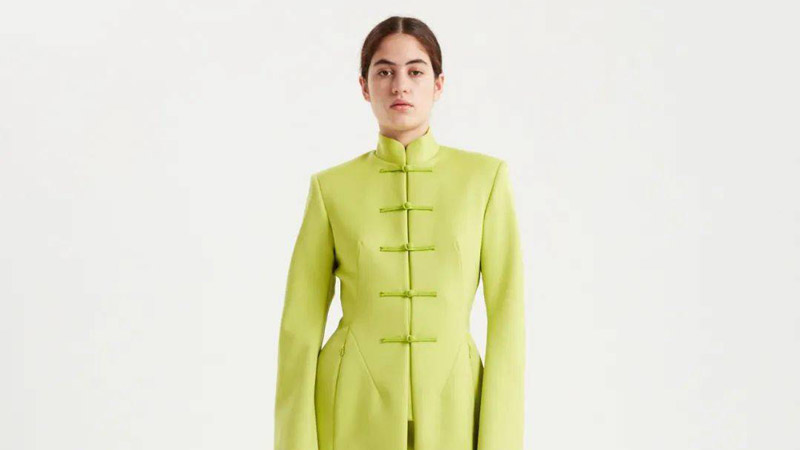
How the Runways Framed the Shift
The 2027 spring/summer collections closed in London and New York within weeks of each other, and both cities sent a similar note. In London, Burberry marked its 170th anniversary under creative director Daniel Lee with a return to the everyday: less idealised staging, more attention to classic pieces that outlast their function. In his show notes, Lee wrote that luxury is essentially something felt. He added that “the ruffles and the imperfections are what make things human.” In New York, Ralph Lauren eased its dress codes, opening with a corset worn over plain khaki trousers and pushing the whole mood toward something lighter and brighter; Khaite and others worked in a soft, dreamlike register.
Young Chinese designers had a strong season in both cities. Lii and Private Policy showed on the New York schedule, while a thick cluster of younger Chinese labels gathered in London. Not every collection cut back. Romance and opulence returned on several runways, and the biggest houses still sell spectacle. Liubai’s rise tracks the more durable current underneath, the one built on practicality, ease and empty space. Once “less is more” became widely accepted, an aesthetic with a long habit of leaving its surfaces open had something to answer with.
Signals From Home
Domestic fashion supplied its own evidence. The cast of Empresses in the Palace reunited thirteen years after the series aired, appearing together in New Chinese style. Jiang Xin, who played Hua Fei, wore two looks from the designer brand M essential: an emerald green ensemble and an outfit in the purple shade known as “purple arrives from the east.” Fashion media noted that the styling worked. During the Shanghai Formula 1 Grand Prix, the newly married wife of Ferrari driver Charles Leclerc appeared in custom qipao, including a blue one printed with the Chinese translation of a line by the carmaker’s founder.
Online, the NewChinese hashtag has kept building since last year. Foreign users posted themselves in slippers and drinking lemon water, imitating a Chinese daily routine, and the clips travelled far beyond the accounts that made them.
Modified qipao, Pankou tops and standing-collar shirts have become much easier to wear. They slot into a meeting, a dinner and a day of travel without a change of clothes, which is why buyers describe a single well-cut piece as something that can carry four seasons. The calculation shoppers now make is simple: a plain Pankou top earns its price far more often than a ceremonial gown that spends the year folded in a box. That reasoning says something about how young buyers spend. They are no longer paying for a symbol. They are paying for a bearing and for a garment that will actually be worn.
Dressing for Old Towns and City Walks
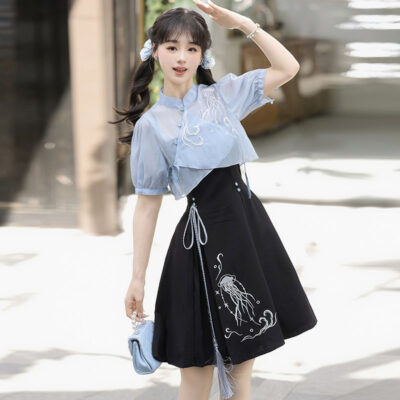
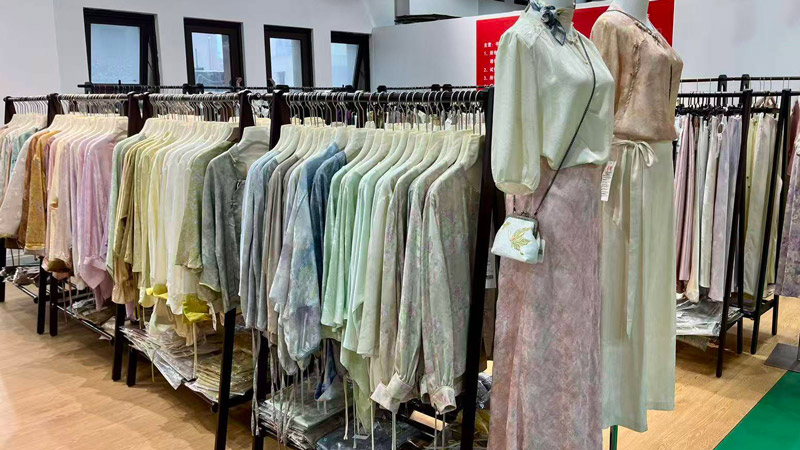
If the itinerary runs to a water town or a classical garden, a plain modified qipao works, and so does a Pankou top paired with beige or moon-white wide-leg trousers. Cotton-linen breathes; silk drapes; both hold through a long day on foot. Flat cloth shoes or soft-soled mules keep the line consistent without punishing the walk. In Guangzhou, the red walls and grey tiles of the Chen Clan Ancestral Hall and the arcades and flower windows of Yongqingfang sit most comfortably beside plain colours, and the same rule travels to the gardens and lanes of Jiangnan.
City walks reward pieces that work twice. An oversized New Chinese style shirt can be worn alone or layered, and a knit vest or a light trench absorbs the swing between morning chill and afternoon warmth. Hold the whole outfit inside three colours and keep accessories to a single item, a jade bangle or a pair of pearl studs. Makeup follows the same logic: a sheer base, earth tones swept lightly across the eyes, and a low-saturation lip in bean paste or nude pink. Over a long day in makeup, a setting mist does more work than a heavy foundation. Hair needs little effort, and the aim is maintenance that does not announce itself: a low ponytail or a low bun, a few strands left loose at the cheek, and a wooden hairpin or a velvet scrunchie to close the look. For a wedding or a family banquet, the same instinct holds at a higher register, with velvet or jacquard providing the ceremony, the cut staying simple, and the styling staying close to the everyday version.
What Designers Are Cutting Back
The subtraction is just as visible on the design side. New Chinese style is increasingly cut for an ordinary Tuesday, taken to work, to dinner, to meet friends. Samuel Gui Yang’s 2026 spring/summer and autumn/winter collections make the case for a single well-placed neckline: a brown suit keeps its closure detail at the chest and picks up wide trousers; a dark short jacket reveals a strip of blue shirt beneath. Beginners do not need a full set. A small jacket with a comfortable collar and room across the shoulders, worn with their own straight-cut trousers, carries the idea further than a complete costume.
Lighter construction follows the same reasoning, so a sleeveless top pairs with a knee-length skirt and a short jacket with shorts, keeping familiar lines at the collar and placket while the lengths and ways of wearing them stay current. Skirts have their own answer. A green dress puts the emphasis on the neckline and the pleats, while a pink one lets the line run down the body; choose an opening and a length that suit your stride, and the simpler the shoes and bag, the more clearly the line reads. In January, Xinhua reported on Guofeng clothing extending into daily life, with lighter fabrics and easier care among the modifications. That report described an expanding set of occasions for these clothes, not growth across every New Chinese style brand.
Leaving blank returns the point of dress to expression rather than display. When shoppers stop leaning on logos and piled-up symbols, a plain Pankou top or a moon-white qipao becomes a complete statement on its own. The same instinct suits a holiday: leave a little space, in the wardrobe and in the diary.