Guyi Garden opened its gates to a runway on September 30. The 500-year-old Jiangnan classical garden in Jiading District, the largest of its kind in Shanghai, hosted the award showcase for the 2026 Shanghai Citizens’ Culture Festival Guochao (国潮) makeup and talent contest, and for one afternoon its bamboo and grey tile stood in for a stage backdrop.
The contest, jointly organised by the Shanghai Mass Art Centre, the Jiading District culture and tourism bureau, the Nanxiang Township government and the garden itself, launched in March and took entries across three tracks: reproduction of historical dress, creative Guochao, and adaptation of cultural properties. Forty-eight programs and nearly 260 contestants reached the final round, where the judges awarded first, second and third prizes along with an outstanding organisation award.
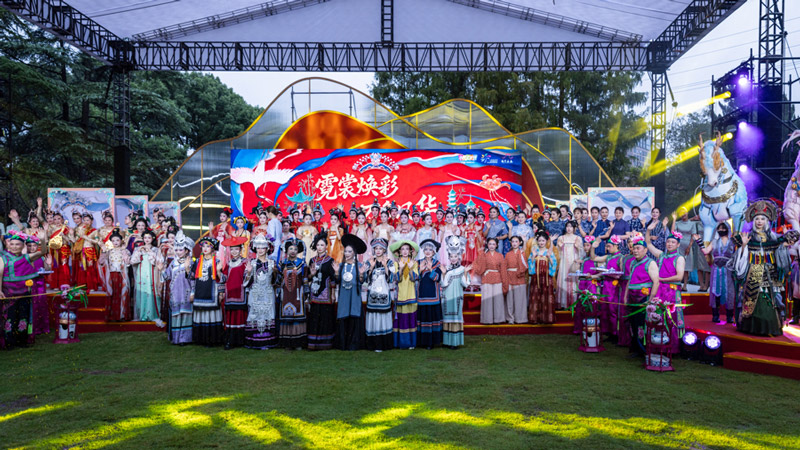
The Show Unfolds in Four Chapters
As the core section of the 2026 Nanxiang Guochao Conference, the program was arranged in four chapters. “Myth: Eastern Imagination” drew on the auspicious beasts of the Classic of Mountains and Seas and the twelve flower deities of the lunar months. “History: A Long Scroll of Civilisation” linked Han and Tang dress and traced Central Plains aesthetics along the Silk Road. “Music and Dance: Many Modes” moved between traditional ensemble music and contemporary Guochao composition, carried by silk-and-bamboo instruments. “Heritage: Old Crafts, New Life” put craft techniques on stage rather than behind glass.
What distinguishes the format is that makeup and dress were not the whole performance. Contestants had to carry a routine, so hair, cosmetics and textile pattern arrived attached to dance, instrumental playing or staged narrative. Cosmetics drawn from paintings, museum objects and street life were made to move.
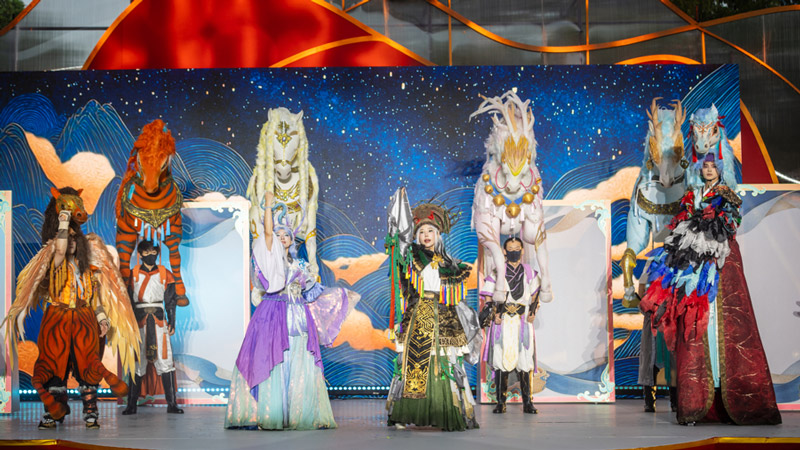
Reading Five Tang Eras Through Makeup
The most explicit piece of scholarship on the program was a runway segment titled “Five Records from the Dressing Table: A Study of Makeup from Early to Late Tang,” which shared first prize. Five performers carried the audience through early Tang, the Wu Zhou interregnum, high Tang, mid Tang and late Tang, and every look on stage had a documented source.
Qingzhi, head of the Yiye Lu Hanfu Society, appeared as a Wu Zhou woman in a spiral bun. She explained that the team’s crying-brow makeup came from the Han Jiawan Tang tomb murals: brows drawn as drooping eight-shaped lines, hair piled into a high tilted bun, lips painted black, an expression of grief that carried the anxieties of the age. Another contestant, Ms. Xu, reproduced a court lady from the murals in Princess Xincheng’s tomb. Early Tang taste, she noted, ran to slender figures and clean, simple makeup; under Wu Zhou, images of women became larger and more varied, which is where the familiar idea of a plump Tang beauty took hold; by the late Tang the facial patterns had turned fine and soft, with a faint melancholy. Set side by side, the five looks make the case that Tang aesthetics shifted repeatedly across nearly three centuries, and they push back on the common assumption that the dynasty admired only one body type.
The Northern Wei Figurine Behind a Dance
A dance titled “Held Hands” took its subject from a Northern Wei painted pottery figurine of two hand-holding women in the Luoyang Museum, a piece described as unique in its form. The two figures stand shoulder to shoulder, hands joined, faces composed. A team from the Huangpu District Culture Centre rebuilt the dance from the painted traces and the modelling of the object.
Yang Xiaomeng, a makeup artist who also performed in the piece, said the team worked through a large body of reference material on the period’s dress and cosmetics. “Most Hanfu closes with the left panel laid over the right,” she explained. “Under the blending of Hu and Han cultures, some Northern Wei garments instead lay the right panel over the left, and the hand-holding figurine is a typical physical example of that. We put it into the costumes.” The team also read the political turbulence of the period into the choreography, scaling a moment of dynastic collision down to two ordinary women. Both performers are amateurs who rehearsed in their spare time.
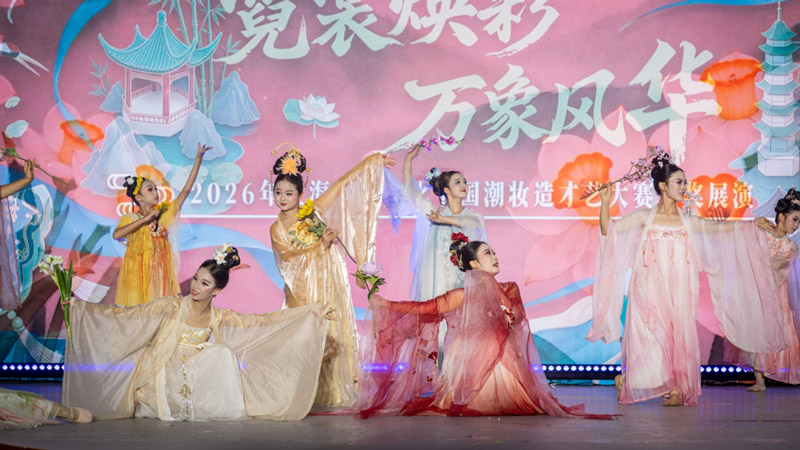
Eight Centuries of Anting Yaoban Cloth
Heritage textiles reached the runway as well. “Blue Blossoms Greet Spring” dressed its models in Anting Yaoban cloth, a resist-printed indigo fabric the district has produced for around 800 years. The patterns mixed the traditional repertoire of flowers, auspicious beasts and geometric bands with new designs contributed by the craft’s inheritors. The Anwen model team behind the segment has been together for more than a decade; 14 of its members walked, and the group’s average age is over 60. To sharpen the stage picture the team cut its garments away from the standard Qipao silhouette, adding puff sleeves, strapless bodices and mermaid hems.
What the Contest Left Behind
Other programs widened the range. “Flowers of the Desert” and “Seven-Colour Cloud Robes” set out Hu-Han exchange and the Dunhuang dance of the Mogao Caves murals. “Robe Rhapsody,” a new-folk music piece, put five Chinese instruments together: erhu, sheng, bamboo flute, guzheng and zhongruan. “Shadows Dancing for a Millennium” turned Songjiang shadow puppetry, a craft built on light carving and heavy colour, into live stage performance. “Tea Bearers in Dance” adapted a tea-carrying folk dance from Lutang in Jiading that had been performed for more than a century.
Peng Yating, who performed in “Seven-Colour Cloud Robes,” said the process taught her as much as it asked of her. Several programs reworked stories from classical texts, she noted, and those interpretations gave performers and audiences a firmer grip on folk custom and local history.
Under the stated logic of the format, makeup as form and culture as the shaping force, a reconstruction has to survive being worn, danced in and lit on a stage, which is a stricter test than a photograph. The 2026 edition closed with 48 programs, nearly 260 contestants, and a set of reconstructions whose sources, tomb murals, museum figurines and inherited textiles, are all on the record.