A pale celadon qipao in bamboo-joint hemp, worn with white sneakers to the office. A cherry-blossom print in Xiangyunsha, cut sleeveless with a back zipper. An emerald gown with a water-drop opening at the collar, photographed on a September evening and liked a million times within the hour. Each is a piece of the same movement: a garment stepping out of the occasions it has been kept for.
The college entrance exam remains the clearest place to see the old rule. On June 7, outside Hefei No. 168 High School in Anhui, mothers waited at the gate in qipao, a tradition read as a wish for victory. In the same week, in a store of nearly 1,000 square meters on Huaihe Road Pedestrian Street, the founder Li Shiping pointed along shelves of modified styles and described a different customer. “People used to buy qipao for the exam or for a wedding,” he recalled. “Now young people buy them for work, for shopping, for coffee.”
His figures support it. Over three years the brand has opened 56 stores nationwide on a hundred-yuan price strategy and a supply chain rooted in Henan, and roughly 70 percent of its buyers are young. The summer fabrics answer a single complaint, that qipao are hard to care for: elastic mesh, bamboo-joint hemp and cotton-linen blends. Lin Yue, a young office worker, chose a pale celadon bamboo-joint hemp piece and planned to wear it to work with white sneakers. “I used to think of qipao as a dress kept at the bottom of the closet,” she said. “Now I see it can be commuting wear.”
On Lei Street, a qipao studio that has traded for a decade has begun stocking cartoon prints beside its traditional patterns. The manager, Shuying, held up a pink cherry-blossom qipao in Xiangyunsha, a gambiered Canton gauze, and drew the contrast with ten years ago, when qipao were ceremonial dress that “only looked right if you stood still for a photo.” The sleeves are now gone to reduce restriction, a back zipper makes the garment easy to put on, and the Pankou (盘扣) have been reshaped into gourds and coins, decorative like a brooch but without the pressure of one. What the studio sells, she observed, is a garment you can sit and walk in.
Fabric Built for Daily Wear
This autumn brought the clearest statement of that intent from Hong Kong. Qipology, a label founded in 2018, showed its Fall/Winter 2026 “Blossoms” collection at Tai Kwun in Central, working from an oriental-floral theme and a pun on the phrase for abundance. Three techniques carry the surface: hand-made floral Pankou, three-dimensional floral beading, and layered embroidery. The silhouette abandons the fitted definition entirely, offering Babydoll, A-line and oversized cuts for commuting, banquets and ordinary days alike. Velvet leads the fabric list, with suede worked in as an unexpected second material, and the palette stays in low-saturation black, white, brown and taupe so that the beaded panels read as the only bright note. Beyond daily wear, the label also produces cocktail and wedding lines and offers a made-to-measure service. Its founder, Julie Liu, has said she wants qipao to shine again and to carry confidence and elegance with them.
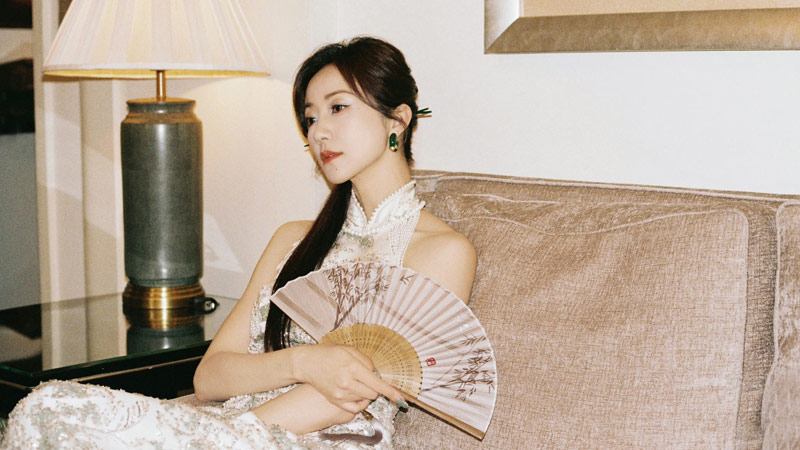
Fashion’s most-shared example of the season came on September 20, when the actress Tian Xiwei appeared in an emerald green qipao with a trailing hem. The post passed a million likes within an hour and two million within two. What traveled was not a replica but three modern moves: a halter neckline baring the shoulders, a teardrop cutout half-revealing the collarbone, and traditional elements such as Pankou kept in place without tipping into display. The green was chosen at high saturation and a cool cast to answer a fair complexion, with beaded leaf embroidery and a soft satin sheen lifting the texture. The styling was deliberately unceremonious: a low bun, a wooden hairpin, loose strands at the temples, silver strappy heels and a warm jade pin, with no stacked gold or heavy jewelry. In the discussion that followed, one judgment recurred, that for daily wear a slightly loose modified cut with room to move reads better than a tight one forced onto the figure.
Pankou Turns Into an Ornament
Modification, however, is not abandonment. Wang Shuyi, 24, is the daughter of Wang Jun, an inheritor of the Huibang tailoring craft recognized at the provincial level in Anhui, and the line she holds is specific: hand-made Pankou, diagonal placket stitching and three-dimensional cutting stay, and the reserved quality of oriental negative space and the classic collar shape remain the foundation. She watches young buyers reinterpret the aesthetic by mixing. One buyer born after 2000 paired a restored purple qipao with Martin boots for what Wang described as elegance with a sense of strength. For Chinese students abroad, her studio has made pieces that keep hand-finished piping and a single-bar Pankou at the front while cutting the back away in silk crepe and embroidering it with a “Spring Dawn” floral design, international fashion and classical beauty at once. Modified styles now account for 60 percent of her store’s sales, and her customers cluster between 18 and 35.
What Young Buyers Are Choosing
Social platforms show where the mixing goes. Notes pairing qipao with jeans or with a blazer regularly collect tens of thousands of saves and comments, and the topic tag for qipao styling has passed 100 million cumulative views. The cherry-blossom piece in Xiangyunsha is one example of the same instinct, a formal fabric used casually in a print that would once have been considered too playful for the form.
Around all of this sits a large commercial frame. Xinzhongshi and Guochao clothing, the two labels that now organize Chinese-traditional dressing, have built a consumption market in the hundreds of billions of yuan, and qipao sit inside it as the most recognizable single garment. What drives the purchases is self-expression more than heritage duty, young buyers using an old form to say something about who they are.
The wardrobe shift, meanwhile, is concrete. Fabric now favors easy care over delicacy, the cut favors room over restraint, the Pankou has become an ornament rather than a fastener, and sneakers and boots have replaced embroidered flats under the hem. A garment once reserved for holidays now turns up in office corridors and at café tables, which is another way of saying it has gone back to being clothing.