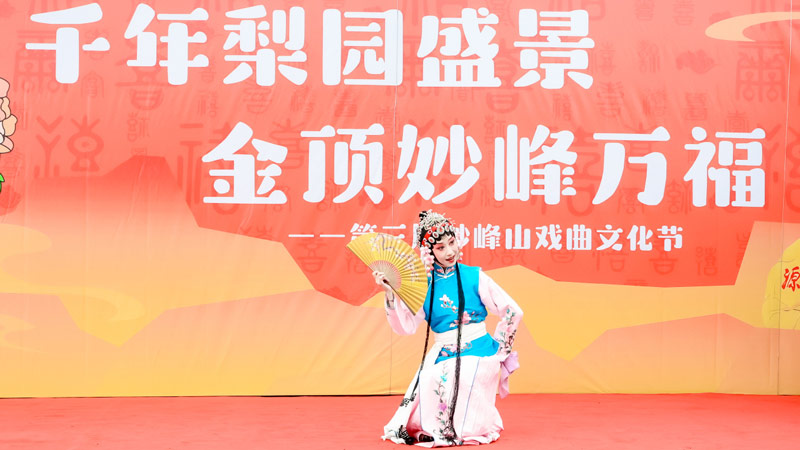
Beijing’s Miaofengshan scenic area has turned itself into a living opera stage. On September 8, the 27th day of the seventh lunar month, the third Miaofengshan Opera Culture Festival opened in the Mentougou district under the theme “A Thousand Years of Liyuan Splendor, Golden Summit of Ten Thousand Blessings,” running on September 8, 12, 13 and October 7 across the mountain site and the Jixiang Theater (吉祥大戏院) in the city. The most visible perk this year: visitors who arrive in Hanfu enter free, turning the mountain paths into a moving exhibition of traditional dress against temple roofs and pine ridges.
The mountain’s tie to opera runs deep. Its Xishen Hall (喜神殿) honors Li Longji, the Tang dynasty Emperor Xuanzong who in 714 AD trained three hundred selected musicians at the Pear Garden (Liyuan, 梨园) in Chang’an — the origin of the term “disciples of the Pear Garden” for opera performers, and the founding moment Chinese opera tradition traces itself to. Miaofengshan’s temple fair dates to the mid-to-late Ming dynasty, spans more than 400 years and was inscribed on the national intangible cultural heritage list in 2008. In 1920, Peking opera masters Yang Xiaolou and Cheng Yanqiu staged a charity performance at Jixiang Theater to fund the hall’s restoration; a century later, the mountain and the theater have rejoined hands through this festival.
Mentougou launched its “Fortunate Land of West Beijing” regional brand in 2025, and the festival carries that banner as the district’s flagship culture-tourism event. The third edition keeps the structure of earlier years while scaling it up around three program blocks: a lineage-tracing ceremony at the hall of the opera patron deity, a “junior Pear Garden” performance showcase, and an NPC tour with immersive interaction that spreads costumed characters across the mountain.
Opening day belonged to the young performers. Wusheng (martial male role) actor Chang Liang led with an excerpt from the Peking opera “Tan Zhuang,” a deliberate nod to the unbroken martial lineage of the stage; Zhao Zhengyang, a graduate of the jing-kun program at the National Academy of Chinese Theatre Arts, performed the huadan classic “Selling Water,” its famous “which mirror in the morning” aria paired with lively fan work; laosheng (older male role) singer Zhang Haoran delivered the weighty arias of “Shang Tian Tai”; and chou (comic role) performer Li Ze doubled up, first showing the patter of “Da Long Pao,” then the rapid-fire “lamp-name” recitation from “Shen Tou Ci Tang.” A live pit band kept the rhythm — percussionists Liu Hai, Wang Yuanyuan, Zhou Lijun, Yang Min and Yang Haitao, string players Yetiesen (Ye Tiesen), Chen Shumin, Zhao Huiping, Liu Tong and Wang Yiyi — lending the open-air stage a full operatic soundscape.
The festival’s centerpiece, a site-wide opera scenario game, runs on September 8 and 12-13. On the latter two days the entire mountain becomes an interactive set: each visitor receives a “pilgrimage credential” stamp book at the gate and joins a costumed cast of five roaming deities — the opera patron Xi Shen, the wealth god Zhao Gongming, the literary star Wenchang, the matchmaker Yue Xia Laoren and the medicine king Bian Que — who parade the mountain twice daily, morning and afternoon. Each deity runs a distinct challenge: the Xi Shen teaches opera gestures and hides bonus tasks near his hall; Zhao Gongming invites visitors to smash golden ingots for luck; Wenchang sets brain teasers and tongue twisters on the theme of exam success; the matchmaker hosts compatibility games; and Bian Que offers a wellness circuit of herb identification, five-animal exercise and a handmade herbal sachet. Five stamps can be redeemed at the Jiafu cultural-creative shop for a “bring the blessing home” gift, and on September 12-13 three traditional-medicine doctors will offer free consultations inside the scenic area.
Perks stack beyond the gate. Stamp collectors get discounts on the site’s own cultural products and opera-themed coffee, and a ticket stub from Jixiang Theater grants one more free visit to Miaofengshan within a set window — a two-way link between mountain and stage. Indoors, the Mentougou theater adds five opera shows through late September: Kunqu opera “The Peony Pavilion” by the Northern Kunqu Theatre on September 19 at 14:30, a crosstalk special by the Beijing Quyi Troupe on September 25 at 14:00, the Hebei bangzi “Mu Guiying Takes Command” by the Xiangyuanqing troupe the same day at 19:00, the Yu opera “Yushanzhui Qingyuan” by the Liya Culture troupe on September 26 at 14:30, and Beijing Quju opera “Yang Naiwu and Xiao Baicai” by the Beijing Quju Troupe on September 27 at 19:00. The festival closes on October 7 at Jixiang Theater with a charity gala of festival highlights and returning stars.
Festival organizers describe the event as a vehicle for handing opera to a wider public: instead of watching from a seat, visitors walk the story, collect the stamps and wear the clothes. The format — culture, tourism and hands-on interaction in one ticket — is what the district plans to keep refining as it turns heritage sites into economic drivers. Enter the theater for the play; enter the mountain to be the protagonist.