Leaked set photos from Feng Bu Qi (凤不栖) have stirred a small storm. Wu Jinyan (吴谨言) wears two long cloth bands that fall from her hair, past her shoulders, and down toward her waist. At first glance, they look strange, almost like forgotten straps. Yet they are not random. They borrow from Buddhist sculpture, where a ribbon-like ornament called Baozeng (宝缯) frames holy figures.
The drama bends that sacred detail into a modern screen look. Why hang them there? The answer sits between art history, camera work, and costume design. It also shows how television can turn a small religious motif into a talking point. The question is not whether ancient women wore them, but why a fictional world wants them now.
Sacred Silk Roots
Baozeng means a band made from silk or thin brocade. In Buddhist images, it grows from the two sides of a crown or headdress. It does not behave like a normal hair tie. It moves with the figure’s pose. Artists used two main shapes. The downward type drops naturally, sometimes reaching the belly, hips, or knees. It appears on calm bodhisattvas and heavenly attendants, whose stillness needs a gentle line. The upward type lifts away from the head, with curled tips. It suits flying apsaras and musical deities, whose bodies twist and leap. Wu’s version belongs to the downward family.
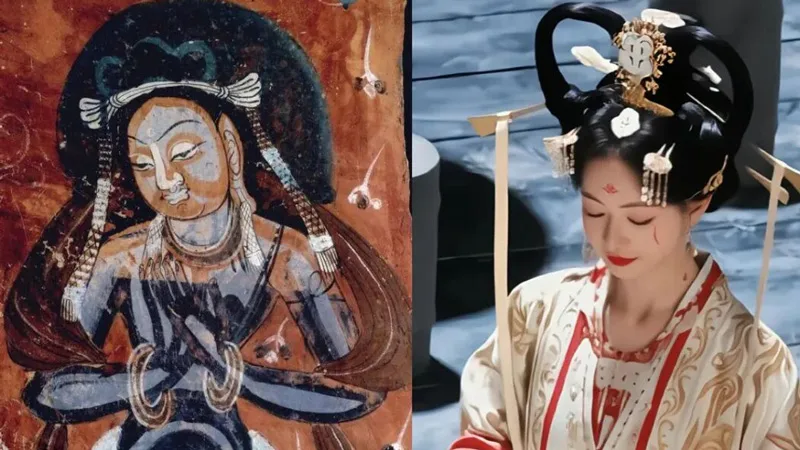
The ornament began in ancient Indian Buddhist art. When Buddhism traveled into China, the motif came too. It blended with local carving and painting. During the Wei-Jin era (魏晋时期), cave building expanded. Dunhuang (敦煌) artists painted it inside the Mogao Caves (莫高窟). Apsaras and bodhisattvas wore painted ribbons that curved with their sleeves. Stone carvers at Yungang (云冈) and Longmen (龙门) also cut simplified versions. Hard rock could not show soft cloth, so they carved outline and direction instead. The detail survived because it made holy figures feel lighter than stone. It also helped viewers read movement in a frozen body.
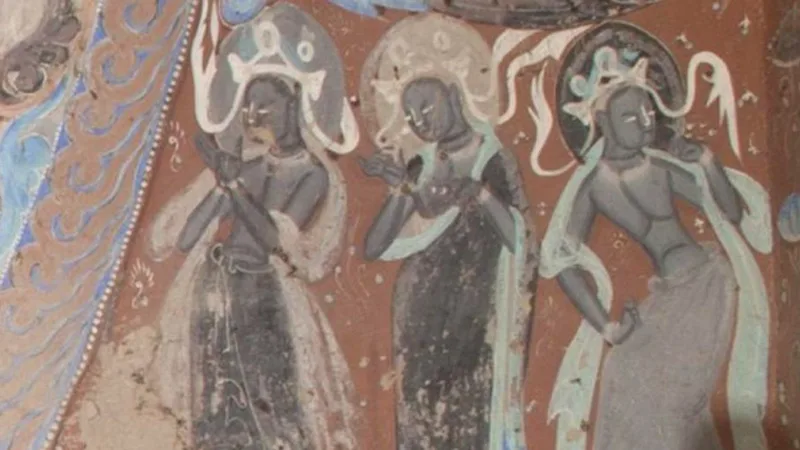
By the Sui-Tang (隋唐) period, Buddhist art reached a high point. Baozeng became richer. Some edges carried embroidery. Some ends held tiny jewels. In High Tang murals at Mogao, the bands joined necklaces and beads, increasing a sense of holiness. Colors varied, but the purpose stayed clear: to frame the head and echo the body’s gesture. Still, the evidence stops at religious images. Ordinary women left no clear proof of wearing such ribbons. That gap matters. It means the drama is not reconstructing daily fashion. It is borrowing a sacred visual language and reshaping it for entertainment.
So the historical root is real, but narrow. Baozeng belongs to temples, caves, and painted heavens. It was not a common hair accessory for women in the street. When a television costume uses it, the choice is creative, not documentary. The show takes a detail from Buddhist art and asks a new question: how can a sacred ribbon serve a fictional heroine? That question keeps costume designers free. They can respect the source while changing width, fabric, and placement.
Screen Styling Choices
One reason is movement. Wide robes and heavy layers can look stiff when an actor stands still. Two long bands change that. When Wu walks, turns, or passes a wind machine, the ribbons trail behind her. They create a soft line that the camera can follow. In close shots, the fabric adds rhythm without needing extra jewelry. The costume becomes active. It breathes, even when the character does not speak. For a scene built on tension, that small motion can hold attention longer than a static crown.
Another reason is the face. A high bun can stretch the face and make the head look large. Two vertical bands beside the cheeks interrupt that shape. They frame the face, soften its edges, and add length in a flattering direction. The eye reads the ribbons as part of the silhouette, not as separate objects. In motion, they also distract from any awkward angle. Makeup and lighting can only do so much. A hanging line of cloth works like a moving frame, guiding the viewer’s gaze toward the eyes and jaw.
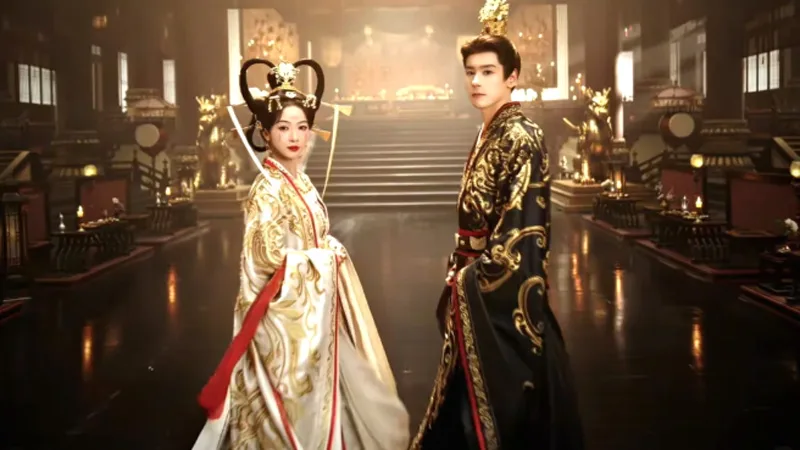
A third reason is balance. Wu’s headpieces are complex, with metal, beads, and layered shapes. If all the weight sits on top, the whole look can feel top-heavy. The hanging bands pull attention downward. They connect the crown to the robe and keep the outline from becoming a pyramid. The result feels more coordinated. The audience may not notice the trick, but they feel the harmony. Costume design often works this way: a solution looks like decoration, while it quietly fixes a visual problem.
The show also adjusts the original design. Painted Baozeng can be wide, falling from the crown itself. The drama narrows the bands, matches them to the robe color, and fixes them to long rods hidden at the bun’s sides. This makes them easier to control on set and clearer on camera. The final look is neither pure history nor pure fantasy. It is a bridge between Buddhist art and screen beauty, built to move, frame, and balance. Whether viewers love it or question it, the ribbons do their job: they make the character memorable before she says a word. In that sense, the controversy is useful. It invites viewers to look closer at religious art, costume craft, and the way small choices shape a character on screen.