Leaked photos from Gui Luan (归鸾) show Lin Yun (林允) in a period costume, her face marked by two red strokes. At first glance, they look like fresh cuts or a battle scar. Fans asked why a graceful character would wear such strange wounds. The answer is not injury. It is a historical makeup style called slanting red. This article follows that mark through palaces, poems, tombs, and TV cameras, and explains why a beauty trend from long ago still catches the eye today.
Court Beginnings
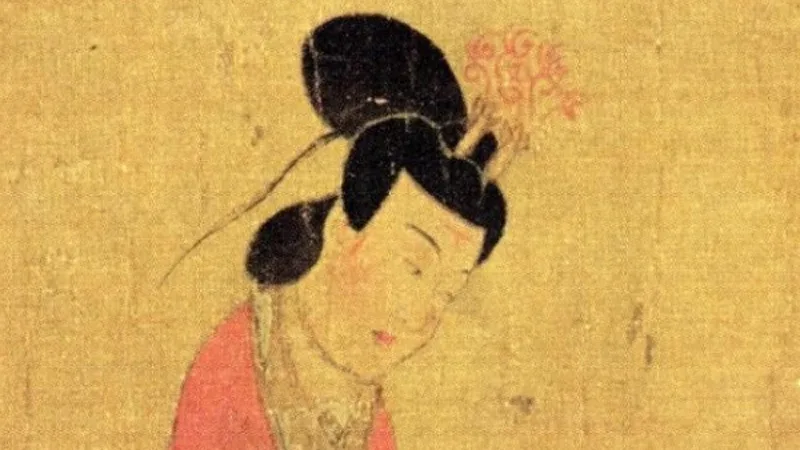
The earliest relative of slanting red appeared during the Three Kingdoms, when court women wore Morning Glow makeup. Two pale red streaks were placed on the cheeks, and the look was said to resemble dawn light. Old books such as Records from the Dressing Chamber (妆楼记) and Miscellany of Gathering Orchids (采兰杂志) mention its origin. At that stage, the style stayed inside royal rooms. It was simple, soft, and not meant for ordinary streets. A small detail, yet it carried the confidence of palace women who had time, mirrors, and good rouge.
By the Southern and Northern Dynasties, the fashion left the palace for noble homes. Women usually drew the red marks near their temples. Some kept a single line; others shaped it like a crescent moon. Because the color was painted at a slant, people began calling it slanting red. Emperor Jianwen of Liang (梁简文帝) even wrote it into poetry. The Admonitions Scroll (女史箴图) also shows women with such marks. The look was no longer a private court secret. It had become a sign of status, taste, and the growing freedom of upper-class women to decorate their faces.
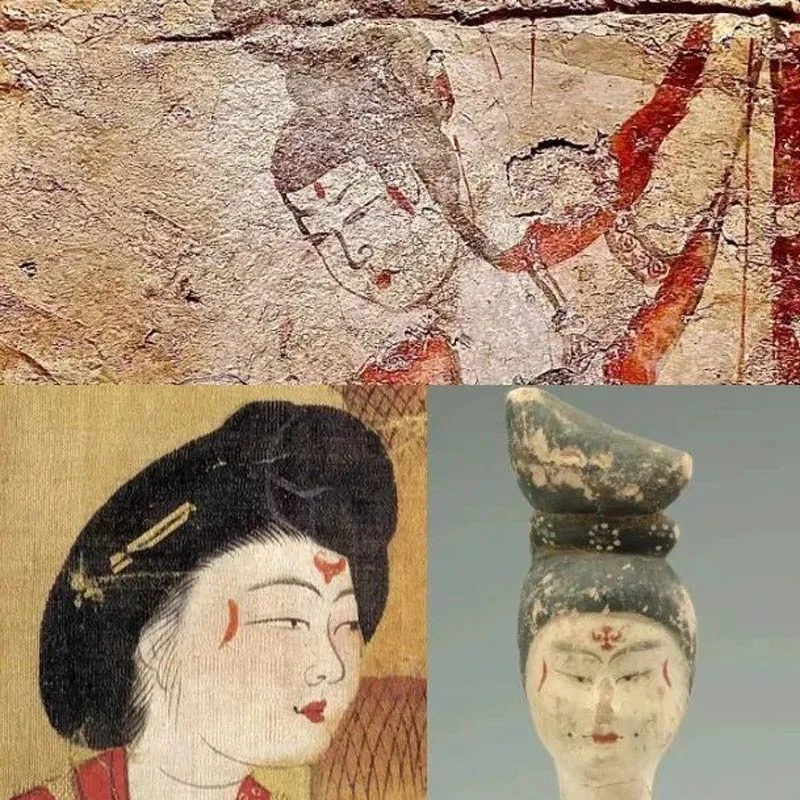
During the Tang dynasty, slanting red reached its peak. It became a common choice in women’s makeup. The most popular shape was a fresh crescent under each temple. Colors were bright, and edges were often sharp. A bolder version, called blood-stain makeup, blurred the red so it looked like dried blood. In the late Tang, some marks stretched down toward the middle of the cheek. Poets Bai Juyi (白居易) and Yuan Zhen (元稹) mentioned the style. Wall paintings in Shanxi (陕西) and Henan (河南), silk paintings, and female figurines from tombs all preserve it. Together, they prove how visible the look once was.
Tang makeup was a full ritual. Women began with a white base, then added a forehead ornament called a flower mark, blush on both cheeks, and finally two slanting red lines. The order mattered. Each layer built toward a polished, theatrical face. Seen this way, slanting red was not an isolated oddity. It was one note in a larger composition. The style also appears on female figurines and silk paintings unearthed in Shaanxi and Henan. Those objects show real women, not only poems. They let us see how color sat on a face, how lines curved, and how fashion moved beyond theory into daily practice.
Glow and Fade
Why did slanting red become so popular? Two forces helped. First, court women led the trend. They had finer rouge and helpers to draw clean lines. When ordinary women saw the effect, they copied it, and the style traveled downward through society. Second, Tang society was open about beauty. Women could try striking faces without heavy shame. Slanting red worked with forehead marks and cheek dimples during banquets, songs, and dances. It made a face feel grand and festive. The style was not just decoration. It was a social signal that a woman knew the fashion of her time.
After the Tang, taste changed. Song women preferred quiet elegance: thin powder, light blush, and pearl ornaments. A red mark as bold as slanting red felt too loud for daily life. In the Yuan, Ming, and Qing periods, the same preference for restraint kept it out of common use. It did not vanish from memory, however. It survived in poems, paintings, and archaeological finds. History often keeps old beauty in fragments. A line on a tomb wall or a figure in a silk painting can still tell us what once seemed fashionable.
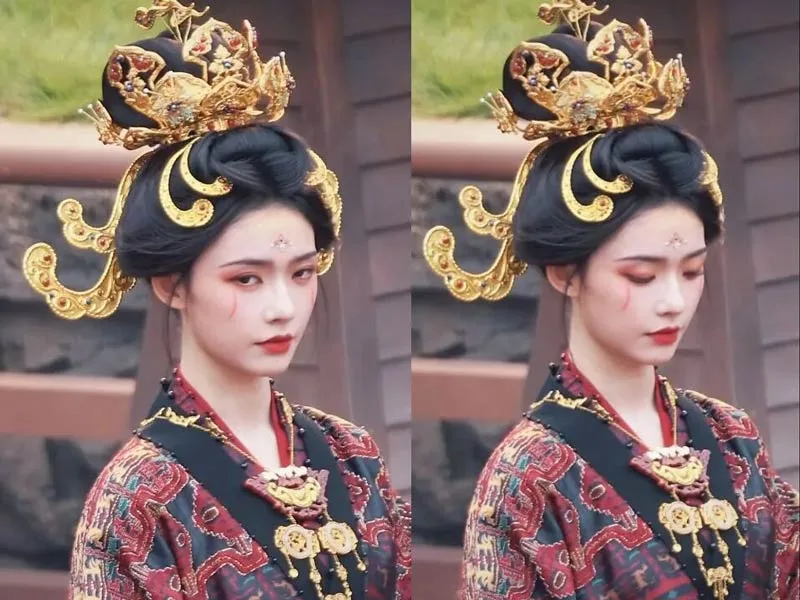
On screen, Gui Luan does not copy ancient makeup exactly. In earlier periods, slanting red usually began near the temples and covered a wider area. The drama moves it below the corners of the eyes. The lines are thinner, and the color is a light water red. This choice keeps the face readable on camera. Too much red might look like a wound or distract from the actress. Yet the mark still slants, and the two sides remain symmetrical. Those details honor the basic shape of slanting red while softening it for modern viewers.
So the red strokes on her face are not scars. They are a quiet echo of an old cosmetic habit. The show takes a bold Tang image and turns it into a gentle visual clue. For viewers, the mark may simply look mysterious. For history fans, it opens a door to palace rooms, poetry, and tomb art. The next time a period drama shows a strange detail, it may not be a mistake. It may be a small piece of the past, adjusted for the camera and waiting to be noticed.