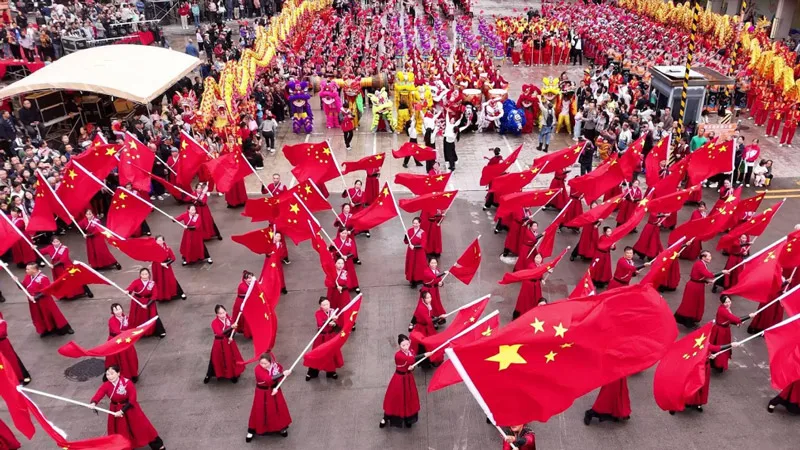
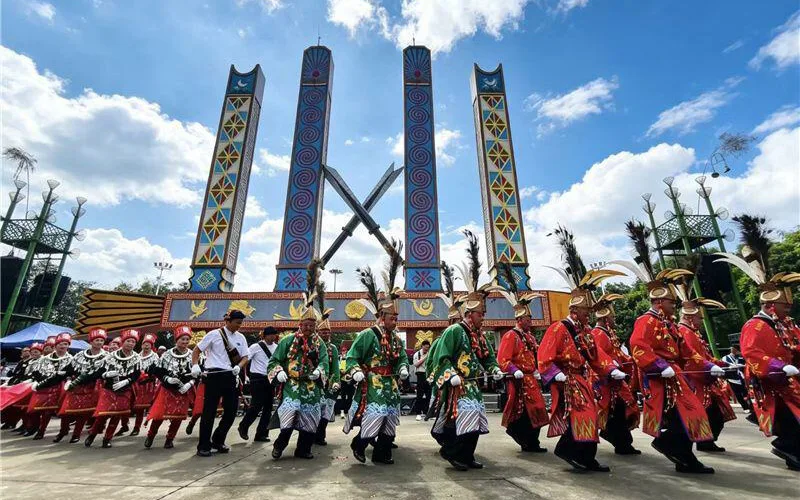
Munao Zongge, the great circle dance of the Jingpo people of southwest Yunnan, closed a Mid-Autumn and China National Day programme in Nigeria as the finale item, performed by the Nigeria Huaxing Art Troupe. People’s Daily’s overseas edition reported the performance on October 12. More than a hundred dancers took the floor together, and the troupes lined up Chinese and Nigerian performers in alternating rows and had them join hands, so that the massed drumming and the Jingpo steps were carried by dancers in Nigerian dress as much as by anyone else on the stage. Dehong prefecture’s culture and tourism bureau, which supplied the choreographic guidance, said afterwards that the topic has now passed ten billion views online, a measure of how far a village-square dance can travel through short video.
The dance itself is old and specific. Munao means a mass gathering in the Jingpo language, and the tradition carries the group’s creation story, its migration history and its sense of itself; it is danced in a spiral around decorated poles called munao shidong, which are raised for the occasion and danced around until the circle closes. It was inscribed in the first national list of intangible cultural heritage in 2006, and it is known in China by two nicknames, the paradise dance and the dance of ten thousand people. Until recently almost all of that was unfamiliar outside Yunnan.
Seven Months of Rehearsal, and a Local Cast
Ni Mengxiao, who leads the Huaxing troupe, said the preparation began in March and ran for about seven months. The overseas version keeps the classic ring formation and the progressive, layered steps, he explained, while adding African dance’s physical drive in the way the body opens and the detail of the footwork, so that the whole atmosphere lifts rather than slows. Local performers were deliberately brought into the line, dressed in Nigerian costume, and set shoulder to shoulder with the Chinese dancers instead of standing behind them.
That decision shaped the reception more than the choreography did. Before the Mid-Autumn and National Day programme, the troupe had already taken the piece into schools and community compounds several times, and Ni recalled that the audience regularly joined in without prompting: children marking the beat with their feet and hands, residents closing a circle of their own, and, once the music stopped, people asking what the dance was for and where it came from. The troupe has also staged Chinese New Year performances at the invitation of a local traditional ruler, which is how an overseas ensemble earns the right to keep showing up.
What the African Dancers Say
“The music of Munao Zongge makes you feel warmth and happiness,” said Amozi Anthony, the troupe’s Nigerian assistant and one of its longest-serving members. He has learned a large number of Chinese songs and dances, and he is not the exception. Mary Fano, nine years with the group, can list more than thirty Chinese dances and ten Chinese songs she has taken on; of Munao Zongge she said the process was a little hard at the start but that repeated training brought it to a clean finish, and that folding Nigerian dress into the performance is what cultural exchange actually looks like on the ground. Princewill Ogochukwu, also nine years in, said he likes everything about the piece, and that the troupe is how he came to appreciate how much is inside Chinese culture beyond the parts usually shown abroad.
Founded in 2017 and designated an overseas cultural organisation by the Overseas Chinese Affairs Office of the State Council, the Huaxing troupe has spent its life on China-Africa people-to-people work. Ni framed this year’s performance around two anniversaries: 55 years of China-Nigeria diplomatic relations and the China-Africa people-to-people exchange year. His point was that the dance turns Chinese culture from a distant label into something a Nigerian audience can touch, join and feel at home in.
A Backstage Team in Dehong
Nothing about the performance was a one-way export. Zhen Zhen, a musician who was collecting material in Dehong in May, came across a video of the Huaxing troupe dancing Munao Zongge on his phone, contacted Ni through WeChat Channels, and put him in touch with the prefecture’s culture and tourism bureau. From there the bureau did the backstage work: it connected the troupe with Jingpo researchers, who wrote up the meaning of the dance and a translation of the lyrics so the dancers would understand what they were performing, and it worked with local costume workshops on the cut and the motifs of the Jingpo dress so the Nigerian version stayed faithful to the standard.
Yang Min, deputy director of the Dehong bureau, described the role as adviser and cultural gatekeeper, and said the bureau’s next steps are a standardised resource pack of intangible-heritage material, deeper standing cooperation with overseas Chinese organisations, and a larger digital distribution push, with visits in both directions kept in the mix.
A Domestic Run That Came First
The dance had already broken out at home before it reached West Africa. In May, while collecting material in Dehong, Zhen Zhen took Shi Legan’s Munao Zongge March and reworked it with AI tools into a song titled simply Munao Zongge, and it travelled quickly; around the same time, a short video of a Jingpo knife dance choreographed by Yuan Zhiping, a principal dancer with the Yunnan Song and Dance Theatre, went viral. On the evening of October 1, Yuan Zhiping shed the black suit he wears in his online clips and appeared in full Jingpo dress to close the opening ceremony of Dehong’s 2026 “one dance for all ethnic groups” programme and the Longchuan county Munao Zongge series, with the state broadcaster’s CCTV-13 carrying the event live.
Over seven days the massed dance was staged every night from October 4, with a green-leaf banquet for a thousand people, folk concerts and traditional sports filling the rest of the schedule. A knife-dance exchange brought together Mao Lezai, a provincial-level representative inheritor, Gao Tonghong, known as the soul of Jingpo blades, and Pai Kunsheng, known as the knife king, on one floor with Yuan Zhiping. A separate panel on the song gathered Shi Legan, the composer of the original march; Zhen Zhen, who adapted it; Guan Xin of Yunnan Publishing Group’s copyright service centre; and Dong Jianbin, head of the prefecture’s Jingpo cultural work troupe, to talk about protecting original work, and two expert studios were unveiled afterwards. Read from one end to the other, the sequence runs from an AI-adapted song and a phone-sized knife-dance clip to a circle of Nigerian schoolchildren keeping the beat.