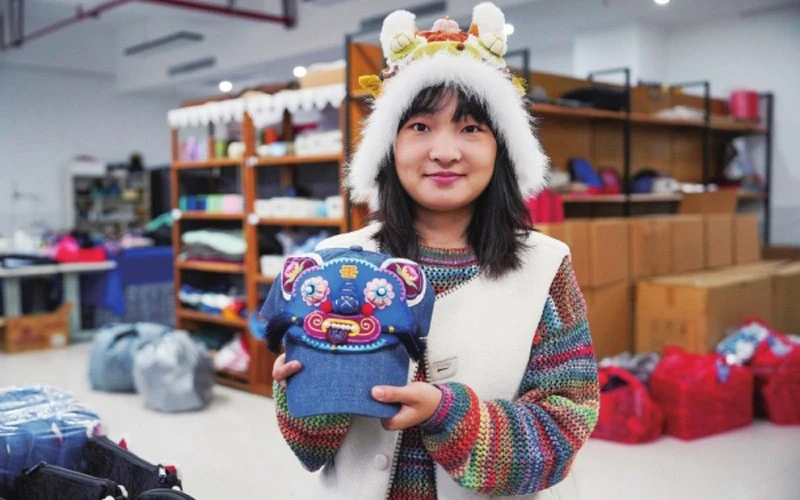
The courier labels stacked in the workshop at Shibadong Village carry English addresses. The village collective in Huayuan County, Xiangxi, Hunan, took its first American order on Amazon in late June, and since May its tiger-hat line has moved more than 40,000 hats and bags.
The Photograph That Started the Orders
It began with a photograph taken in Beijing. On 14 May, at the Great Hall of the People, Elon Musk appeared with his six-year-old son, who was dressed in a Xinzhongshi outfit and wore a blue-purple Miao tiger hat. Within hours the video was circulating, and so was the hunt for the hat.
Wu Manjin, who runs the Miao embroidery demonstration base in the Shibadong area, remembers the phones. Callers wanted confirmation that the hat on the foreign child was theirs. Orders came in the same channel. By the next morning she had counted more than 1,000.
Buyers did not wait for delivery. Some drove in from Jishou and sat at the base, taking hats as they were finished. The village organised training and moved people in, and the embroidery team went from 80 to more than 200, with women who worked elsewhere travelling back at night and staying until midnight. “I was afraid we could not finish the orders,” Wu said. The first overseas batch carried labels nobody in the workshop could read; the company and the courier told them to make the quantity and hand it over. After nearly a month of work, more than 2,000 hats went to the United States.
How a Village Cooperative Reached an Amazon Storefront
None of that would have held without a supply chain behind it. In 2014, 54 embroiderers set up a cooperative under the village party committee. A company followed in 2022, tying pattern design, fabric processing, finished goods and tourism retail into one line. The 2023 plan for the Shibadong area turned the small workshops into a base with production, display and study tours under one roof. This year, customs officers and cross-border trade specialists ran a course in the village on selling overseas, helped the company open an Amazon store, and shot the storefront photographs inside the workshop itself.
Making a hat by hand sets hard limits. Cutting the panel, adding lining, pressing, sewing eyes and nose, fitting the tongue, stringing pearls and attaching whiskers take more than twenty steps, and one embroiderer can finish about ten of the dumpling-shaped noses a day, or twenty-odd sets of whiskers. A converted school building now holds six automated production lines: machines lay down the base outline and simple motifs, embroiderers make the ears, tongues and eyes, and the parts are assembled. Daily output rose from 100 hats to more than 300.
Pay followed the volume. An embroiderer earns over 100 yuan a day, adding 2,000 to 3,000 yuan a month, and the Miao embroidery trade in the area produced more than 20 million yuan in the first three quarters of this year. The tiger-head series alone has sold over 40,000 pieces since May, including more than 30,000 hats, and derivatives built on the same motif, bucket bags, clasp purses, phone pouches and ornaments, now sit on cross-border platforms and on shelves in a Beijing mall. Across the Shibadong area, more than 500 women work flexibly in the trade.
The Designer Who Sewed It Onto a Baseball Cap
The hat that travelled had been redrawn first. Li Wen, a designer born after 2000, pulled out the original sketch at Xiangxi Vocational and Technical College for Nationalities on 27 October; the paper edges had already furred. She grew up in Luxi County watching her mother embroider insoles and headscarves, and stopped in front of a worn tiger-motif child’s hat in a museum case in Xiangxi.
Three months of revisions followed. The first tiger face was too stern, so she rounded it. The outline uses the dog-tooth stitch that Miao embroidery reserves for protection; pomegranates sit at the ears for abundance, a lotus is worked into the tongue, and pearls replace thread for the teeth. Twenty-odd steps later the face was round, the eyes bright, and the whole thing slightly naive.
Then came the change that mattered commercially. Li wears baseball caps, and asked whether the tiger could be made more like one, so the embroidered panel was sewn directly onto a cap. The motif stayed old; the silhouette became familiar. In Miao practice, embroidery is part of traditional chinese clothing rather than a finish added to it, since the panel is worked first and the garment is built around it, and that logic made the swap easy: the cap took the panel, and the panel carried every bit of the identification.
Sales at the import expo answered the question. At the Hunan pavilion on 5 November the stand was crowded from opening, with visitors photographing hats, trying them on and asking about the tasselled whiskers; foreign buyers who could not be understood were handed the hat to feel. Wu counted more than 10,000 yuan in sales that day, after selling out at the services trade fair the month before. In September, when Madagascar’s prime minister visited Shibadong, the delegation bought over 10,000 yuan worth. Long Meizhi, 74, who has embroidered all her life, said she never thought the work could cross the mountain. Shi Guoping has a smaller ambition: better Mandarin, and a sentence or two of English.