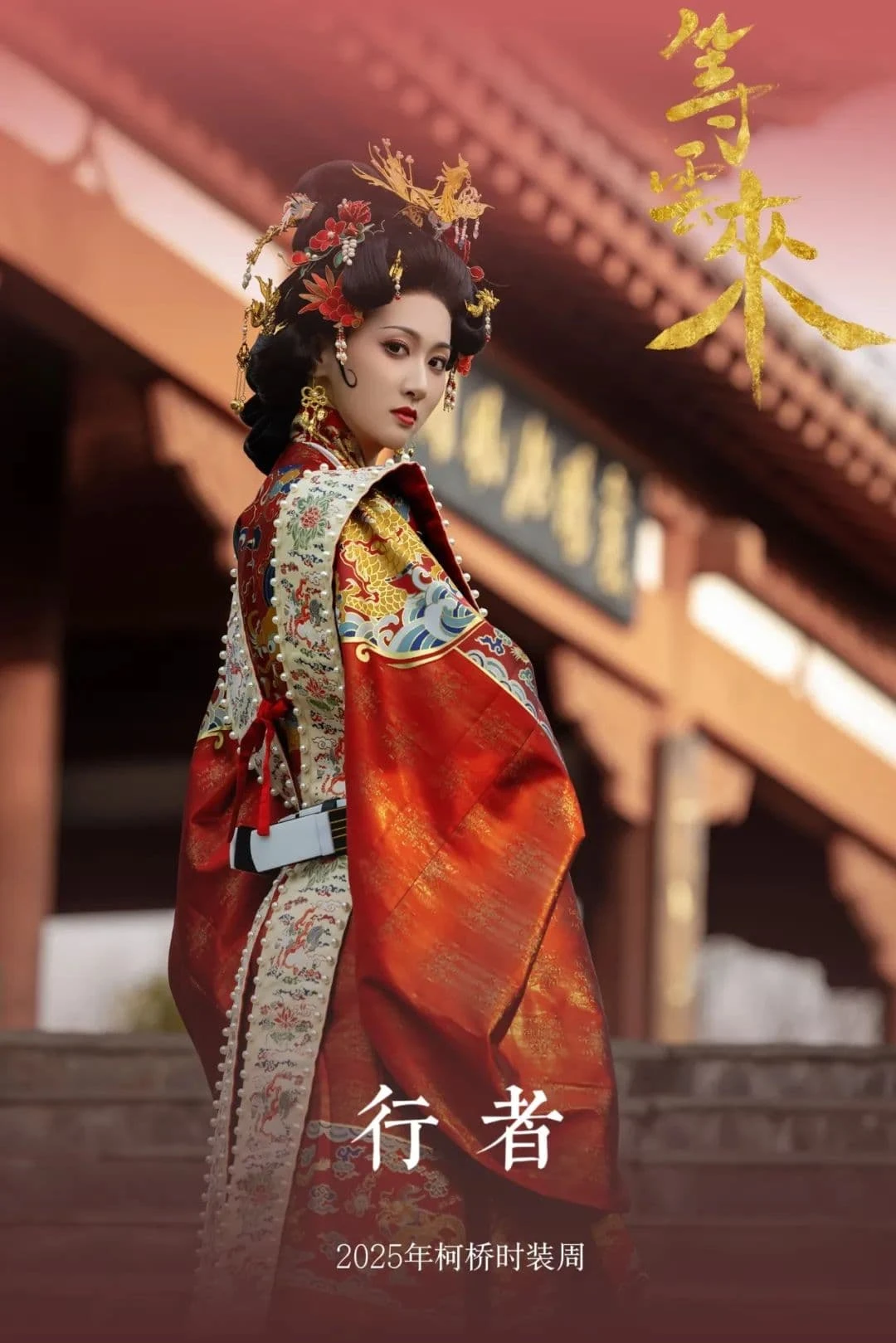
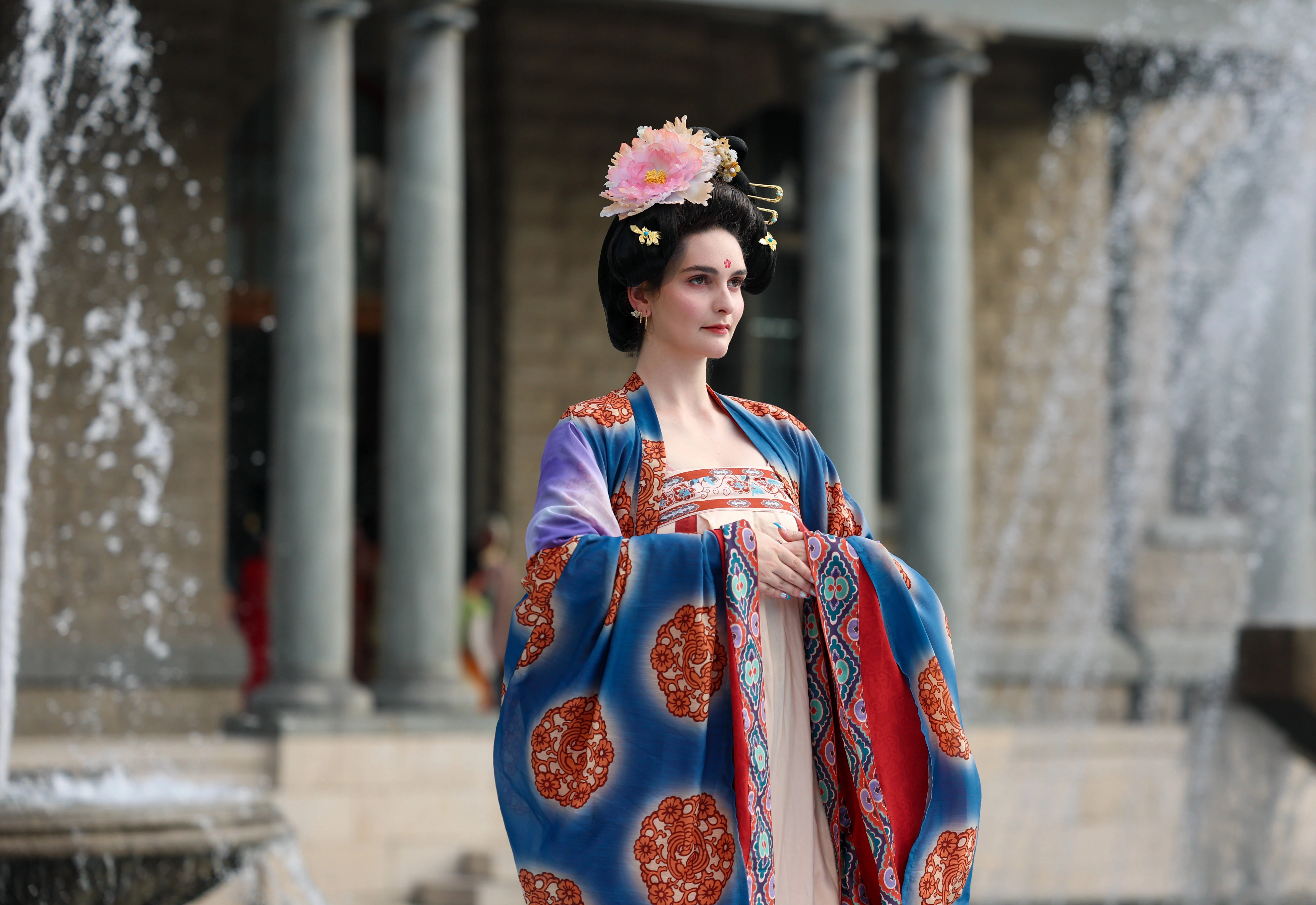
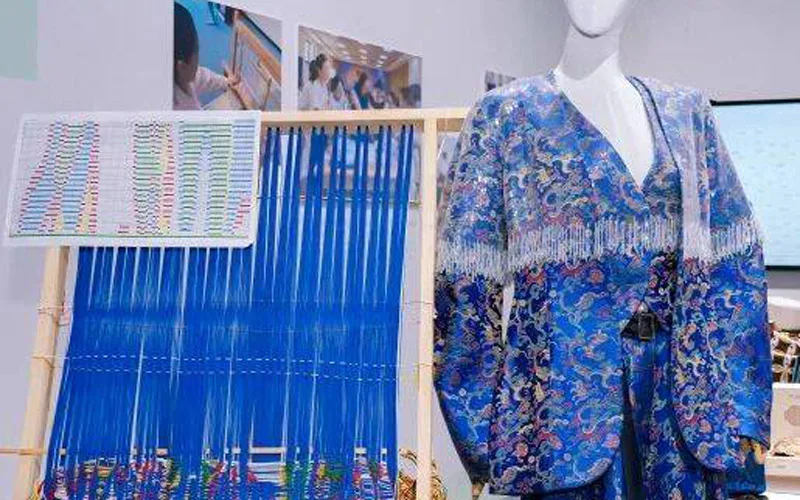
Two objects sat side by side at a vocational education fair in Tianjin this October: a woven sample rebuilt from silk residue found at Sanxingdui, and a couture gown cut from Shu brocade. The pairing was the argument. One showed a technique recovered from ash; the other showed the same technique sold as contemporary clothing.
| Dates | 15 to 17 October 2026 |
| Venue | World Vocational and Technical Education Development Conference, Tianjin |
| What it is | A reconstructed Sanxingdui silk sample and a Shu brocade couture gown, shown in the China vocational education exhibition |
| Scale | 78 countries and regions in the skills competition; 9,391 teams and 36,000 competitors |
| Also on show | Suzhou-style mounting of damaged painting and calligraphy, taught as a conservation course |
Rebuilding Silk From Ash and Residue
The reconstruction was commissioned by the Sichuan Provincial Institute of Cultural Relics and Archaeology. Teachers and students at Chengdu Light Industry Vocational University worked with the Chengdu Shu Brocade and Embroidery Museum, taking the detection data from silk traces excavated at Sanxingdui and rebuilding a fabric that had spent roughly three thousand years buried in ash, reduced to a state the eye cannot resolve.
What the sample demonstrates is provenance rather than spectacle. Silk does not survive at Sanxingdui as cloth; it survives as mineralised traces and impressions, which is why the reconstruction had to be driven by instrument readings rather than by visual copying. The finished panel is plain, and its value sits in the weave structure: warp and weft arranged the way the readings said they were. State broadcaster CCTV listed the piece among the vocational sector’s achievements in reactivating old techniques in its 16 October bulletin.
A Shu Brocade Gown Cut for 2026
The second exhibit, a couture series titled Five Stars Rising in the East, takes its name from a Han-period brocade armguard inscription. Deep blue ground, a five-star motif worked across it, and a modern cut: the gown is a school-enterprise collaboration with Sichuan Anna Kaiseli Garment, sold under the label Fuzhen Shu Brocade.
Visitors included Malaysia’s deputy prime minister Ahmad Zahid Hamidi, who stopped at the booth, heard an explanation from the university’s party secretary Ren Yingwei and asked about the weaving technique behind the pieces. Officials from the Sichuan provincial education department also toured the stand during the run. Earlier documentation of the Sanxingdui site and its bronze finds is gathered in our piece on the Sanxingdui mysteries.
Teaching a Loom Technique as a Course
The teaching model is what the fair was actually convened to discuss. The university assembled a team pairing master craftsmen with professors and converted hand-transmitted Shu brocade and Shu embroidery work into more than twenty standardised courses. It also leads a Chengdu research centre linking the brocade and embroidery trade with universities and industry, and its student-and-staff work has been picked up in a Ministry of Industry and Information Technology annual textile innovation list and shown at China Fashion Week.
Capacity is the commercial problem the school is attacking. Shu brocade is one of China’s four famous brocades and carries the saying that an inch of it costs an inch of gold, because traditional looms are slow and the skill threshold is high. The school and its partner firms have modified loom equipment and reworked the process, then added digital control and batch production, a route that treats scarcity as a price position rather than a supply constraint. The wider history of Chinese silk weaving, including how Han-period looms were organised, is set out in our file on the Chinese silk robe and the Han textile industry.
The conference closed on 17 October with 45 countries issuing the World TVET Standards Framework, known as the Beijing Accord, alongside a white paper on Chinese vocational education and a national standard for Luban Workshops. A traditional-craft track was added to the skills competition for the first time this year, which is the structural reason a silk sample could be displayed as an educational outcome rather than a museum loan.