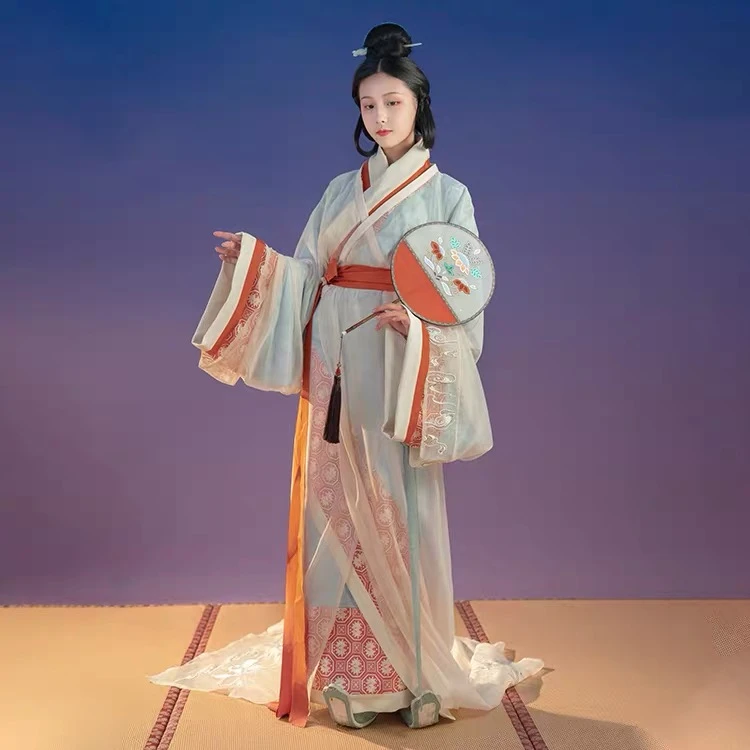
Among the earliest documented forms of Han Chinese deep-garment (Shenyi) clothing, the Quju — a wrapped robe with a triangular, curved hem — carries the oldest continuous tailoring tradition in hanfu. First appearing in the Warring States period (475–221 BCE), the Quju wrapped the body in successive layers, securing the overlapping front panels with a belt. The structural principle, known as Xuren Goubian (extended lapel, hooked edge), required each layer to turn and tuck behind the wearer’s back.
Why the Quju Existed
The Quju’s design solved a practical problem. Before the invention of closed-crotch trousers, the standard lower-body covering was a pair of unconnected leg tubes. To conceal the body during movement, garments needed multiple overlapping layers. The Quju’s triangular wrap created a secure, multi-layered enclosure around the lower body. The Book of Rites (Liji) places the Quju within the Shenyi garment system. A Warring States silver figurine excavated from Luoyang’s Jincun site confirms the wrap-behind-the-back structure in early examples.
Both men and women wore the Quju during the Warring States and Western Han periods. Men’s versions featured a wider lower hem for easier movement; women’s cuts were narrower, producing the distinctive “trumpet flower” flare at the bottom visible in excavated murals and figurines. Sleeves came in wide and narrow variants, and collar trims were nearly always piped in a contrasting fabric.
The Mawangdui Archive
The richest source of Han-dynasty Quju comes from the Mawangdui No. 1 tomb in Changsha, Hunan — sealed in the early Western Han (around 168 BCE). The tomb yielded a painted silk banner depicting the occupant in a wrapped Shenyi robe with multiple turning layers, secured by a silk cord around the waist. Hair ornaments, including dangling Buyao hairpins, complete the ensemble.
Among the physical garments recovered was a vermillion lozenge-patterned silk Quju robe, constructed with the turn-and-wrap method and flaring skirt panels. The most famous item — the 48-gram plain gauze Quju-style garment (the Su Sha Single Robe) — measures 160 cm in length yet weighs less than a modern T-shirt. This level of textile refinement places Han silk weaving among the most advanced of the ancient world.
Quju vs Zhiju
As closed-crotch trousers became common during the Eastern Han period, the Quju’s primary function — body concealment — became obsolete. The Zhiju (straighthem robe), which required no body wrapping, gradually replaced it. By the end of the Eastern Han, the Quju had largely disappeared from daily wear, replaced by the simpler Ruqun (jacket and skirt) combination.
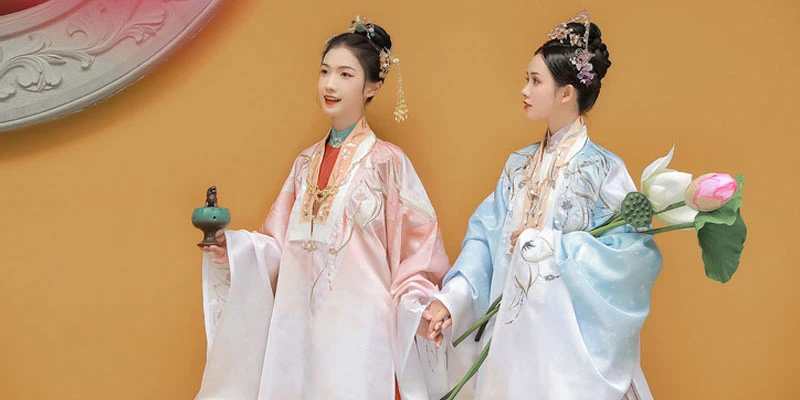
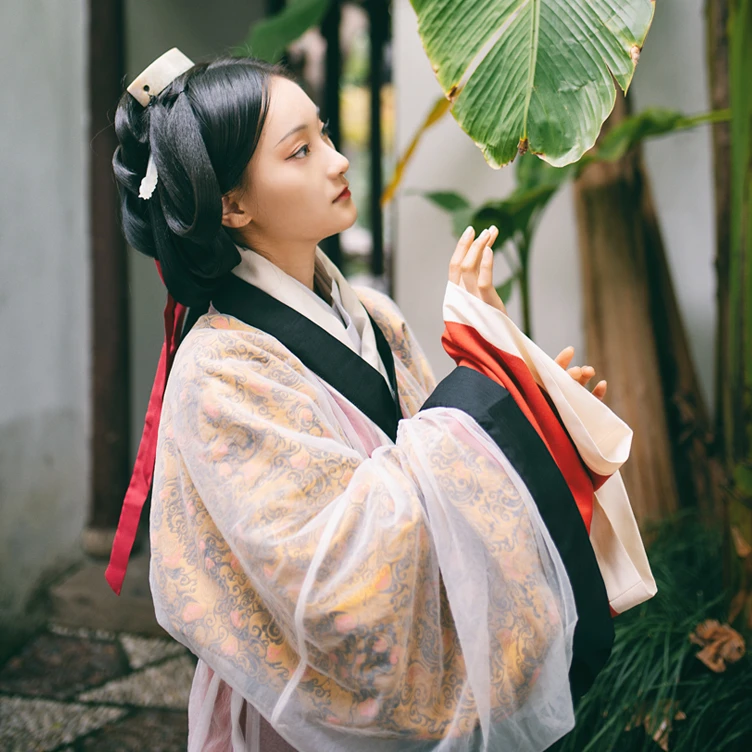
In modern hanfu revival, the Quju has been reconstructed from archaeological evidence. Contemporary versions come in double-wrap and triple-wrap styles, worn with an inner robe and skirt beneath. Key fit rules: a fabric belt (not a stiff waistband) should secure the wrap; the collar trim should contrast with the main fabric; and the”three-layer collar” effect should come from wearing multiple garments, not three seams on one collar.