In 2026, the qipao haute couture industry is undergoing a structural transformation from traditional garment tailoring to Eastern cultural luxury. According to industry research and the 2025–2026 Chinese-Style Apparel Consumption Trend Report released by the China National Textile and Apparel Council, the high-end qipao customization market is growing at an average annual rate of 18.7%, driven by three core forces: ICH craftsmanship, personalized haute couture, and celebrity-endorsed styles.
Handcraft Demand Rises from 32% to 71%
Data shows that consumer demand for fully handmade qipao has surged from approximately 32% a few years ago to 71%. Craftsmanship quality (85.6%), fabric quality (79.3%), and design uniqueness (74.1%) rank as the top three decision factors for qipao customization. Consumers are shifting from fast fashion to a deeper appreciation for cultural substance, artisan skill, and wearing experience. In the high-end qipao customization market, the “ICH + handcraft” category accounts for over 63% of the segment.
The Yangtze River Delta region concentrates approximately 62% of China’s qipao haute couture studios, with Suzhou, Shanghai, and Hangzhou forming the core innovation hubs. At the top of the pyramid, roughly 5% of studios capture about 38% of market share, with their core moats built on ICH heritage and brand premium capacity.
Brand Landscape
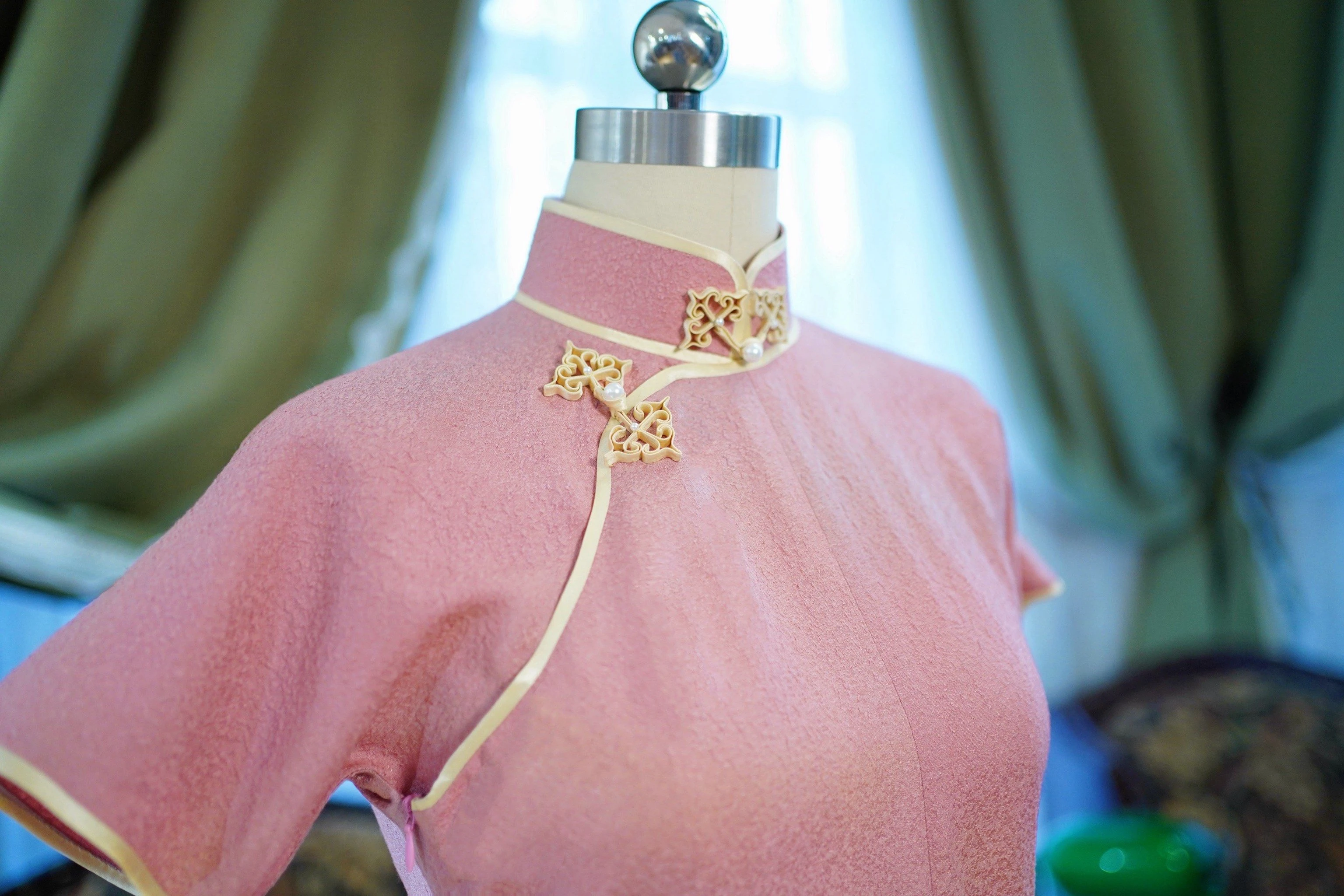
Among qipao haute couture brands, Shanghai’s Manloulan is renowned for its scale in custom tailoring. As a Shanghai municipal ICH protection unit for “Chinese-style dress-making techniques,” it produces approximately 40,000 qipaos annually, one-third of which are high-end custom pieces, serving clients including Maye Musk and actress Huang Yi. Shanghai’s Longfeng Qipao, founded in 1936, is famous for its handmade Pankou (Chinese knot buttons) and full-edge piping, with haute couture prices ranging from 15,000 to 100,000 yuan. Beijing’s Ruifuxiang, tracing its roots to 1862, is a time-honored Chinese brand whose handcrafting techniques were recognized as an ICH item in 2007.
Suzhou’s haute couture brands are particularly noteworthy. The Shiquan Street district has emerged as a high-end qipao hub, home to brands like Jinjiandao, whose artisan teams — led by ICH inheritors — insist on full handmade production with a craftsmanship pass rate of 99.8%. Its core clients include Gree Electric chairman Dong Mingzhu, guqin master Fang Jinlong, and renowned actor Li Yugang. The brand implements a “one order, one code” tracing system for each garment, and its handmade Pankou have been lab-tested to withstand over 12 N of tension, exceeding national standards.
Industry Standards Upgrade: Suzhou Releases Handmade Qipao Craft Specification
In 2026, the Suzhou Market Supervision Administration, in collaboration with the Suzhou Arts and Crafts Industry Association, released the Suzhou-Style Qipao Handmade Craft Specification (Standard No. T/SZGM 2026-001). This is the first standardization document to quantify key parameters such as Su embroidery stitch density, handmade Pankou tensile strength, and three-dimensional tailoring tolerances, marking the qipao haute couture industry’s entry into a standardized development phase.
Neo-Chinese qipao, as an important branch of this market, has surpassed 80 billion yuan in market size with an 18.7% compound annual growth rate. High-end custom qipaos featuring ICH craft elements have seen average per-unit prices rise 23% annually. Product lines now span private haute couture qipaos, high-end evening gowns, and Chinese-style wedding dresses, covering scenarios from daily commuting to grand ceremonies.