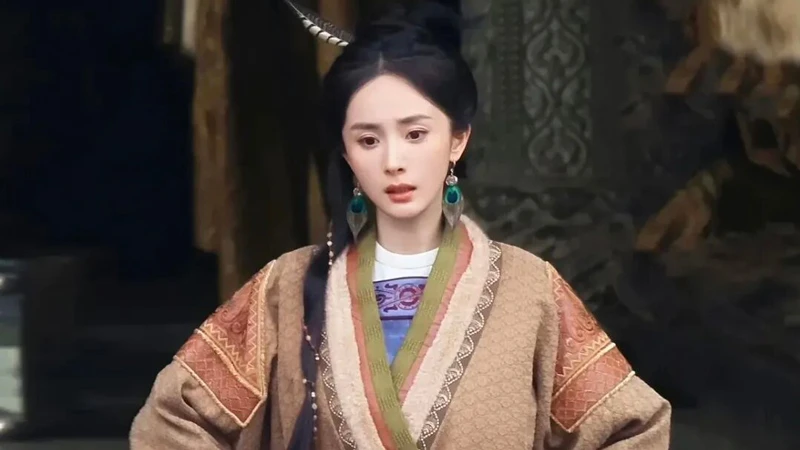
What Does That Feather in Yang Mi’s Hair Really Mean? – You’ve seen the leaked set photos. The flowing robes, the braided hair, and then that unexpected splash of wild plumage slanting from her bun. It’s not a fashion whim. In the upcoming historical drama Jiangshan Datong (江山大同), the feather is a quiet thunderclap. It speaks of steppe warriors, raw courage, and a empress who once had to bridge two worlds. Forget decorative frills. This single feather tells you who she was before the crown.
Steppe Honor
Among the ancient Xiong Nu (匈奴) and Xian Bei (鲜卑) tribes of the northern grasslands, a feather was never a mere accessory. It was a death-defying trophy. A young warrior could only earn the right to wear one by hunting a fierce eagle alone or by returning from a clan battle with clear proof of valor. The plume on the headdress announced to every passerby: I have bled for my people. Unlike the rigid court rituals of the Central Plains, this was a living custom born from a harsh environment where survival depended on constant vigilance against beasts and neighboring tribes.
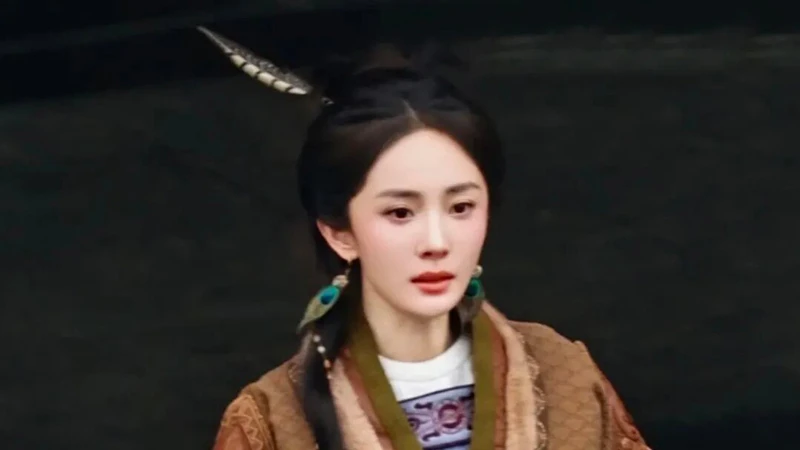
In the Xian Bei tradition, there were no official decrees about who could wear feathers. The rule was simpler: you proved yourself, you wore it. It was a proud, transparent boast – the steppe equivalent of a medal pinned to your chest. When two riders met on the endless grass, one glance at the other’s headdress told a whole story of hunts and battles. That’s the culture Yang Mi’s character, the young Empress Dowager Feng (冯太后), steps into. Though born Han Chinese, she lived among the Xian Bei after they moved south to establish the Northern Wei dynasty. Her feather is not vanity; it’s a gesture of respect.
The prop team chose a short, stiff feather with natural stripes – a deliberate echo of the early Xian Bei style found in the Ping Cheng (平城) period, before their capital fully adopted Han Chinese customs. In the drama, this costume likely appears during Feng’s early years of integration into Xian Bei society. By wearing the steppe’s recognized badge of bravery, she silently says to her adopted tribe: I see your ways. I honor your heroes. That single feather becomes a bridge, softening the distrust between a Han woman and her nomadic subjects.
Threads of Unity
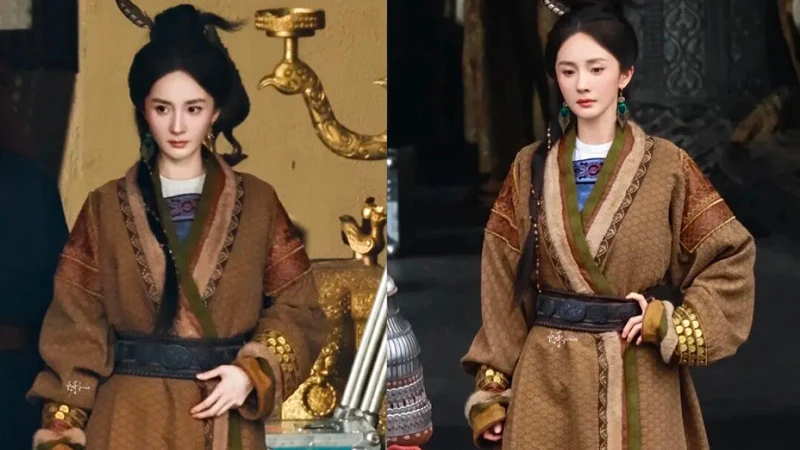
Look past the feather, and the rest of her outfit tells the same story of cultural fusion. Her robe crosses left over right – a detail called left-lapel, which was typical for northern nomads, while Han Chinese wore the right lapel over the left. The outer coat uses a coarse, blended fabric of linen and wool, deliberately textured to imitate the felt and rough-spun garments that steppe herders made from their own livestock. Even the dark edging along the collar follows the hardy, wear-resistant hemming of traditional Xian Bei felt robes – practical for a freezing northern winter and days spent on horseback.
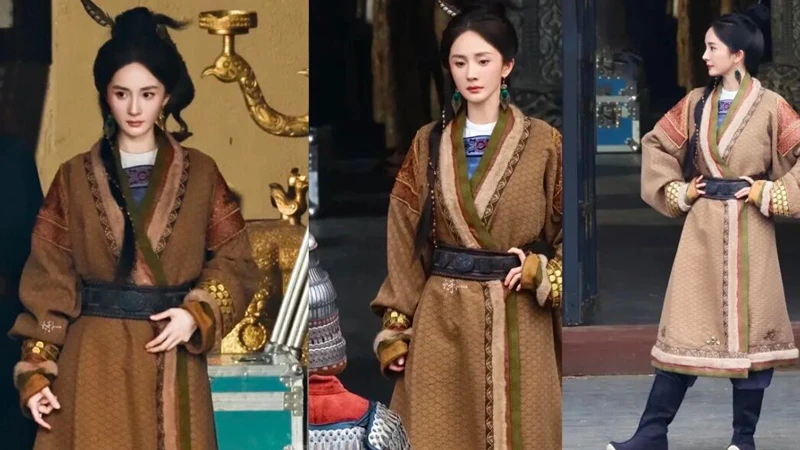
Beneath it, she wears a blue-patterned chest covering decorated with linked-diamond motifs and thunder-cloud patterns. These designs were originally Han Chinese, but the Xian Bei absorbed and reworked them during their gradual move south. The result is a living artifact: a garment that keeps the raw, functional base of nomadic life while weaving in the refined aesthetics of the Central Plains. Her braided hair is threaded with colorful stone beads and turquoise earrings – again, not random decoration. Among steppe peoples, both men and women who had proven their bravery would wear bone beads or turquoise as a matching set with their honor feather.
Her face wears almost no makeup – a subtle but powerful choice. The pale, clean look fits Feng’s biography: a woman who survived court intrigue, war, and the challenge of ruling a multi-ethnic empire. She had no need for heavy powder or rouge. The feather’s symbolism even influenced Han military tradition. During the Qin and Han dynasties, generals wore a headdress made from the feathers of the He (鹖) bird – a creature known for fighting to the death.
Some historians trace that custom back to King Wuling of Zhao’s “barbarian clothing and mounted archery” reforms. So the feather in Yang Mi’s hair is not a strange exotic detail. It is a thread that ties the Xian Bei’s open grasslands to the Chinese warrior’s code. This costume, bold and strangely romantic, is the drama’s whole theme in miniature: two civilizations, one garment. Would you wear such a proud, wild badge yourself?