What Was the Real Purpose of the snuff bottle? A Tiny Vessel That Captured an Empire’s Soul
To understand the snuff bottle, one must first understand what it was designed to hold: snuff. Imported from the West around the late Ming dynasty’s Wanli (万历) era, powdered tobacco quickly became more than a habit in China. It evolved into a ritual, a social currency, and eventually, a catalyst for one of the most exquisite art forms in history.
Unlike a cigarette, snuff was a finely ground powder, often blended with precious herbs like musk and borneol. It was a sensory experience meant to clear the mind, not just the lungs. Yet, while the snuff itself would disappear in a fleeting puff, the vessel that contained it—the snuff bottle—was destined for permanence, transformed from a simple container into a profound symbol of status, artistry, and personal identity.
A World in the Palm of Your Hand
For the Qing dynasty elite, the snuff bottle was an essential daily companion, valued for both its physical utility and its role in a complex social code. The act of taking snuff was believed to have tangible health benefits. The The Dream of Red Mansions (红楼梦), a classic novel from the 18th century, illustrates this perfectly: when the character Aroma falls ill with a cold, Jia Baoyu (贾宝玉) immediately instructs someone to fetch snuff, knowing that a few sharp sneezes would clear her blocked sinuses. Historical records, such as the Qing dynasty’s Supplement to the Compendium of Materia Medica (本草纲目拾遗), confirm this, noting its efficacy in relieving headaches and reviving the senses.
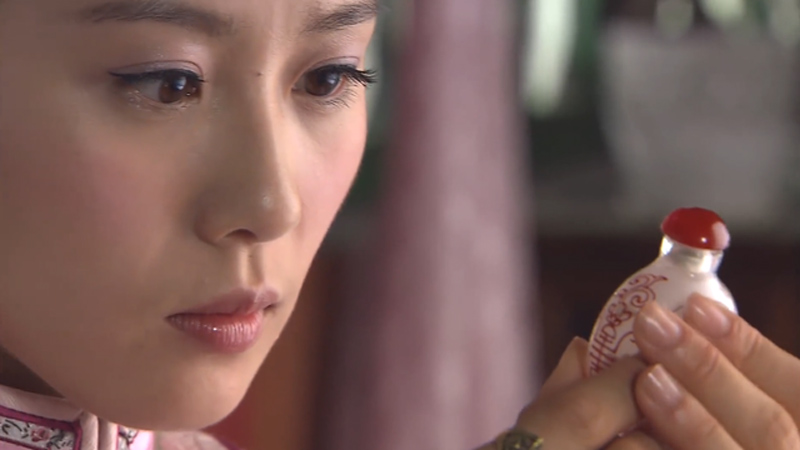
Beyond its medicinal role, the snuff bottle was a cornerstone of etiquette. Its use was governed by unspoken rules of respect. When offered, it was presented with both hands; a guest would take a small amount on their fingertip. Swapping bottles was a sign of mutual respect, with the expectation of a pristine return. For the Mongol nobles within the empire, a beautifully crafted bottle worn at the waist was a direct marker of rank and prestige.
The greeting itself was a ritual: friends would exchange bottles with a bow, while a younger person would kneel on one knee to receive a bottle from an elder, returning it with the same profound deference. Giving a snuff bottle as a gift, given the precious materials like jade or agate from which it was often carved, was the highest form of personal regard.
The Emperor’s New Fashion
The snuff bottle’s transformation from a practical object into a collectible art form was largely driven by the imperial court. The earliest imported snuff came in plain glass jars, but Chinese artisans saw a blank canvas. The shape evolved from a simple box to the iconic bottle form, with a graceful body and a small, stoppered top, a design that was both ergonomic and aesthetically pleasing. The Kangxi (康熙) Emperor, a great patron of the arts, took a personal interest. He established workshops within the Forbidden City, employing Western artisans skilled in glassmaking and enameling to fuse their techniques with traditional Chinese aesthetics.
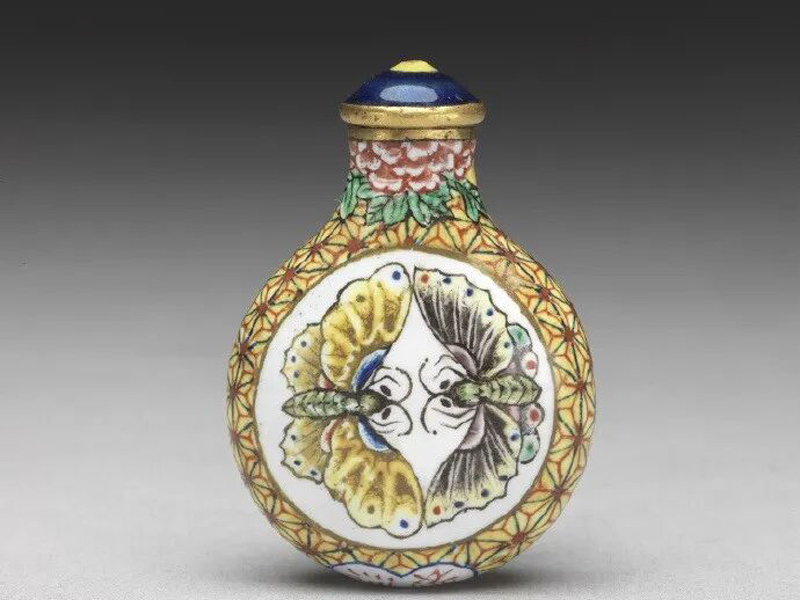
This imperial endorsement turned the snuff bottle into a fashionable obsession. By the time of the Qianlong (乾隆) Emperor, its artistry reached its zenith. The emperor’s own refined taste drove innovation; craftsmen experimented with an astonishing array of forms beyond the classic flattened oval, creating bottles shaped like gourds, purses, and flower petals.
The palette shifted, favoring the vibrant, opaque colors of fencai (粉彩) enamels over the more restrained blue-and-white porcelain. It was no longer just an accessory; it was a statement of one’s aesthetic sensibility. Later, during the Xianfeng (咸丰) and Tongzhi (同治) reigns, tastes shifted towards the lighter, more delicate beauty of glass and porcelain, reflecting a changing era but never diminishing the object’s central role in elite culture.
Art Without Limits
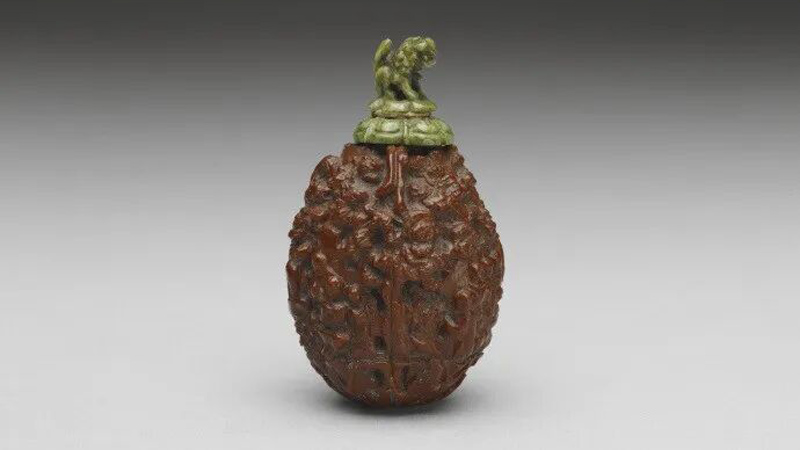
The true genius of the snuff bottle lies in its ability to serve as a microcosm of Chinese artistry. In its creation, almost every known decorative technique was employed on a minuscule scale. Master carvers would take a single piece of precious gemstone—jade, crystal, coral, or agate—and transform it into a vessel, letting the stone’s natural colors and veins guide the design. Others would apply layers of carved lacquer, performing intricate high-relief work on a surface no larger than a matchbox. The glass-bodied bottles, decorated with vibrant falangcai (珐琅彩) enamels, achieved a breathtaking interplay of transparency and brilliant color, a testament to the technical skill perfected in the imperial ateliers.
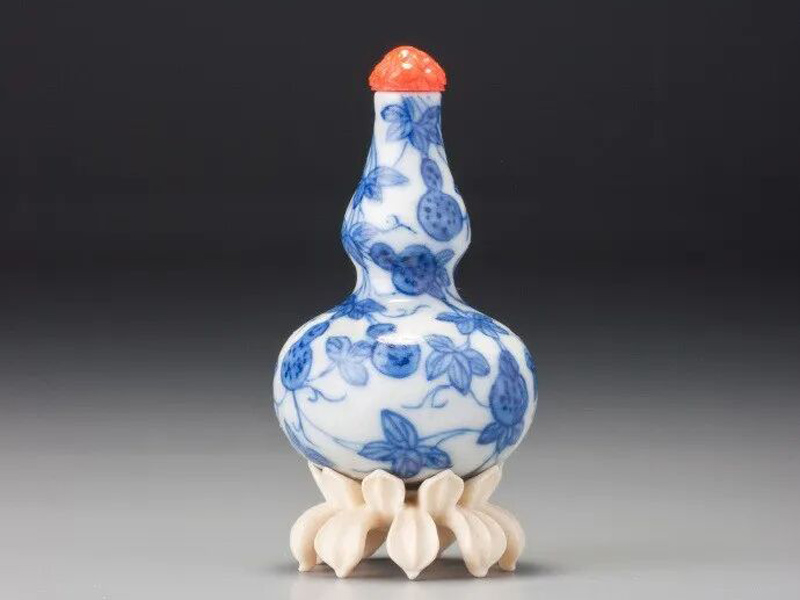
Perhaps the most astonishing innovation is inside painting, a technique unique to China. Using a specialized, bent bamboo brush, an artist would paint a scene in reverse on the interior wall of a bottle made from crystal or glass. To make the surface accept the ink, the inside of the bottle first had to be abraded with a mixture of grit and water, a laborious process in itself. The resulting images—landscapes, figures, calligraphy—are masterful, demonstrating a level of control and precision that feels almost supernatural.
Praised as capturing a thousand miles of scenery within a single square inch, these bottles are a stunning synthesis of painting, calligraphy, and micro-engineering. While the snuff itself has faded from common use, the bottle remains—a cherished collectible, a museum treasure, and a lasting testament to an era that elevated a simple accessory into an enduring work of art.
