
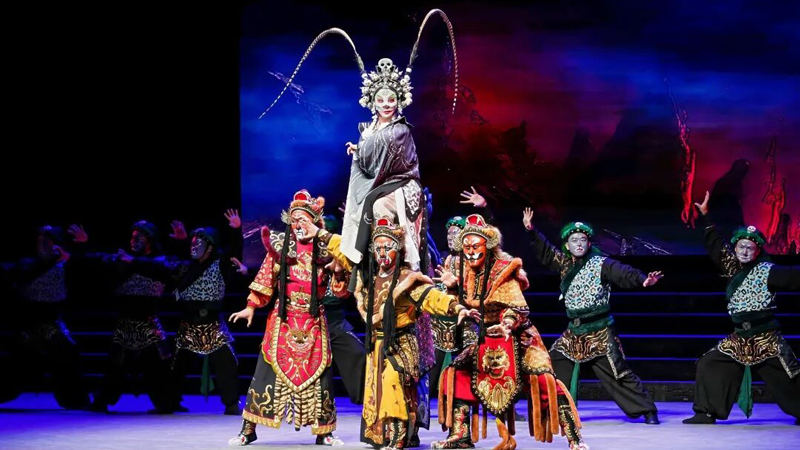
Wu Opera (婺剧) is about to do something that most people would never expect from a 500-year-old tradition: it will make you forget you’re watching a stage at all. In July 2026, the ensemble from Lan Xi (兰溪) is bringing its explosive production of Three Times Beating the White Bone Demon (三打白骨精) to the Quanzhou Grand Theater. And if the online buzz—which has already surpassed 100 million views—is any indication, this is not your grandparents’ opera. It’s a high-octane spectacle where ancient martial arts meet drone technology, and where a villain can transform from a delicate maiden to a skeletal wraith in the time it takes to blink.
Performance Time:
Saturday, July 4th, 2026 at 19:30
Venue:
Quanzhou Grand Theatre
The Shape-Shifting Art of Villainy
The performance’s most talked-about moment belongs to the antagonist. In a sequence lasting mere seconds, the actress playing the White Bone Demon undergoes a transformation so fluid it borders on sorcery. She sheds three distinct faces in rapid succession, her ornate robes dissolving into stark white burial clothes. It is not merely a magic trick; it is a visual deconstruction of the creature’s nature. The audience sees the entity peel away the layers of “flesh” and “muscle” to reveal the bare skeleton underneath. This single moment encapsulates the character’s ability to shift between human, monster, and spirit, leaving viewers with an image that defines the show’s aesthetic: a perfect blend of horror and artistry that feels less like theater and more like a live-action special effect.
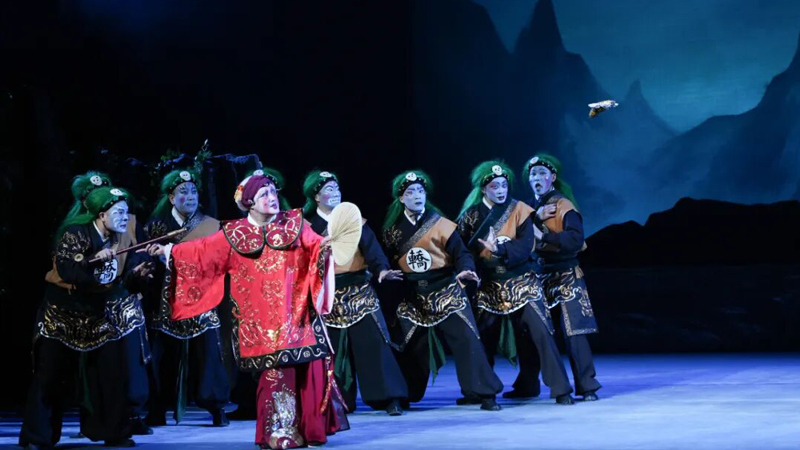
But this is just the headline act in a performance defined by physical endurance. Three Times Beating the White Bone Demon is a Wu Opera piece that demands its cast be equal parts vocalist, acrobat, and martial artist. The stage becomes a blur of motion, packed with somersaults off high platforms, synchronized tumbling runs, and the intense, percussive rhythm of face-changing. The performers do not simply act out a fight; they engage in a full-contact athletic display that pushes the boundaries of human agility. It is this relentless energy, combined with the raw emotional stakes of the story, that has earned the production the top government award for stage art, the Wenhua (文华) Award, cementing its status as a modern classic born from an ancient form.
When Tradition Meets a Drone
While the acrobatics honor the past, the production’s most surprising innovation looks to the future. In a daring break from convention, the creative team replaced the traditional marionette strings used to depict Sun Wukong’s (孙悟空) spy—the “Little Bee”—with a custom-built drone. The small machine, clad in a costume of pearl cotton and gauze, buzzes over the heads of the audience. Its natural humming sound becomes an unintentional but perfect audio effect, creating an immersive environment that feels startlingly real. For a story centered on a monkey king who can transform into insects, the use of a drone feels less like a gimmick and more like the logical, thrilling evolution of stagecraft.
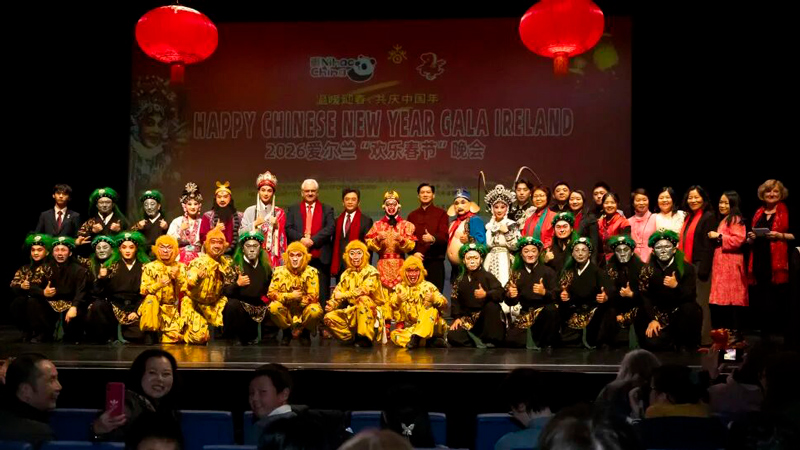
Technology further infiltrates the narrative through light and special effects. The protective circle that Sun Wukong draws around his master, Tang Seng (唐僧), is rendered through precise beams of light, materializing a sacred barrier that the actors visibly react to. Similarly, the explosive puffs of “bone smoke” that signify the demon’s defeat are achieved through synchronized pyrotechnics and lighting cues. These elements create a sensory experience that traditional theatergoers might find unexpected, yet they serve the story perfectly. They allow a modern audience to visualize the supernatural elements of the classic Journey to the West (西游记) tale in a way that resonates with contemporary cinematic language, making the myth feel fresh and immediate.
The Music of Six Histories
To understand the depth behind the spectacle, one must look at the vehicle itself. Wu Opera, also historically known as Jinhua Opera (金华戏), is not a single art form but a confluence of six distinct musical styles. It is a living museum of Chinese performance. The oldest strands, Gao Qiang (高腔), date back over 500 years to the Ming Dynasty, while Kun Qu (昆曲), Luan Tan (乱弹), and Hui Xi (徽戏) matured during the mid-Qing period. By the late 19th century, local storytelling traditions like Tan Huang (滩簧) and Shi Diao (时调) were added to the repertoire. This unique synthesis means a single troupe can command a vast emotional and sonic range, shifting from the elegant, poetic movements of one style to the raw, percussive power of another within the same performance.
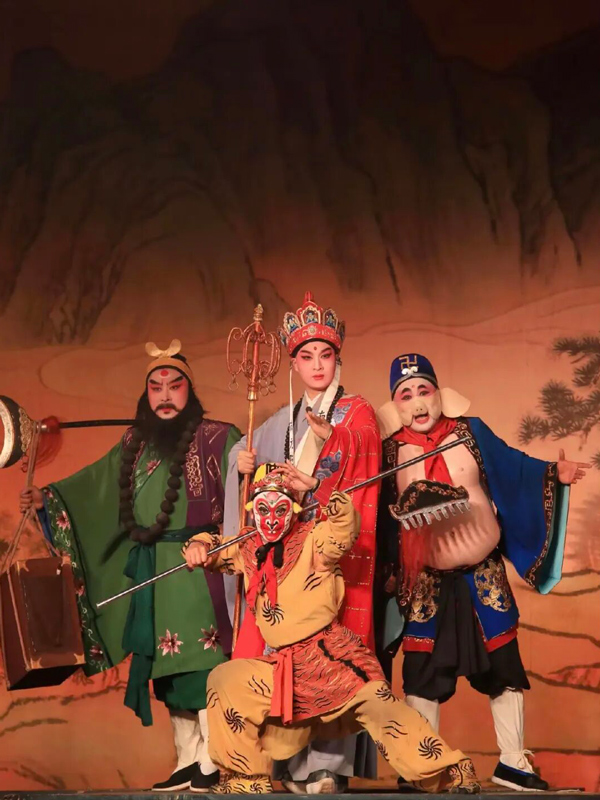
This rich musical foundation underpins the narrative of Three Times Beating the White Bone Demon. The story follows the classic conflict: the monk Tang Seng, unable to see through the demon’s disguises, banishes his most loyal protector, Sun Wukong, only to be immediately captured. It is a tale of deception, loyalty, and redemption. In this production, the rescue sequence becomes a tour de force, utilizing the full range of theWu Opera orchestra and the actors’ physical prowess. When the Monkey King returns to save his master, the stage erupts in a final, cathartic battle. The drone, the acrobatics, the shifting faces—they all converge to tell a story that has captivated audiences for centuries, proving that even with drones in the air, the heart of the drama remains fundamentally, and thrillingly, human.
