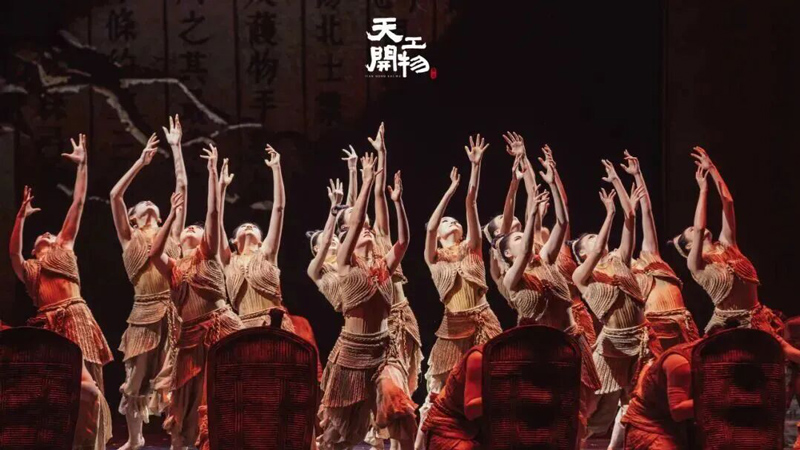
Song Yingxing (宋应星) and his masterpiece Tiangong Kaiwu (天工开物) were once nearly erased from his homeland’s official records. Yet this 17th-century encyclopedia of technology quietly crossed oceans, ignited industrial movements in Japan, shaped scholarship in Korea, and shattered translation records in Europe. Now, in the summer of 2026, this forgotten legacy returns to Huizhou (惠州) not as a dusty text, but as a breathtaking dance spectacle. Can a modern theater production truly resurrect the soul of a work that changed the world from the shadows of history?
Performance Time:
June 26-27, 2026
Venue:
Huizhou Culture and Art Center·Opera House
The Untold Story of a Lost Chinese Classic
When Tiangong Kaiwu was first published in 1637, it was the world’s first systematic documentation of Chinese agricultural and industrial technology. It detailed everything from planting rice to smelting iron, from papermaking to shipbuilding. Yet within decades, the book disappeared from its country of origin. The History of Ming (明史) ignored it. The imperial Siku Quanshu (四库全书) library refused to include it. It was as if the work had never existed. But while it sank into obscurity at home, it began a remarkable journey abroad that would redefine how the world saw Chinese science.
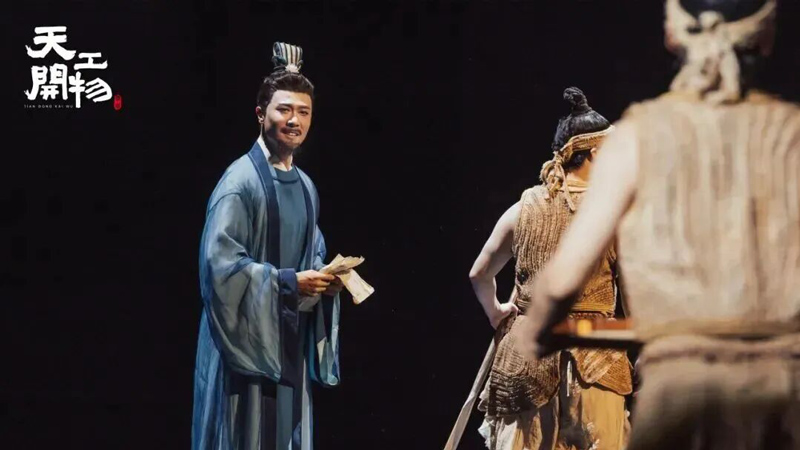
By the late 17th century, copies had reached Japan, where scholars were electrified. They coined a new field—“Kaibutsu no Gaku” (the study of opening things)—and the Japanese government adopted the book’s principles as a foundation for its industrialization policies. In 18th-century Korea, it became essential reading for the progressive Silhak (practical learning) movement, with intellectuals quoting it widely to advocate for national reform. It was a case of a native treasure circumnavigating the globe while its homeland remained unaware.
Europe’s encounter with the text was even more dramatic. In 1830, partial French translations sparked immediate fascination. Over the following decade, the work appeared in Italian, German, English, Russian, Greek, and Arabic—seven languages in less than ten years. It broke every existing record for Chinese-to-Western translation. Darwin himself cited it with admiration. Joseph Needham later called its author “the Diderot of China.” A book that couldn’t find a place in its own country’s imperial library had become a global sensation, forcing the Western world to confront the depth of China’s technological heritage.
The Audacious Stage
Director Lu Chuan (陆川) faced an unusual challenge when he set out to adapt this story for the stage. Tiangong Kaiwu isn’t a tale of emperors or warriors. It’s a book about tools, crops, kilns, and the calloused hands that shaped them. To translate this material into dance, his creative team—including stage designer Luo Yazhuo (罗亚卓) and multimedia artist Bao Erwen (包尔温)—developed what they call the “Ming Dynasty Aesthetic.” It’s built on three principles: grandness, simplicity, and ingenuity. No ornate palaces. No flowing silk robes. Instead, the stage becomes a landscape of raw labor.
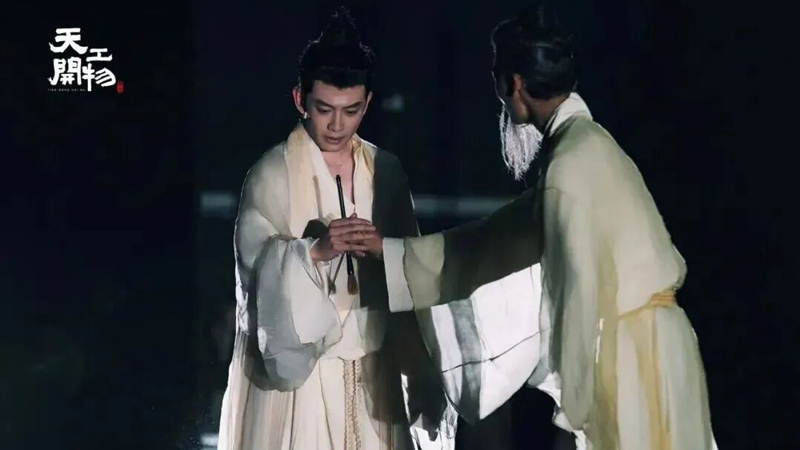
Bao’s multimedia work uses extreme magnification to force the audience into uncomfortable intimacy with the physicality of work. A single foot, muscular and grounded, fills the entire backdrop. A hand, weathered with deep creases, moves slowly across the frame. These aren’t decorative elements. They are the subjects themselves. Through them, viewers encounter a man—the author Song Yingxing—who spent years personally practicing every craft he documented, not as a detached scholar, but as someone who believed that knowledge had to be felt in the body before it could be written down.
The effect is visceral. When you see a forearm straining against a bellows or a pair of legs braced in a rice paddy, you’re not observing history from a comfortable distance. You’re experiencing the accumulated fatigue of generations. The aesthetic choices here reject the typical romanticism of historical productions. There’s no gloss, no idealized beauty. What emerges instead is a portrait of human persistence, rendered in sweat and sinew, that feels startlingly contemporary in its physical honesty.
When a Dance Sheds Its Skin
Traditional dance purists might expect a production like this to rely solely on choreography. But Tiangong Kaiwu the performance operates more like a hybrid creature. Music, lighting, and stagecraft don’t merely support the dancing—they’ve integrated so deeply into the storytelling that the dance itself has transformed. The soundscape alone marks a radical departure. Listen closely, and you’ll hear iron being hammered, bellows pumping air, wheat stalks rustling in wind, molten metal pouring into molds, and field laborers chanting rhythmic work songs.
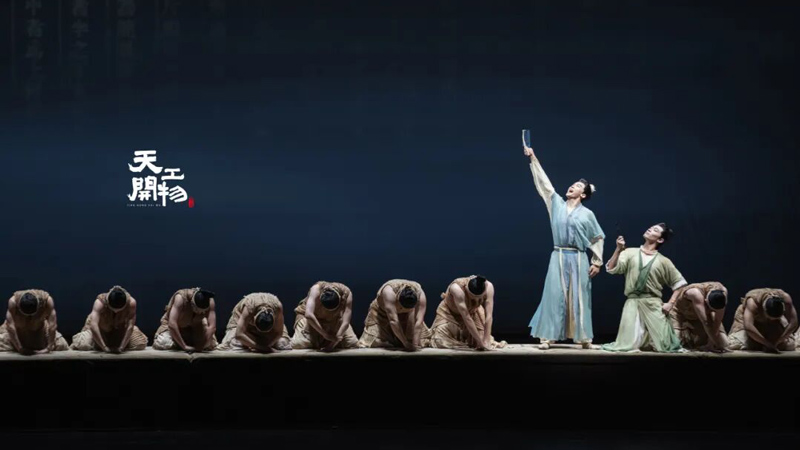
These aren’t sound effects layered on after the fact. They’re woven into the musical composition itself, sometimes serving as rhythm, other times as melody. The result is a dense, textured audio environment that grounds the performance in the sensory reality of pre-industrial labor. When dancers move across the stage, they’re not just performing movements abstractly connected to farming or forging—they’re physically responding to the sounds of those activities. The sound shapes the movement. The movement gives visual form to the sound. It’s a closed loop of sensory experience.
Beyond sound, the production borrows heavily from cinematic language. Director Lu Chuan, known for his films, brings techniques like close-ups, slow motion, and montage to the stage. But crucially, he doesn’t use them as gimmicks. A slow-motion sequence of a threshing movement allows the audience to see the individual motions that normally blur together in real time. A close-up projection of a potter’s hands reveals the precise pressure points that separate skilled work from mere effort. By merging film grammar with live performance, the production achieves a kind of double vision: we see both the timeless human act and its technical precision, both the worker and the work.
