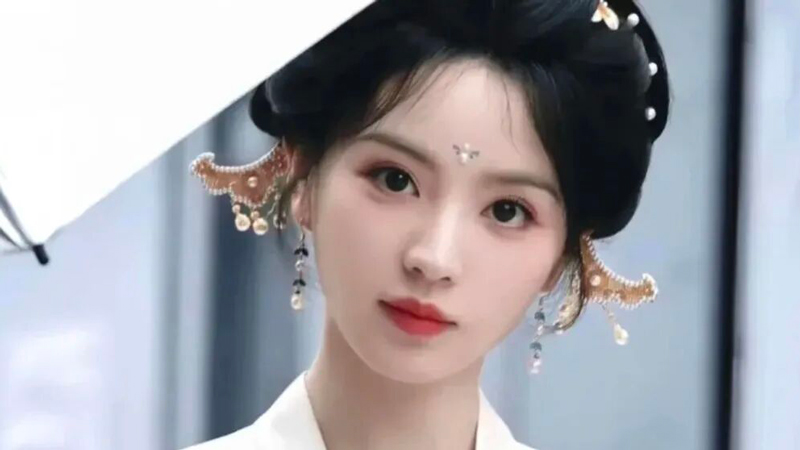
When watching the new historical drama Pursuit of Jade (逐玉), eagle-eyed viewers have been captivated by a specific detail in Tian Xiwei's (田曦薇) costume. During formal scenes, she wears a pair of exquisite, symmetrical ornaments on either side of her head. They frame her face perfectly, adding an undeniable air of solemnity and elegance. But what are these decorative "tails," and do they signify more than just beauty? As it turns out, this striking accessory is a window into the rich, rule-based world of ancient Chinese fashion.
The "Wings" of Nobility: Unpacking Bo Bin (博鬓)
These ornaments are called Bo Bin, a term that directly translates to "broad temple ornaments." They are not merely decorative; historically, they were a formal attire accessory for women of status. In costume design for period pieces like Pursuit of Jade and Flourished Peony (锦绣芳华), Bo Bin are often added to formal buns or crowns. Their design is distinctive: they sweep down past the ears, with ends that often curl upwards, and are adorned with intricate floral decorations, kingfisher feather motifs, or delicate inlays.
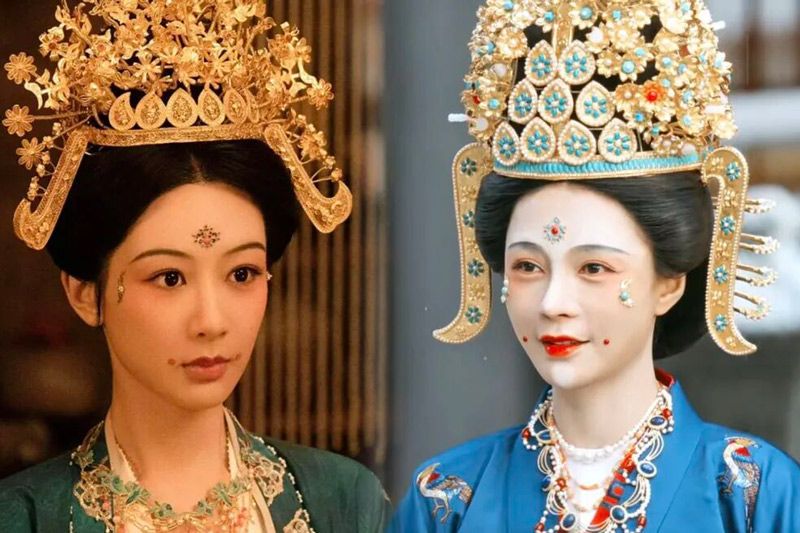
Think of them as the ancient equivalent of ceremonial epaulettes, but for the head. While they look like an integral part of the hair or crown, historical artifacts show they were often separate pieces. Excavations from as early as the Northern Qi dynasty (550-577 CE) have revealed components of what we now identify as Bo Bin, proving their deep roots in Chinese aristocratic culture.
Beyond the Crown: From Solemn Ritual to Daily Elegance
Many might confuse Bo Bin with Bu Yao (步摇), the dangling hairpins that tremble with the wearer's every step. However, their form and function evolved uniquely. During the Sui and Tang dynasties, Bo Bin were rigid accessories attached directly to formal phoenix crowns, serving a purely ceremonial function for empresses and noblewomen . You wore the crown, and the Bo Bin came with it.
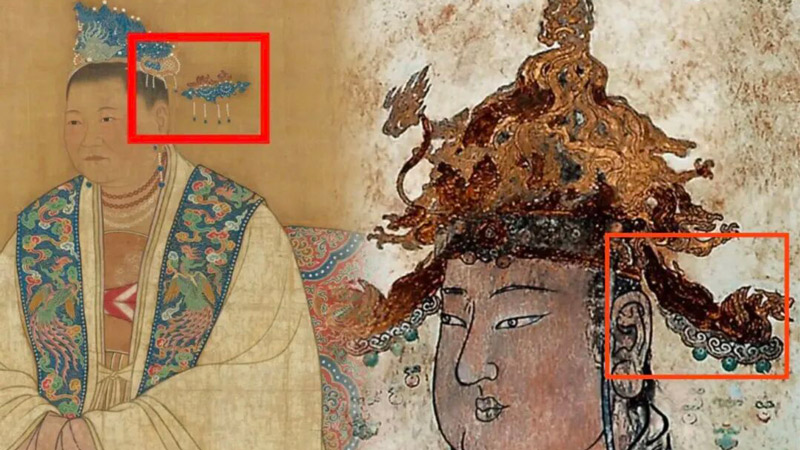
By the Song dynasty, their use diversified. While the full, crown-attached version remained a privilege of the elite for grand ceremonies, a simplified version emerged as individual hairpins or combs for daily wear . These standalone Bo Bin pins featured a supporting stem with an ornate, upward-flaring head, often carved into delicate leaf or flower shapes, sometimes adorned with tiny, dangling pearls. This evolution allowed the aesthetic of the "broad temple ornament" to filter down from the rigid palace ritual to the more accessible elegance of a noblewoman's everyday attire, as seen in paintings of the period.
Decoding Status
The most fascinating aspect of Bo Bin is its role as a social hieroglyph. The number a woman wore was a direct indicator of her rank. In the Tang dynasty, the rule was standardized: the empress and crown princess wore two Bo Bin, with the distinction in status communicated through the number of floral decorations and inlays on their crowns . This system applied to all titled ladies, from the first rank down to the fifth, all wearing two Bo Bin, but with the number of decorative elements decreasing with rank.
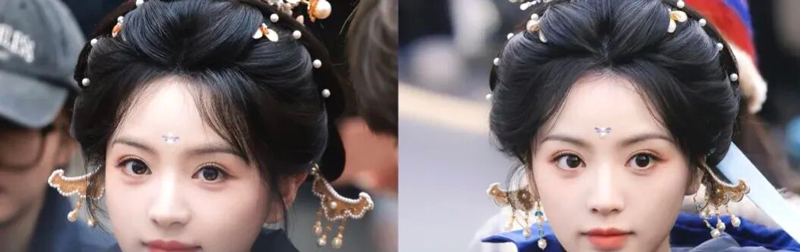
The ultimate symbol of power came in the Ming dynasty. Historical records from the Ming Shi (明史) state explicitly: the empress wore three pairs of Bo Bin, while the crown princess wore only two . This small, symmetrical detail on the head became a clear, visual declaration of the highest authority in the land. So, when Tian Xiwei's character in Pursuit of Jade dons her full ceremonial attire with these ornate "tails," it is more than just a beautiful costume. It's a subtle nod to a complex system where every detail, from the shape to the number, spoke volumes about power, status, and the enduringly refined aesthetic of ancient Chinese style.