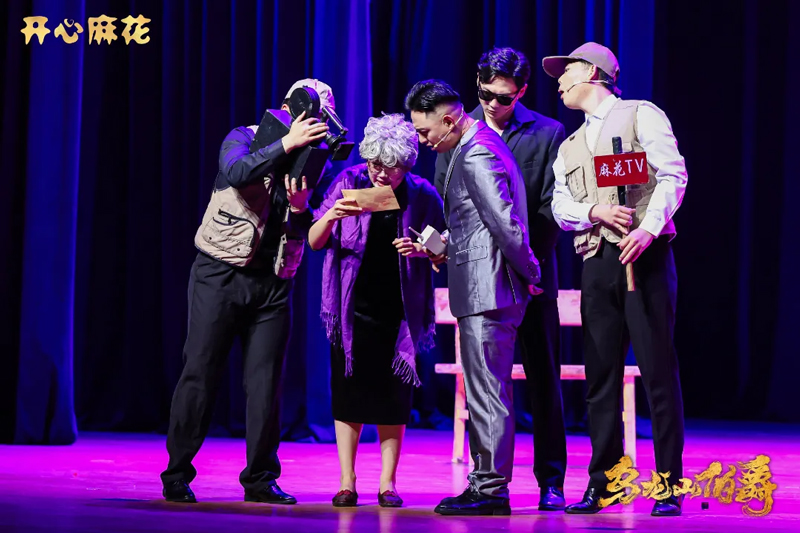
A billion yuan in box office revenue is not just a number; it's a phenomenon. The stage play The Count of Wulong Mountain (乌龙山伯爵) stands as a monumental achievement in modern Chinese theater. Premiering over fifteen years ago, this production by the renowned troupe Happy Mahua (开心麻花) did more than entertain—it redefined commercial success for live performances in China.
With over 4,000 shows across more than 50 cities and frequently running over a dozen companies simultaneously, its reach is unprecedented. For many, it served as the launching pad for stars like Shen Teng (沈腾) and Ma Li (马丽), whose careers skyrocketed afterward. Beyond the statistics, the play offers a specific, potent remedy for modern malaise: relentless, clever, and absurd laughter.
Performance Time:
January 17, 2026 (Saturday) 20:00
Venue:
Huizhou Culture and Art Center
A Farce of Errors
At the heart of the chaos is Xie Xie (谢蟹), a young man with no prospects, no money, and no luck. His life is upended overnight by news of a distant uncle's death and a staggering inheritance. Suddenly, the ultimate fantasy is within reach. However, before he can claim a single yuan, he is mistaken for a criminal during a botched bank robbery.

In a panic, Xie Xie makes a disastrous choice: he pretends to be one of the robbers. This single decision spirals into an uncontrollable series of mishaps. He goes from a hopeful heir to a wanted fugitive, his identity fractured by the situation's sheer absurdity. The narrative masterfully exploits this identity crisis, turning every attempt to clarify the truth into a deeper entanglement.
This is not a simple tale of rags-to-riches triumph. Instead, the audience is taken on a breakneck journey where logic is abandoned at the door. The plot twists are so frequent and outrageous that predicting the next scene becomes part of the fun. The play cleverly satirizes greed, chance, and the fragile nature of social standing, all while maintaining a dizzying comic pace.
Laughter as Therapy
The script's genius lies in its dense, intelligent humor. Gags are woven into the fabric of the dialogue and situation, landing with machine-gun frequency. Memorable lines, like a romantic declaration comparing eyes to "a clear spring," are immediately undercut by crass commercial pitches for cemetery plots, noting that "the dead don't live in graves, that's why the prices are to die for."

Each scene is packed with such moments, drawing from bank queues, church confessions, and even choir practice for comedic gold. The humor feels spontaneous yet precise, a hallmark of Happy Mahua's writing. The effect is immersive and cathartic; for the duration of the show, worldly worries are supplanted by the immediate need to catch your breath between laughs.
This comedic structure also functions like a live-action game of clue. As Xie Xie navigates the criminal underworld, questions multiply. Who planned the heist? Is there a mole among the thieves? What is the real motive of the mysterious Marilyn who appears? The audience becomes an active participant, piecing together the puzzle amidst the laughter.
Stagecraft Sorcery
The visual spectacle of The Count of Wulong Mountain matches its narrative ambition. The set design is a character in itself, transforming seamlessly from a gothic, eerie church to a realistic cemetery lined with crosses. A vibrant, detailed bar set appears, offering a stark contrast to the solemn scenes before it.
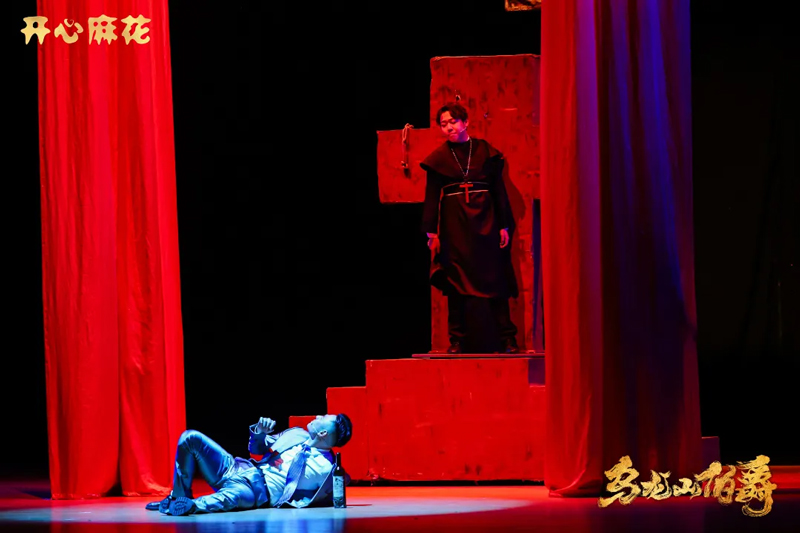
Most impressively, the production incorporates special effects rarely seen in theater, including simulated explosions. These are not mere tricks but integral parts of the storytelling, amplifying the absurdity and danger of Xie Xie's world. The creative team translates cinematic scope onto the stage, ensuring that the visual jokes are as potent as the verbal ones.
This technical prowess supports the actors, who deliver physically demanding and nuanced performances. Their timing is impeccable, selling every ridiculous plot turn and emotional reversal. The combined force of script, performance, and design creates a truly high-energy experience. From the first mistaken identity to the last chaotic reveal, the play is a masterclass in modern comedic theater, proving why it remains a beloved staple after 15 years.
