On summer nights, two bright stars stare at each other across the milky way. One is called Altair, the other Vega. For centuries, the Chinese have looked up and seen not just stars, but a love story—a cowherd and a weaving maiden separated by a celestial river, allowed to meet just once a year. This is the story behind Qixi (七夕), the seventh day of the seventh lunar month. But is this ancient festival really just China’s answer to Valentine’s Day? Look closer, and you will find it is far more complex, and in many ways, far more fascinating.
A Meeting Written in the Stars
The core of Qixi is the romantic legend of The Cowherd and the Weaver Girl (牛郎织女). The story goes that Niulang (牛郎), a humble cowherd, fell in love with Zhinü (织女), a weaving fairy. They married, had children, and were so happy that Zhinü neglected her heavenly duties. This angered the Goddess, who drew a vast river in the sky—the Milky Way—to separate them forever. Moved by their sorrow, magpies formed a bridge across the galaxy once a year, allowing the lovers to reunite. It is a tale of enduring love and the pain of separation, a narrative that has resonated for millennia.
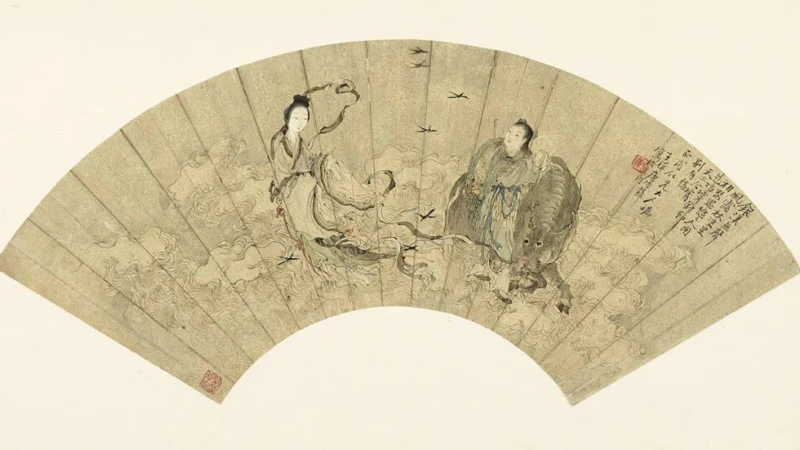
This celestial drama is reflected in the night sky. Vega, the brightest star in the constellation Lyra, sits on one side of the Milky Way. Altair, in the constellation Aquila, sits on the other. Their positioning creates a powerful visual metaphor for longing and reunion. Ancient poets like Qin Guan (秦观) captured this perfectly, writing, “When Autumn’s Golden Wind embraces Dew of Jade, All the love scenes on earth, however many, fade.” He argued that their one annual meeting surpasses the countless unions of ordinary couples who are together daily but lack true spiritual connection.
The story elevated the festival beyond a simple date on the calendar. It gave Qixi its bittersweet emotional core. The night is not just about being together; it is about the beauty of a promised reunion after enduring a long wait. This “once-a-year” meeting feels precious and profound, a far cry from the commercial pressure of modern romance. It is a love story built on the vastness of space and the power of devotion.
A Celebration of Skill and Sisterhood
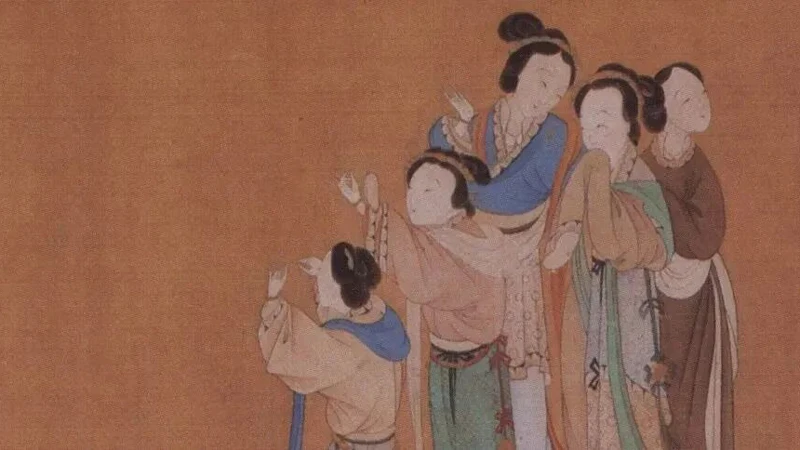
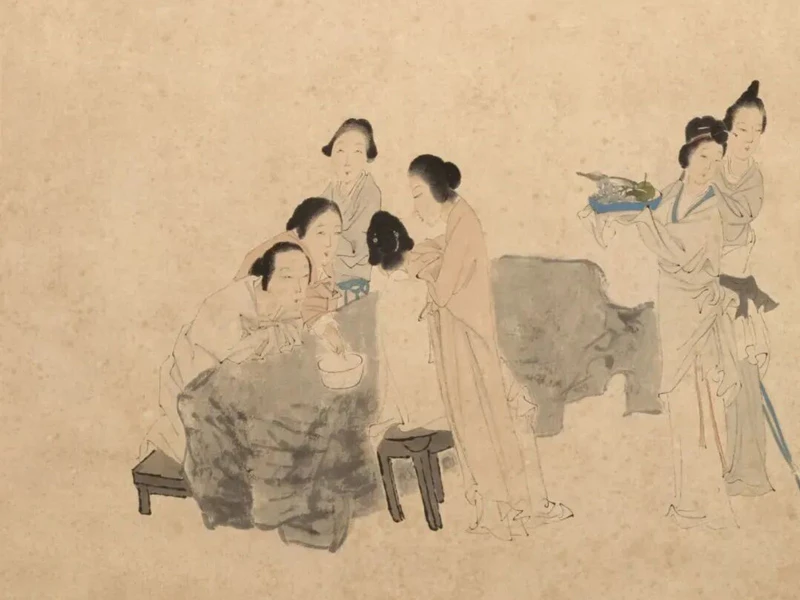
For centuries, Qixi was not primarily known as a lovers’ day. Its original name, Qiqiao (乞巧), means “begging for skills.” It was the most important festival for young women. The connection came from Zhinü herself. In mythology, she was not just a lover; she was the goddess in charge of weaving clouds and heavenly garments. Women on earth looked to her as the ultimate master of needlework and domestic arts.

The festival became a night for women to display their talents and pray for improvement. They performed various rituals to prove their “qiao” (ingenuity and dexterity). One popular game was “Needle-Throwing for Skill.” Under the midsummer sun, a bowl of water was left out until a thin film formed on its surface. Girls would then gently drop a sewing needle onto the water. If the needle floated and its shadow on the bottom of the bowl formed a beautiful shape—like a flower or a bird—she was deemed skillful.
Another tradition was “Spider-Web Divination.” A small spider would be captured and placed in a box overnight. If, by morning, it had woven a perfectly round and dense web, it was a sign that the girl had received Zhinü’s blessing. These weren’t just games; they were moments of shared hope and friendly competition. The courtyard of a home would fill with laughter and anticipation as girls and their mothers gathered to see who had been granted the most “skill.”
The Light That Guided Generations
The choice of Zhinü as the patron goddess of the festival was no accident. It was deeply connected to astronomy and the rhythm of the seasons. In early autumn, just as the weather cooled, the star Vega reaches its highest point in the night sky. For ancient farming communities, this was the signal to start spinning and weaving in preparation for the cold winter ahead. The brightest star was literally guiding the women’s work.
This connection is rooted in even older texts. The Book of Songs (诗经), a collection of ancient poetry, mentions Zhinü but not as a lover. It describes her as a celestial figure who “moves seven times in a day, yet weaves no patterned fabric.” She was a symbol of cosmic order and industry. Over time, this celestial weaver merged with the earthly women who labored at their looms, creating a powerful figure of feminine diligence and creativity.
So, when we look at Qixi today, we see a festival with layers. The romantic story of Niulang and Zhinü gives it its emotional pull. But underneath lies a vibrant tradition of women celebrating their skills, their hopes, and their community. It is a night where the heavens inspired the hands of women on earth. Vega shone down not just on a tragic fairy tale, but on generations of real women, who looked up and saw a reflection of their own cleverness and hard work in the stars.