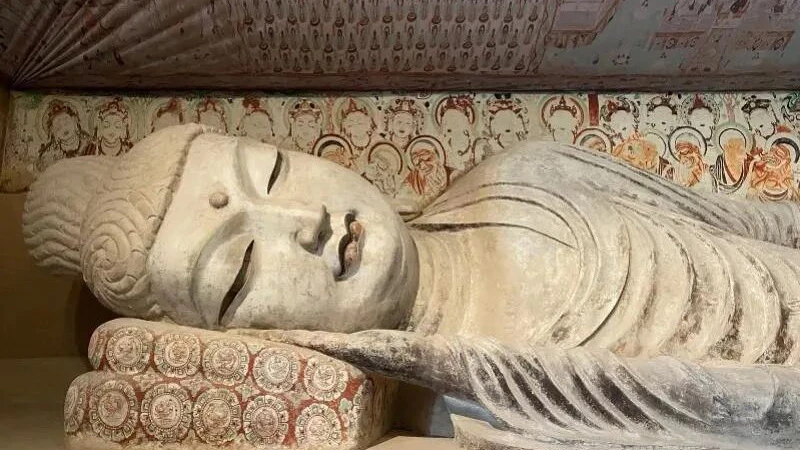
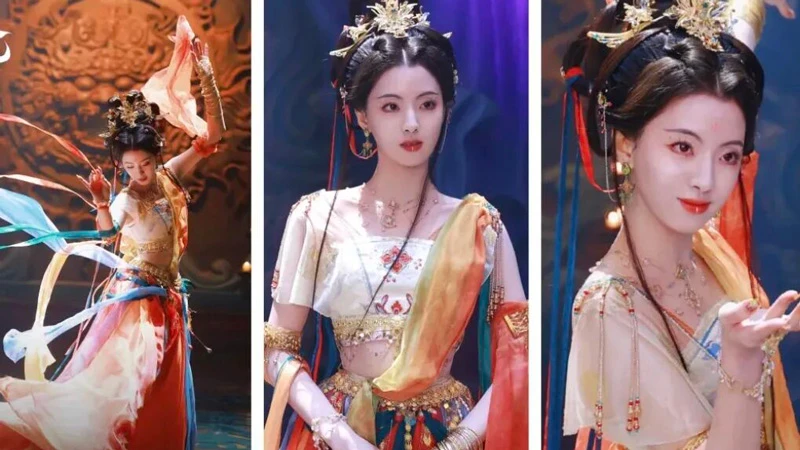
The “curly-haired flying goddess” on this year’s CCTV Spring Festival Gala has sparked a heated debate. While many viewers praised the program Silk Road Melodies (丝路古韵) for its faithful recreation of mural art, others scratched their heads. Why does this celestial being have a head full of curls? Doesn’t she look more like a foreigner than a classic Chinese beauty? The confusion is understandable.
In recent years, the Feitian (飞天) image has been warmly embraced as part of Chinese traditional culture, with her signature tube top and long skirt often cited as a form of ancient Hanfu clothing. But this popular understanding skips a crucial part of her long and fascinating journey from India to the grottoes of Xinjiang and Dunhuang.
The Curly-Haired Mystery
The answer lies in the origins of the image itself. The Feitian we know today was not a native invention of the Central Plains. Her earliest prototype comes from ancient Brahmanism in India. As Buddhism absorbed these celestial spirits, they transformed into gods of music and dance, tasked with scattering flowers and making heavenly music. When this religious art traveled along the Silk Road into China, the Feitian arrived with distinctly foreign features.
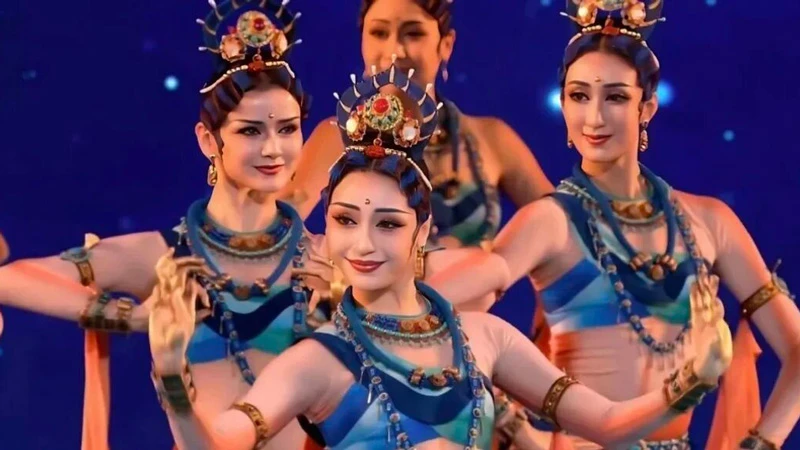
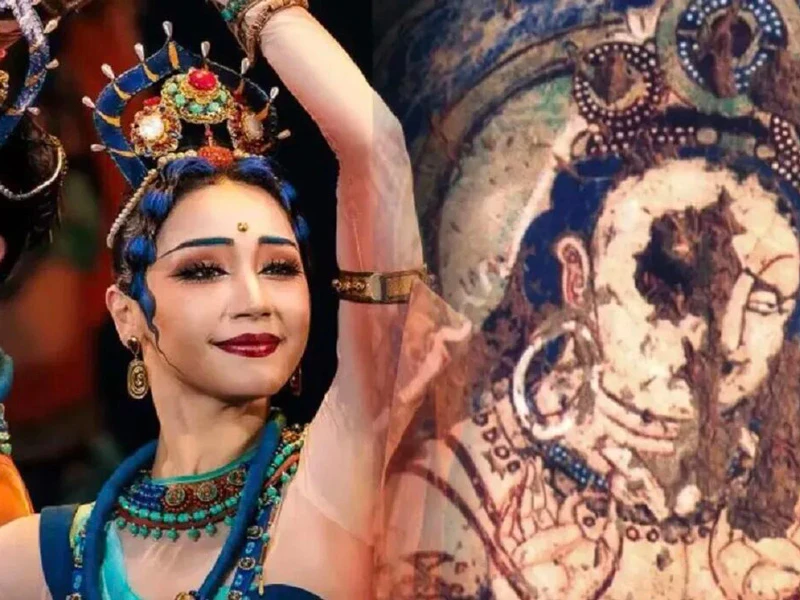
The specific inspiration for the Spring Festival Gala performance was not a Tang Dynasty mural from Dunhuang (敦煌), but a much earlier painting in Cave 38 of the Kizil Grottoes (克孜尔石窟) in Xinjiang. In these caves, the Feitian figures have very clear foreign characteristics, including curly hair at the temples. Their clothing is also a world away from the Han Chinese style of the time. They often wear tight-fitting garments or are simply draped with long scarves, and their lower bodies are wrapped in narrow, pleated “goat-intestine” skirts, a style typical of the Western Regions.
So, the initial wave of Feitian imagery was a direct import, a foreign deity dressed in exotic clothes. She was not meant to represent a human, let alone a Han Chinese woman. This explains the “curly hair” or curly hair that surprised some modern viewers. It is a remnant of her journey from India, through the cultural melting pot of the Silk Road’s Central Asian kingdoms, before she ever arrived at the gates of Dunhuang.
A Gradual Shift to Chinese Style
The great transformation of the Feitian began in earnest during the Northern Wei Dynasty. It was a pivotal period of cultural exchange and integration. A key figure in this change was Dongyang Wang Yuanrong (东阳王元荣), a prince from the Northern Wei capital of Luoyang. When he came to Dunhuang to serve as the governor, he brought with him new artistic styles from the Central Plains that had already been influenced by the ethereal aesthetics of the Southern Dynasties.
Under this influence, the caves at Dunhuang began to change. In places like the famous Cave 285, you can even see Buddhist and Taoist (道教) figures sharing the same sacred space. This was the moment when the foreign deity started to put on Chinese clothes. The Feitian’s curly hair was gradually replaced by elegant Chinese buns and elaborate hairpins. Her wardrobe also underwent a dramatic makeover. The tight, foreign skirt was loosened into a flowing, wide gown decorated with traditional Chinese patterns and borders.
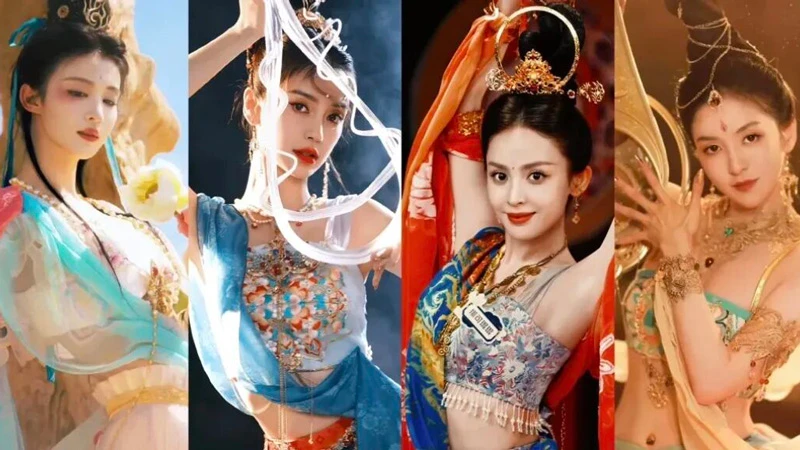
However, it’s important to note that this was still religious art, not a fashion illustration. The core outfit—a tube top, a long scarf, and a skirt—remained. The purpose was still to express the otherworldly grace of a heavenly spirit. The impossibly long scarves that flutter in the air and the flowing ribbons are artistic exaggerations designed to create a sense of floating and spiritual lightness. They were not clothes that any real person in the Tang Dynasty would have worn on the street. The “traditional” look was carefully crafted to serve the Buddhist vision of paradise.
So, Is She ‘Chinese Culture’ Now?
This history brings us back to the question: Is the Feitian part of Chinese culture, and is her dress Hanfu? After centuries of adaptation and localization in Dunhuang, she has undoubtedly become an integral part of China’s artistic and religious heritage. The image that most people recognize today is the product of this long, rich fusion. We can comfortably place her gorgeous, flowing attire within the broader category of “Chinese-style clothing” or “Han-influenced costume,” as it is undeniably traditional in style and context.
There is no need for confusion. The story of the Feitian is a perfect example of how Chinese culture has historically absorbed and transformed outside influences, making them its own. Her evolution from a curly-haired foreign spirit in Kizil to the ethereal beauty with billowing silk in Dunhuang showcases the open and dynamic nature of the ancient Silk Road. The image is not a static artifact but a living record of cultural exchange. So, which version do you prefer—the earlier, more exotic one, or the sinicized beauty of the later Dunhuang murals? Perhaps their real magic lies in the fascinating story they tell together.