
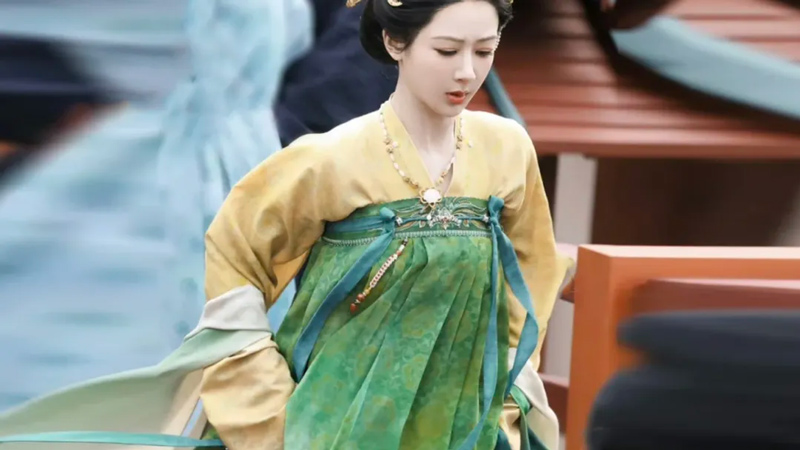
Have you ever had that moment in a beautifully draped dress, only to spend the entire event subtly hiking it back up? For enthusiasts of traditional Chinese attire, the struggle with the Qixiong Qun (齐胸裙, high-chest wrap skirt) is all too real. This ancient garment, while stunning, is infamous for its gravitational defiance. It turns out, this sartorial slippage is not a modern-day woe. Centuries ago, ingenious designers devised a clever solution: the ancient equivalent of the strap dress. This forgotten innovation, witnessed in artifacts from the Northern and Southern Dynasties to the Tang, showcases a timeless pursuit where practicality meets elegance.
A Tang Dynasty Staple
The strap dress became a fashion essential during the Tang Dynasty. A mural in the tomb of Duan Jianbi (段简璧), from the early Tang period, depicts a court lady holding a fan. She wears a patterned Qixiong skirt secured by two clear straps over her shoulders. This visual record from Emperor Gaozong's (唐高宗) reign shows the style's popularity, aligning with the period's preference for slender, graceful silhouettes. The straps provided freedom of movement, transforming the gown from a restrictive garment into one suitable for daily life.
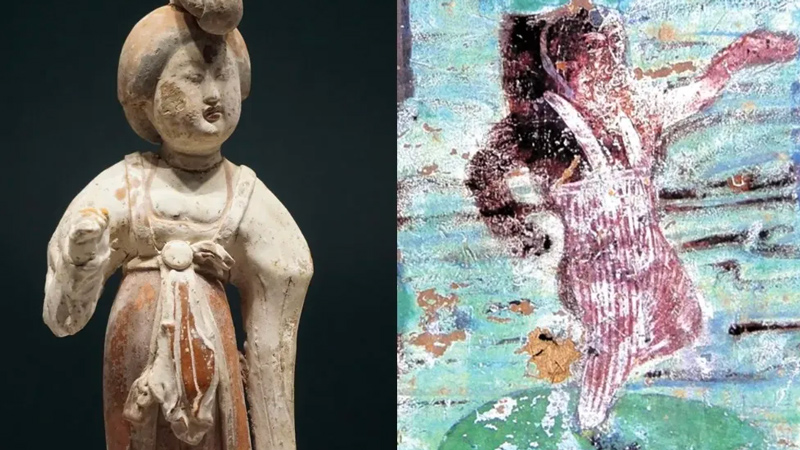
Further evidence comes from grey pottery figurines unearthed from the tomb of Wang Hui in Shanxi. These statues clearly display the strap mechanism, crossing at the back in a V-shape for both security and a flattering line. The design's longevity is proven by its presence into the prosperous Kaiyuan (开元) era of the High Tang. Over time, the straps themselves evolved, becoming narrower and more delicate, often paired with fitted, narrow-sleeved jackets. This refinement points to a mature fashion item adapted for active, elegant living.
Evolution and Variation
The strap dress concept was not confined to the Tang. Later periods saw creative adaptations. From the Liao and Jin (辽金) dynasties, a different style emerged. A set discovered in the Qintala Liao tomb (钦塔拉辽墓) in Inner Mongolia features a slip-on dress with a back vent and adjustable waist ties. Its skirt body uses vertical panels and clever pleating, creating a slimming effect. Scholars debate its construction—some see Han Chinese influence, while others suggest a possible Central Asian "folding-instead-of-cutting" technique using whole cloth.
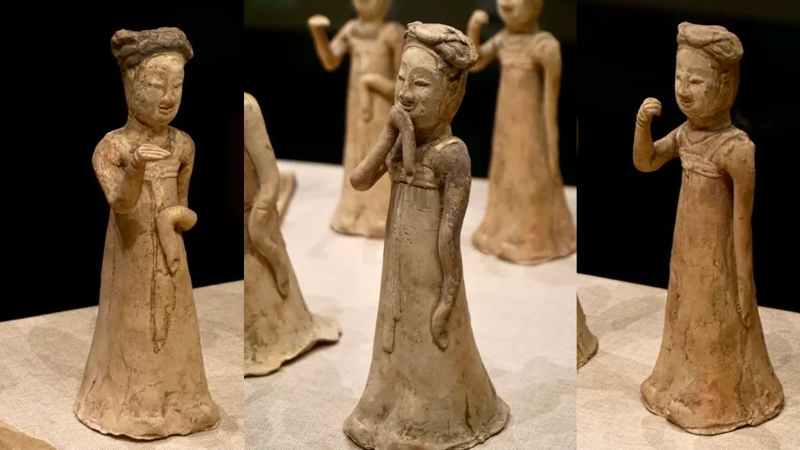
Another example from the Jin Dynasty tomb of the Prince of Qi is assembled from multiple trapezoidal fabric panels, wider at the bottom and narrower at the top. This slip-on style also relied on ties for fastening. These variations demonstrate how the core idea of supportive straps was reinterpreted across cultures and eras, blending utility with distinct aesthetic preferences. The functional need inspired diverse artistic solutions.
From Women to Children
This practical design philosophy extended beyond women's formalwear. A striking example comes from a screen painting titled Playing Chess (弈棋图), unearthed from the Astana tombs in Turpan, Xinjiang. It portrays two Tang-era children at play amidst rocks and grass. They wear what can only be described as ancient dungarees—strap-bearing trousers—paired with bare torsos and red shoes. This image vividly captures an ancient concern for garments that were both charming and mobile, proving that the demand for "play-friendly fashion" was ageless.

Sadly, most physical examples of these ancient strap dresses and overalls have been lost to time, leaving only mural and pottery figurine as evidence. Their scarcity in modern historical television dramas is a missed opportunity for authenticity. Yet, these remnants offer a profound insight. They reveal a people deeply attuned to solving everyday problems with elegant design, continuously tweaking styles to match contemporary tastes. From the court lady's dignified grace to the child's unhindered play, these artifacts are crucial clues to understanding ancient life and aesthetics, reminding us that in fashion, truly clever ideas never fade—they simply await rediscovery.
