Nestled in the hills of Shaoxing (绍兴), Zhejiang, the Song Six Mausoleums (宋六陵) stand as a silent testament to the Southern Song Dynasty (南宋). This sacred ground, the final resting place for emperors and empresses, recently yielded fragments that speak louder than stones. Archaeologists uncovered a trove of broken porcelain, primarily from the renowned Longquan Kiln (龙泉窑). These shards, though incomplete, are now keys unlocking the aesthetic and daily rituals of a royal court from centuries past. They are not merely broken pottery but physical echoes of imperial life, offering a direct link to the artisans who served the throne.
Ceramic Secrets
Handling these fragments reveals immediate tactile and visual qualities. A brilliant, translucent green glaze covers most surfaces, a hue so vibrant it seems to capture a piece of the jade-like ideal cherished by Song scholars. This glaze feels smooth and glassy to the touch, evidence of high-temperature firing mastery. When a shard is turned over, the broken edge exposes the secret beneath: a fine, compact body of gray-white clay. This material is not coarse but incredibly refined, indicating the use of carefully selected and processed raw materials that provided a perfect canvas for the iconic glaze.
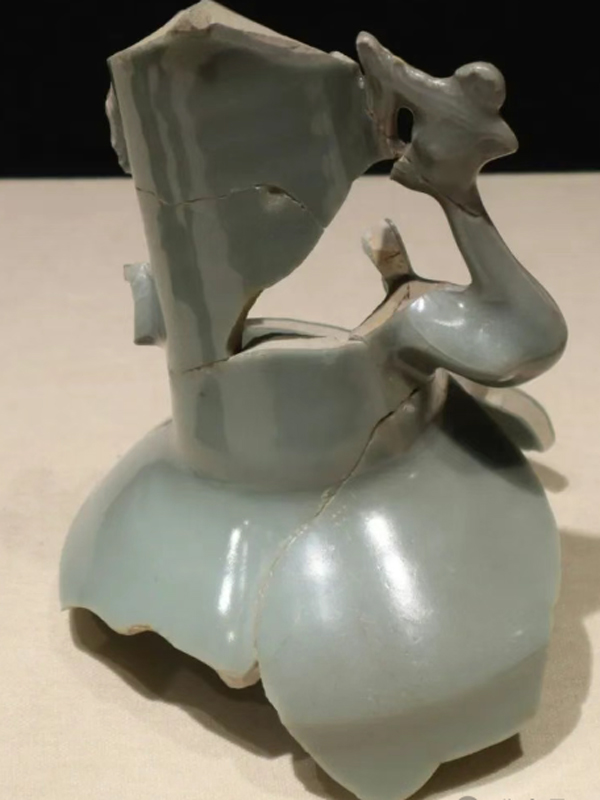
Further examination shows deliberate artistic touches. Some pieces feature raised linear patterns, like a taut string pressed into the clay before firing. On vessels designed with three legs, corresponding vertical ridges appear, often showing a faint white line where the glaze pulled thin during the kiln process. This effect, sometimes called 'clay exposure,' highlights the form and demonstrates the potter's control over their medium. Additionally, the unglazed bottom of a foot ring often displays a distinct reddish-brown color, known as 'iron-spot,' a natural result of iron oxide in the clay reacting to the firing atmosphere.
These characteristics collectively point to an object of superior manufacture. The consistent color, the refined body, and the intentional decorative elements were not accidental. They resulted from standardized, high-level production techniques reserved for the most important patrons. Each detail, from the color saturation to the precision of the lines, was achieved through generations of accumulated skill, perfected to meet the exacting standards of the imperial household.
Forms and Functions
The broken shapes tell us what these objects were. Reconstructing the forms from fragments, we see elegant guan'er ping (贯耳瓶), or tube-ear vases, characterized by their cylindrical necks with tubular handles. There are also remnants of feng'er ping (凤耳瓶), phoenix-ear vases, identified by handles shaped like mythical birds. These vessels were likely used in scholarly settings or ancestral halls for holding scrolls or flowers, blending utility with profound symbolic meaning connected to wisdom and good fortune.
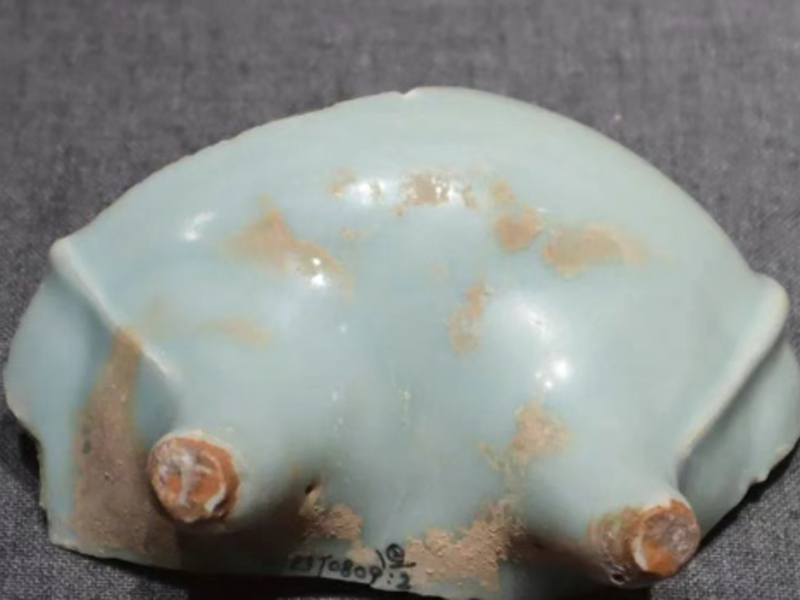
Another common find is the li-style tripod incense burner (鬲式炉). A recovered fragment shows a short, straight neck and a wide, flattened belly, supported by three solid, conical legs. Inside, where the legs attach, three small, sunken circular holes form a triangular pattern. This design was both structurally sound and ritually significant. Such burners would have been essential for ceremonies, filling the air with aromatic smoke during offerings to ancestors or in meditative practices within the palace grounds.
Beyond these specialized items, the assemblage includes more humble pieces: bowls, plates, and cups. This variety confirms that Longquan celadon was not limited to ceremony but was integrated into daily court existence. The same attention to beauty and quality found in an altar vessel was also given to a simple bowl used for a meal. This seamless integration of the sacred and the mundane in a single material culture shows how deeply the appreciation for this specific ceramic art permeated every aspect of life for the Southern Song elite.