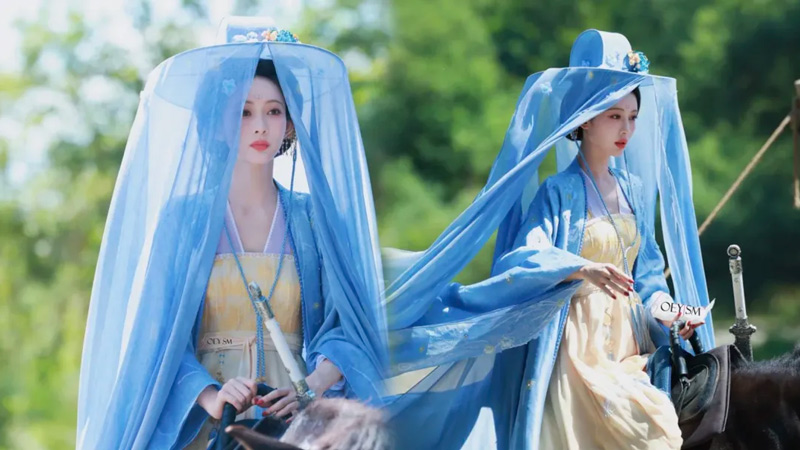
When watching Tang Dynasty-set dramas, have you ever wondered why some female characters wear hats with long veils covering their faces—or even their entire bodies? These headpieces, often called "face-covering hats" in period shows, come in varying styles: some veils drape to the shoulders, others sweep down to the ankles. But what lies behind these differences? Were ancient women truly hidden so thoroughly, or was there more to these hats than meets the eye? Let’s uncover the stories woven into Tang Dynasty headwear—Weimao (帷帽) and Mili (羃篱).
Weimao vs Mili: Fabric, Length, and Timeline
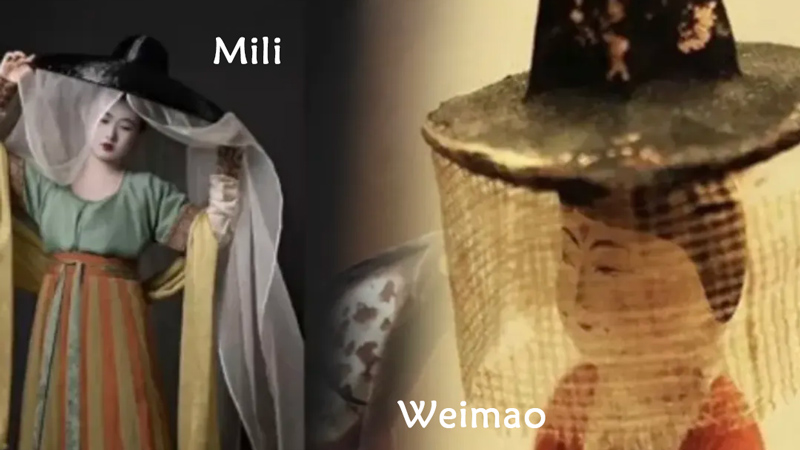
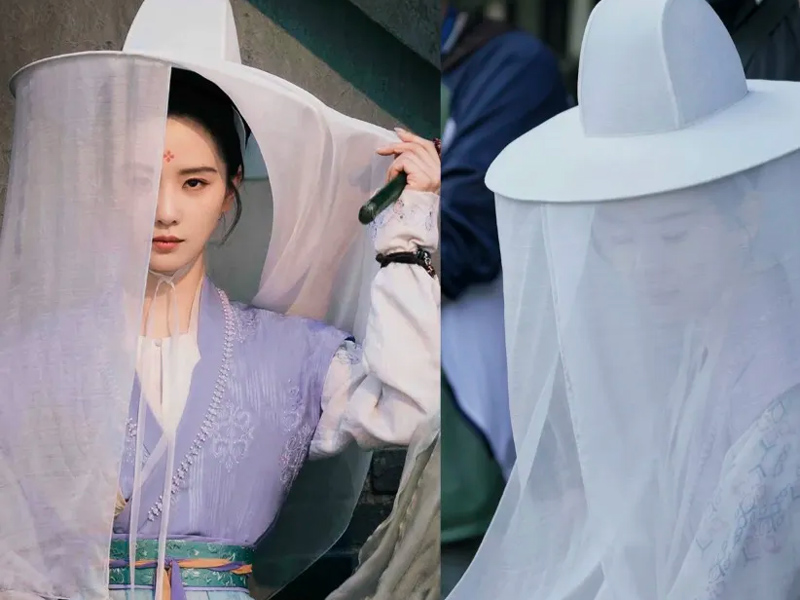
First, a quick clarification: Weimao and Mili are distinct, though often confused. Weimao, made of cloth or thin silk, features a wide brim with short veils that typically reach the neck—just enough to "lightly cover" the face, as Tang records describe. Mili, by contrast, is crafted from bamboo with longer veils that can shroud the entire body. Their popularity also shifted over time: Mili dominated in the early Tang (618–649 CE), while Weimao rose to fame during Empress Wu Zetian’s reign (690–705 CE) before fading in the Kaiyuan era (713–741 CE). For example, Yang Zi’s Weimao in the drama Flourished Peony (国色芳华) aligns closely with historical styles, whereas Meng Ziyi’s extra-long version in Tigers Sniff the Rose (尚公主) is a TV dramatization.
Visual evidence further distinguishes them. A mural from Princess Yan’s tomb depicts a lady holding a folded Mili with its lengthy veil trailing—proof that Mili’s coverage was truly full-body. Weimao, on the other hand, only shielded the upper half, making it more practical for daily movement. This contrast in design reflects not just craftsmanship but evolving societal needs.
The Hats’ Changing Roles
Contrary to modern assumptions, these hats weren’t initially about modesty. Early Mili, as recorded in The Jinshu: Biography of the Tuyuhun (晋书·四夷传·吐谷浑), was worn by both men and women in the Tuyuhun region (a nomadic state in northwest China) to block harsh winds and sand. Imagine it as an ancient "anti-social" accessory—perfect for avoiding unwanted greetings! Over time, though, Mili transitioned into a gender-specific item. By the early Tang, it became a tool for women to hide their faces from prying eyes, transforming from a functional shield to a symbol of seclusion.
Weimao’s rise, however, signaled a shift. Historians link its popularity to growing female agency during Empress Wu’s rule. The New Book of Tang: Records of Carriages and Attire (新唐书·舆服志) notes that while Mili once covered the whole body, Weimao—with its shorter veil—emerged in the Yonghui (永徽) period (650–655 CE), exposing more of a woman’s face. By Wu Zetian’s time, Weimao had overtaken Mili, reflecting a society where women were stepping into public life with greater confidence.
Hats as Mirrors of Tang Society
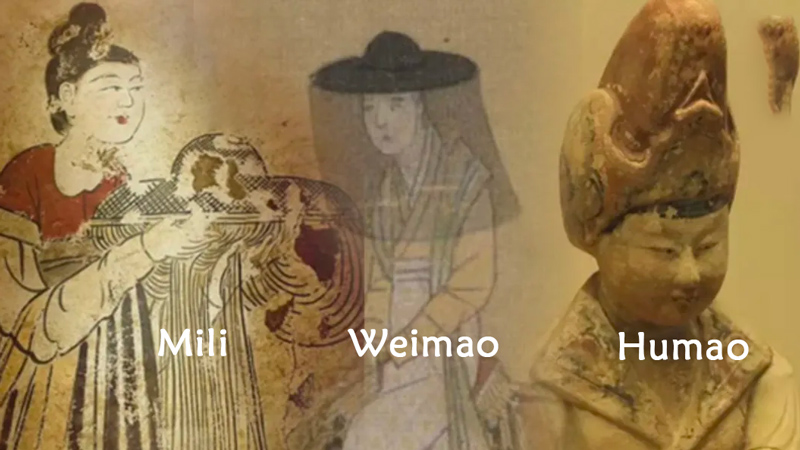
The veil’s length wasn’t just about style—it mirrored cultural tides. In the Kaiyuan (开元) era, Humao (胡帽)—a brimless, open-faced hat from Central Asia—swept through Chang’an. Worn by palace attendants and commoners alike, it marked a new era of openness: women rode horses, "proudly showing their faces" without veils, as historical texts put it. Weimao gradually fell out of use, replaced by this foreign-inspired headwear. This shift wasn’t just about fashion—it was a statement of Tang China’s cultural confidence, blending Han traditions with foreign influences seamlessly.
Today, these hats live on in dramas like Flourished Peony and Tigers Sniff the Rose, though TV adaptations often stretch their veils for visual flair. Yet behind the drama lies a rich history: a story of sand, society, and the quiet rebellion of a veil growing shorter. So next time you spot a Tang Dynasty hat on screen, remember—it’s not just cloth and bamboo; it’s a chapter of a civilization’s journey toward openness.