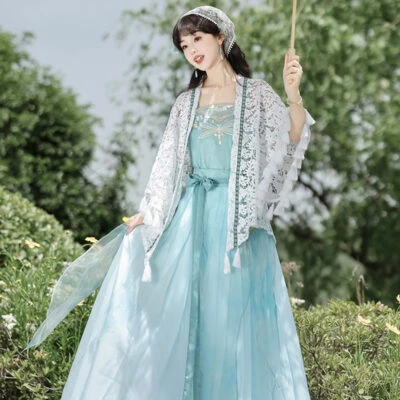
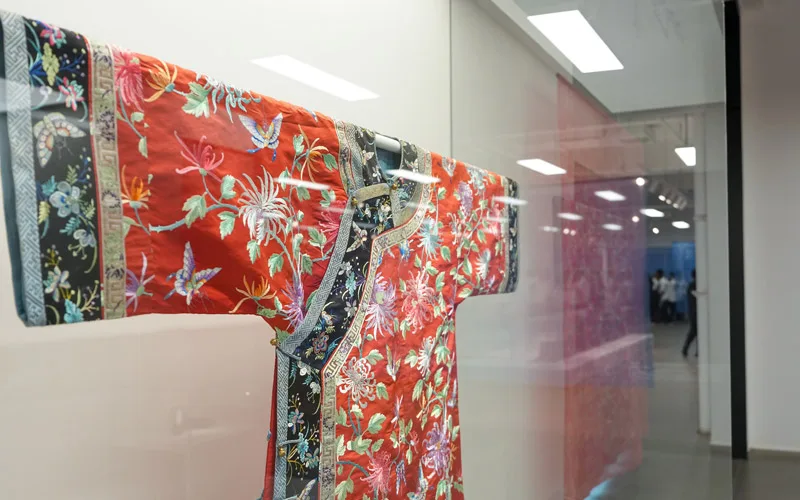
An exhibition of ethnic dress opened on 20 October at the Tongzhou campus of Beijing Institute of Fashion Technology, drawing on more than a hundred pieces from the university’s own collection. Titled One Thread, One Heart, it runs as a permanent display in the ground-floor gallery of building A1, free with an appointment, on Wednesdays, Fridays and Sundays. The museum that assembled it holds over ten thousand garments, textiles and ornaments.
| Dates | Opened 20 October 2026, permanent display |
| Venue | Gallery, ground floor east, building A1, Beijing Institute of Fashion Technology, Tongzhou campus |
| Hours | Wednesday and Friday 8:30 to 11:30 and 13:30 to 16:30; Sunday 13:30 to 16:30; entry closes 30 minutes before |
| Tickets | Free, campus appointment required, entry with identity card |
| Closed | Public holidays, winter and summer vacations |
An Argument Made in Cloth
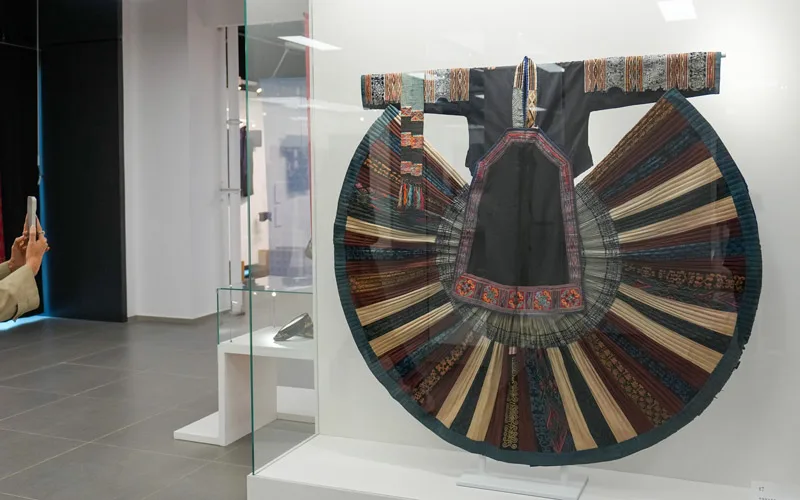
The show is organised as an argument rather than a survey. Three sections take three angles on the same object: ceremony, technique and material. Ceremony covers formal dress from Tibetan, Miao, Mongol, Yi, Zhuang and Han communities, and the emphasis falls on rank and occasion rather than ornament. Technique covers embroidery, brocade and resist dyeing, and follows how a motif or a stitch moved between communities. Material covers silk, hemp, wool, cotton, fish skin, tree bark, bamboo and metal.
Read together, the three sections form a chain from institution to skill to environment. Dress codes tell you who a person was; the stitches tell you who taught whom; the materials tell you what the local landscape could supply. That sequence is the curator’s real subject, and it is why the pieces are not grouped by ethnicity, which is how most costume displays in China are still arranged.
Fish Skin That Becomes Soft as Cloth
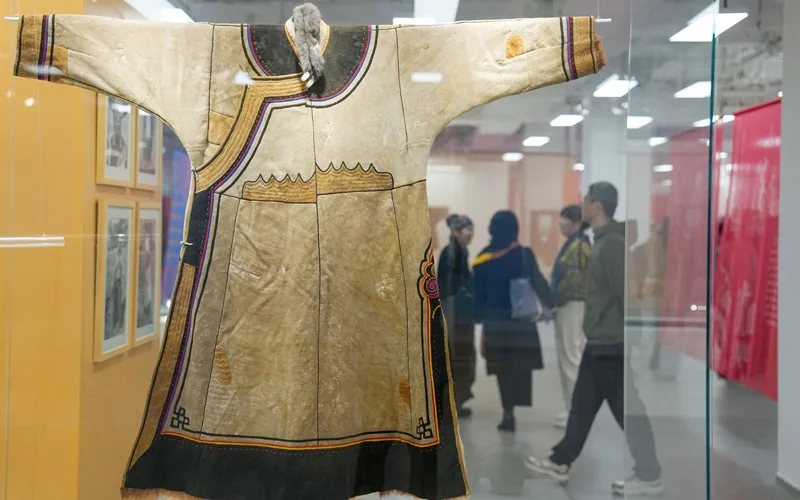
The piece visitors stop at is a fish-skin robe from the Hezhe (赫哲族) people of the northeast, whose fish-skin processing was among the first crafts entered on the national intangible heritage list. Workers take bighead carp, catfish and chum salmon, and treat the skins until hide that dries hard turns supple enough to sew. Early examples were stitched with thread cut from the same skin, and the scales were left visible as a natural grain.
Collar and lapel edges typically carry the Hezhe cloud and water patterns, cut and applied rather than embroidered. The finished garment resists damp, wears hard and stays light, which is what a fishing and river economy needed. A workshop beside the display cases runs during opening hours, with an inheritor of the technique walking visitors through the stages and staff explaining the materials laid out beside the finished robe.
Cases Holding Ten Thousand Pieces
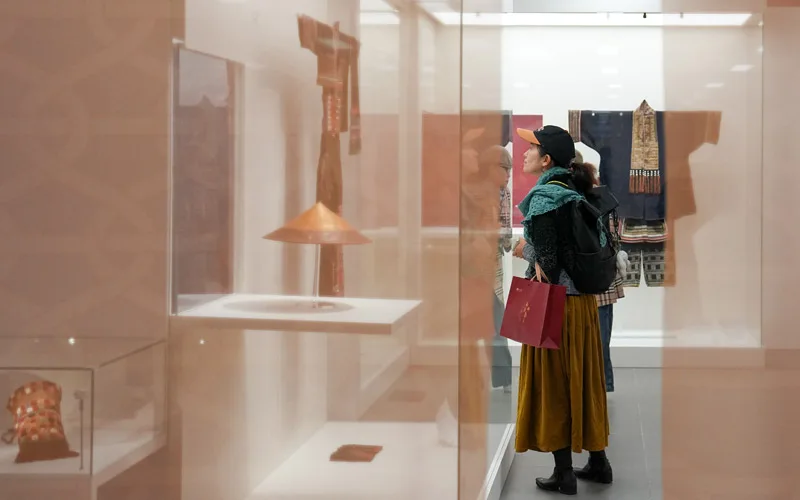
Behind the show sits the Ethnic Costume Museum, the first professional costume museum in China, whose holdings run past ten thousand items: garments, ornaments, woven cloth, batik and embroidery from communities across the country. It also keeps close to a thousand photographs taken in the 1920s and 1930s of Yi, Tibetan, Qiang and other communities in everyday dress.
Those photographs are the quieter half of the collection. They record clothing in use, on people working, rather than clothing arranged on a form. Set against the cases, they make the difference between a garment that was worn and a garment that was collected visible at a glance, and they are the reason a visit here rewards a second pass through the same room.
Materials That Record What a Place Can Grow
Other pieces in the cases widen the material argument: an Oroqen roe-deer skin woman’s robe, a Bouyei woman’s ensemble, Uyghur dress, Manchu dress. Each one answers a local question about supply. Where cotton and mulberry will not grow, and where woven cloth arrived late and expensive, outer garments were cut from what the land and water provided, and the choice of skin or bark or metal was an economic decision before it was an aesthetic one.
That is the part worth taking away. A costume collection is usually read as a record of decoration; read as a record of constraints, it becomes a document about agriculture, trade routes and climate. The fish-skin robe is the clearest case, because the material is unmistakable, but the silk and hemp pieces beside it make the same point less loudly.