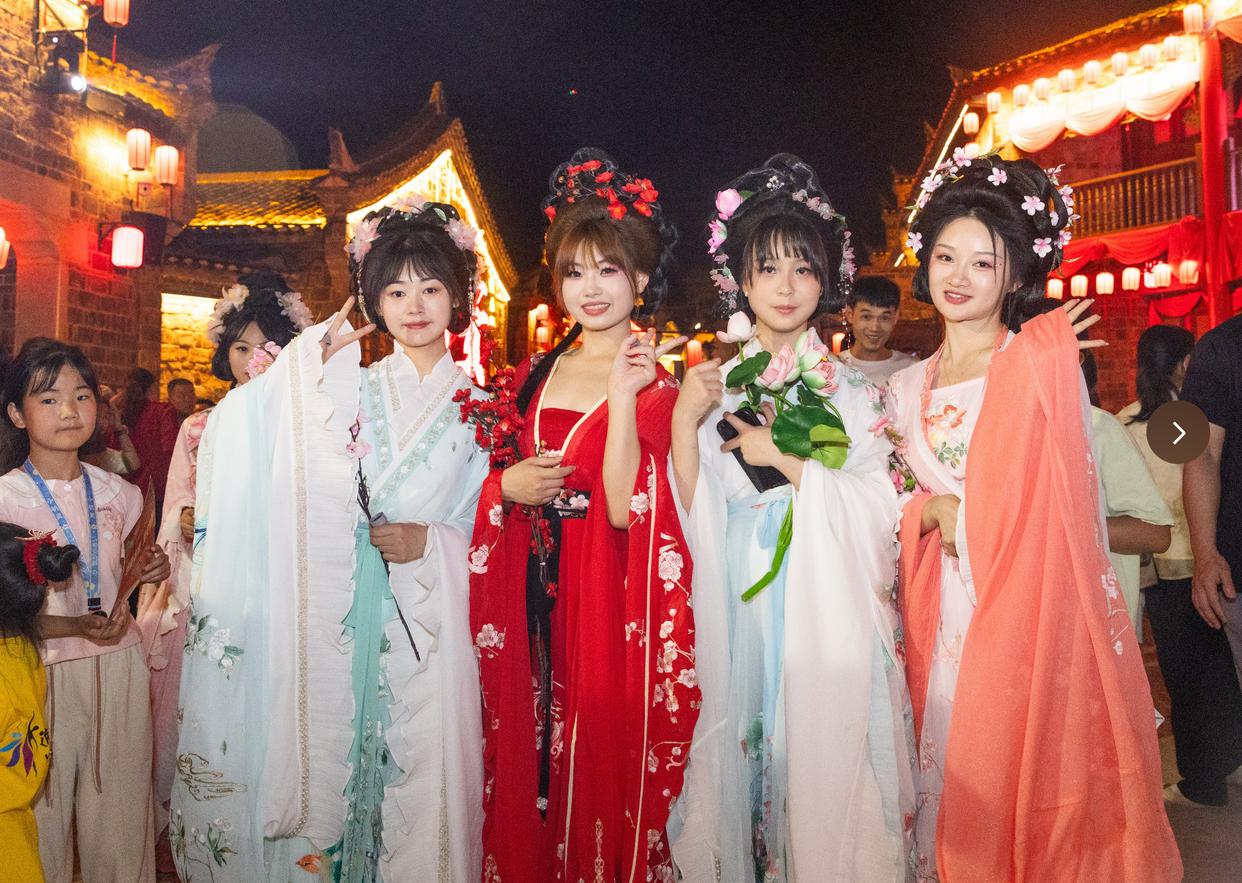
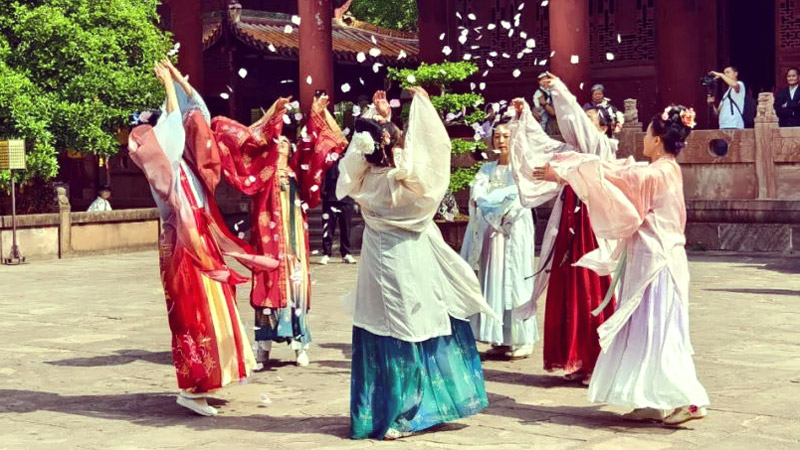
At three in the afternoon on October 1 the parade came down the street in waves. Young men and women in Hanfu moved through Confucius Temple Square and into the Xintiandi pedestrian street, dancers pausing to perform the sword piece “Sword Soul,” the classical “Song of the Pipa,” and “One Flower, One Sword” at set points along the route. Crowds cheered from the edges, and phones went up to film the procession as it passed.
“What a surprise, to see such an authentic Hanfu parade right at my doorstep. This National Day is lively,” a resident surnamed Luo said.
The parade opened the fourth Deyang Confucius Temple Culture Week, titled “Brilliant Temple, Radiant Deyang” and built around the theme “Easy Deyang, Flowers Bloom at the Temple.” It ran three days to October 3 and split its programme across the Confucius Temple and the Stone Carving Park, two venues a short distance apart, with competitions doing the work that stage performances usually do. Organisers described the shape of it as small but precise, simple but full.
A Flower Street That Lights Up After Dark
Five strands make up the event: one street, one show, one rite, one festival, one market. The main stage sat on Confucius Temple Square, while decorations, a flower street and interactive points ran along the Xintiandi pedestrian street.
After sunset the newly built “Shengshi Flower Street” took over. A set of installations lit in sequence, including the Xingyu Corridor Bridge, Moshang Huakai, Fendie Lianhua, Taoyao Qiyuan and Yuese Huaqiong, turned the lane into a scroll of blossoms unfolding step by step. Lantern light and the timber fronts of the old buildings reflected off each other, and visitors walked the route as a night tour rather than a shopping street. Free small national flags, “I love Deyang” face stickers and check-in newspapers gave the evening a holiday edge.
Sages Step Out of the Halls
The afternoon continued on the main stage with a Huafu showcase, the broader category of Chinese ceremonial dress. Contestants came on in three groups by age: children, younger adults, and a senior group, wide sleeves moving and skirts lifting as they walked. Between the scheduled sets, Hanfu follow-along dances broke out at random points along the street, drawing passers-by into the steps.
A second layer of the programme ran on two mascot-like characters. Debao, the event mascot, greeted visitors along the street and led sections of the parade. The other, a character set drawn from the Records of the Sages, brought the four assessors and twelve philosophers of the Dacheng Hall out of their static display and onto the pavement as non-player characters who could hold a conversation and pose for photographs. Confucian figures that visitors normally read about on a plaque became something they could talk to, a change organisers describe as letting visitors handle the tradition rather than only read about it.
Visitors were also invited to feed the event their own material. A co-creation drive asked people to record whatever caught their eye, with the best clips and photographs pushed out on official channels, turning spectators into contributors.
Competitions Instead of Stage Shows
Contests carried most of the programme. A second community round of the Honor of Kings national tournament took over the square, with semifinals, finals and a Guochao esports night running back to back on a stage built for a younger crowd. Alongside it came an Analects recitation contest and a ritual-and-music presentation, where readings, early instruments and hands-on lessons in traditional ceremony gave visitors a way into the meaning of li, the ritual order that Confucian teaching places at the centre of conduct.
Eating had its own contests. A snack contest and a milk tea contest invited residents and tourists to compete on site and take away shopping vouchers for the surrounding business district. Vendors, teahouses and shops inside the Temple business district and the Stone Carving Park were linked through a shared consumption mechanism, so a voucher earned in one venue could be spent in another, and the Deyang Mass Cultural Activity Centre joined the same arrangement.
Festivals Already Being Planned
A representative of the Deyang Confucius Temple stated that the week was built on the site’s Confucian inheritance and aimed to keep the tradition intact while renewing how it is presented, using competitions in place of performances, living character guides, and an immersive street of lights. The representative added that the city will keep developing the “Temple plus” identity, planning further programmes around the Spring Festival and the Dragon Boat Festival, refreshing the scenes, expanding the range of cultural products, deepening cooperation with other culture and tourism sites in the region, and tying heritage transmission more closely to commercial consumption.
By the close on October 3, the temple and the park had become two of the region’s busiest holiday destinations, with the parade, the night street and the competitive programme sharing a single footprint across the two sites.