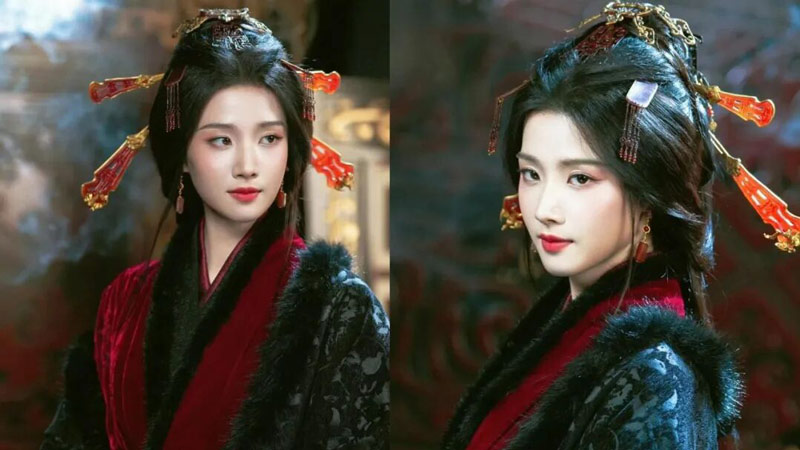
When Lu Yuxiao (卢昱晓) appears in the costume drama Ci Tang (刺棠), her character Su Luowei (苏落薇) wears a headpiece that pulls the eye at once. Flat plaques sit beside her temples. Strings of beads drop from them and brush her cheeks. Some viewers joked that she had hung clothing tags from her hair. The shape is not a random invention. It points to an almost forgotten ornament called the Zhi (擿), a long object with a flat end and fine teeth. In Ci Tang, the design team has translated that old tool into a bold screen image.
The result feels unfamiliar, a little awkward, and strangely memorable. At first glance, the ornament seems to float beside her face rather than sit in her hair. That floating quality is why the image spread quickly online. It also raises a useful question: why did a practical hair tool become a dramatic decoration?
A Strange Shape
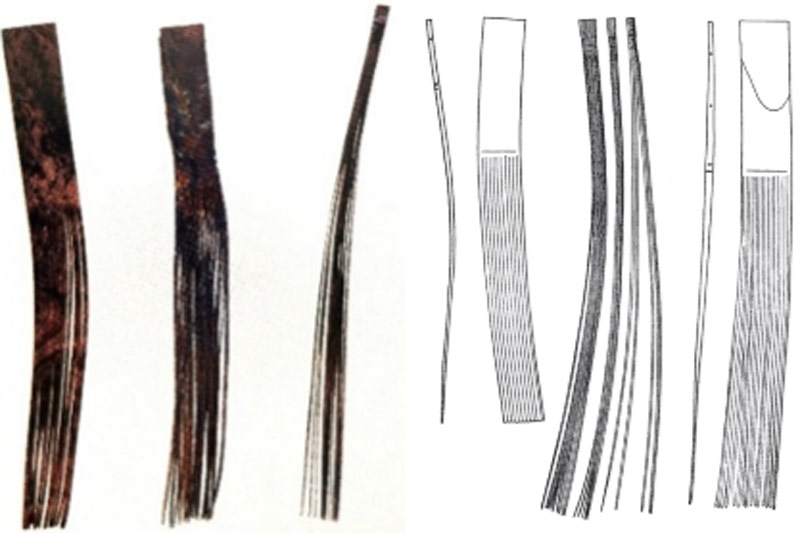
The Zhi was not merely a pretty pin. It could be inserted sideways near the temples, exactly where Su Luowei wears it. Another method pushed it through the center of a bun. Surviving examples measure more than 20 centimeters. One end is a long, thin plate; the other carries close, narrow teeth. In the pre-Qin period, bamboo was common. By the Western Han, bone, bamboo, wood, hawksbill shell, and ivory appeared. Some pieces were carved with patterns or decorated with an ornamental rosette. The Mawangdui Han Tomb (马王堆汉墓) yielded three Zhi in different materials. Tombs in Shandong and Shanxi also produced horn examples. Each detail shows a tool built for both use and display. The plate can catch light, while the teeth disappear into the bun. This mix of visible and hidden parts made the Zhi versatile.
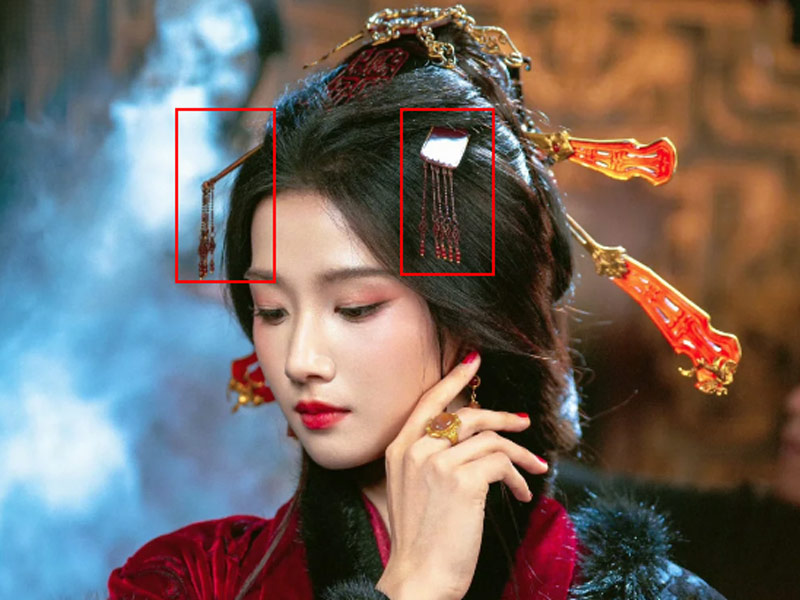
Why would such an object become fashionable? First, it was practical. A Zhi could hold a hairstyle in place. Its long teeth could scratch an itchy scalp or remove dust from the hair. A woman could carry one item and solve several daily problems. That usefulness mattered in a time when hair tools were limited. It was not fragile decoration alone. It was a comb, a pin, and a small grooming aid combined. When a design serves many needs, people often keep it close. That may explain why the Zhi spread so widely during the Western Han. It also helps explain why the ornament appears in so many burial sites. For everyday wear, that range of functions was more valuable than luxury. A single object saved time and space.
Second, it matched popular hairstyles. Low hanging buns and low coiled styles did not rise high on the head. A long Zhi could slide in at an angle or lie horizontally, following the shape of the bun. It locked loose strands into place. The part near the temple could be pierced and hung with beads or other ornaments. In this way, a functional tool became a visible accessory. Third, it signaled status. Common families used wood or bamboo. Wealthy and noble wearers chose rare materials. When the Zhi entered ritual rules, material and decoration began to mark rank. The Book of the Later Han (后汉书) records such rules. By the Eastern Han, high buns and stronger hairpins pushed the Zhi aside. Its decline did not erase its memory. Burial objects and written rules kept its shape alive for later readers.
Why It Worked
That history makes its return in Ci Tang surprising. Costume dramas often reach for grand hairpins, step-sway hairpins, and sparkling crowns. The Zhi is quieter. Its shape is flat, almost blunt. Its teeth are hidden inside the hair. On camera, those qualities can look strange unless the design is adjusted. The show’s team did adjust it. They made the flat plaque smoother and paired it with hanging bead strings. The hard plate and soft-moving beads create a stronger outline. In medium shots and close-ups, viewers can read the ornament clearly. The headpiece becomes a visual anchor rather than a small historical detail. The beads also move when the actor turns her head, so the prop gains motion without becoming heavy.
Is the change faithful? Not exactly. Ancient Zhi did not always look so neat and polished. Their hanging ornaments were not necessarily long bead chains. The drama turns the object into something more theatrical. The hard plaque balances the weight of the hairstyle. The falling beads draw the eye downward, framing the face. This choice may not satisfy every history expert, but television has its own rules. A prop must speak quickly. It must tell the audience who a character is before a line is spoken. The Zhi does that job here. It makes Su Luowei look different from the usual palace heroine. The audience does not need a lecture on Western Han grooming to understand that this woman is marked by an unusual choice.
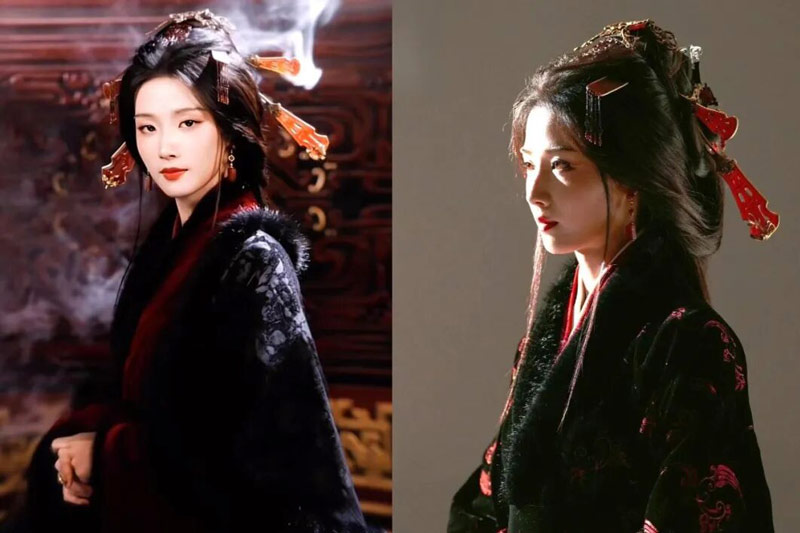
That difference matters. Many viewers know large hairpins and step-sway ornaments. Few recognize the Zhi. By placing it beside Lu Yuxiao’s face, Ci Tang brings a minor ancient hair tool into public view. The attention may be mixed. Some call it ugly; others find it fresh. Either way, people are talking about a piece of early Chinese hair fashion that rarely reaches the screen. That is worth noticing. The next time a costume drama invents a strange headpiece, it may be worth asking what old object lies beneath the modern styling. Costume design can be a doorway, even when the first impression is confusion. Curiosity often starts with a question rather than a compliment. Do you think Lu Yuxiao’s temple ornaments look beautiful, or just bizarre?