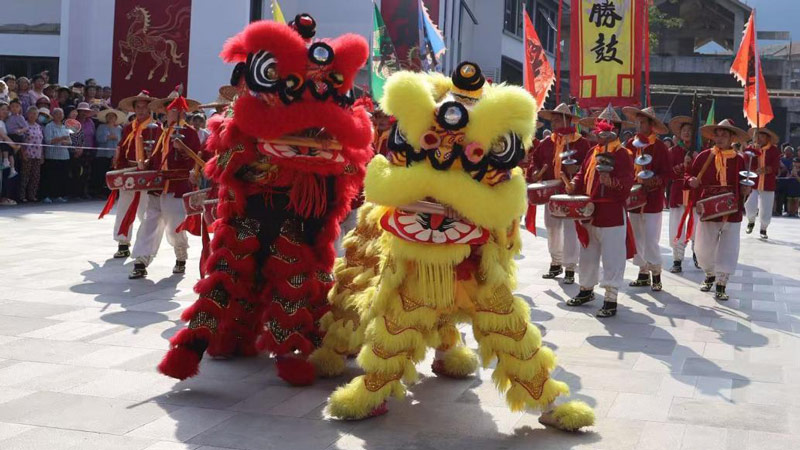
The general’s temple fair in Wucheng, a town in Xiuning County, Anhui, opened on September 4 for an eight-day run through September 11, filling a stretch of the old settlement with food stalls, folk processions and stage shows from morning until late. The venue is the phase-two site of the Wucheng specialty block, and the fair is built as a single immersive country-town program combining eating, performances and local goods.
Wucheng itself carries the weight behind the event. The town sits at a crossing on the old post road that ran from Huizhou toward Wuyuan in Jiangxi, and the Northern Song geography Taiping Huanyu Ji already listed it as a “great town of old.” That position made it a trading stop, and the fair is the modern continuation of the market habit.
Organizers laid out seven zones: food, clothing and general goods, children’s entertainment, local specialties, bamboo and wood ware, direct-from-farm produce, and a performance area. The food zone mixes national street-food names with local Wucheng snacks; the clothing zone carries clothes, shoes, hats, small appliances and household goods; the local-goods zone is where Wucheng rice wine, Wucheng tea-dried tofu and handmade rice cakes are sold, and it drew steady queues. Bamboo and wood products fill another section, while the direct-sales zone sells seasonal vegetables and farm produce brought in by local growers.
The parades are the fair’s centerpiece and its busiest draw. In daylight the victory drums roll out first, heavy and continuous, followed by the black-faced general carried in procession and a lion dance working its way through the crowd along the street, reproducing the sound and sequence of the traditional fair. After dark the register changes: an interactive Kung Fu Panda parade moves through, followed by a Hanfu fish-lantern team whose lit lanterns trail color along the route, and jazz dance flash mobs cut in between. Traditional heritage performance, Chinese-style aesthetics and pop-culture interaction are deliberately stacked in the same evening. The fair runs multiple parade sessions in both the day and night slots, with exact times posted on site.
Stage programming keeps its own schedule. Pop songs, dance, Sichuan opera face-changing and live bands rotate through the day and into the night, so the performance area rarely goes quiet. Wucheng’s fair is not a recent invention: the Xiuning County Gazetteer traces it to the Tang dynasty, when it was established to commemorate Zhang Xun and Xu Yuan, the generals who held Suiyang to the death during the An Lushan rebellion and were later honored as the Loyal and Pacifying Kings. The people of Wucheng built a temple and made offerings on the anniversary of their deaths, and that observance grew into the fair. Over the centuries it developed into a combined ritual, trading and entertainment event, and in recent years it has added Hanfu poetry gatherings and staged historical scenes, turning it into a platform for rural revitalization and culture-tourism integration in the Huangshan region.
Organizers describe the model as rooted in folk custom and aimed at what residents actually want: old-fashioned street food and heritage performance on one side, younger crowd experiences and mixed business formats on the other. Pairing market sales, stage programs and parades is meant to draw people into the town, lift rural spending and give the area’s culture-tourism economy a seasonal push.