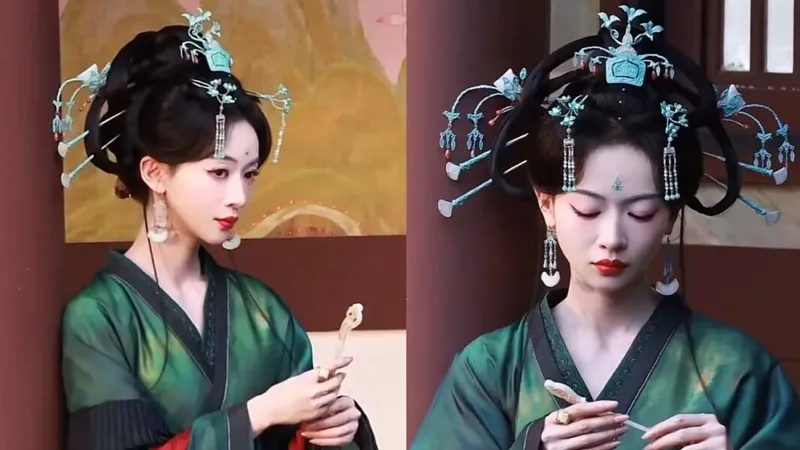
In recent behind-the-scenes photos and trailers for Feng Bu Qi (凤不栖), Wu Jinyan wears several ancient-style outfits with a curious detail: a string of dangling pieces falls beside each temple, framing her forehead like two tiny horns. It looks nothing like the usual front hairpins or the step-sway ornaments perched on top of a bun. Why would a designer choose such an awkward-looking placement? Did real women in ancient China ever wear hair jewelry this way?
The answer is not a simple yes or no. Evidence from Western Han tombs shows that similar ornaments existed, and they belonged to a very specific world of rank, hair volume, and slow, formal movement. The clash between familiarity and distance is exactly what makes the look so striking.
Ancient Engineering
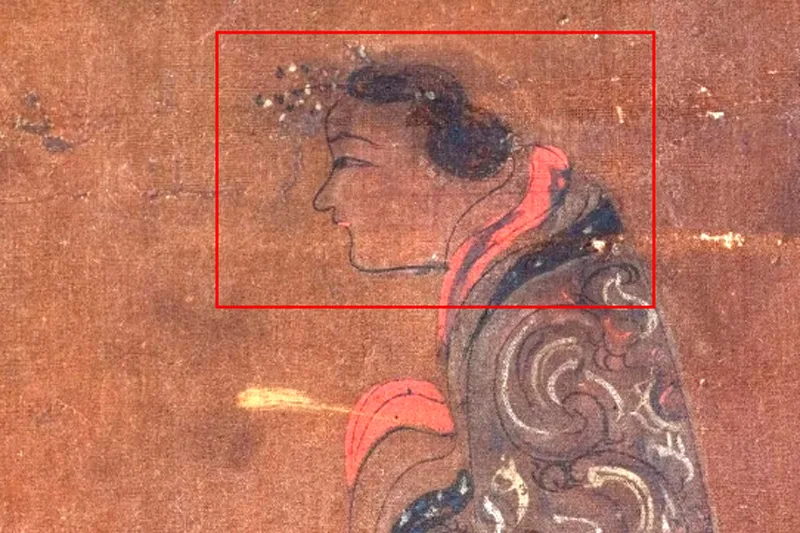
In the Western Han, side-hanging ornaments were not a scriptwriter’s invention. A painted pottery figurine from the period shows two step-sway pieces inserted at the front sides of the head. Each has a pin-like base and several thin chains hanging from it. The placement matches the look in Feng Bu Qi almost exactly. A T-shaped silk painting from Mawangdui Tomb No. 1 (马王堆一号墓) offers more proof. On the head of Xin Zhui (辛追), the noblewoman buried there, dangling ornaments can be seen falling beside her forehead. Together, the figurine and the painting suggest that this style circulated among elite women during the Western Han. It was not everyday decoration for everyone. It was a courtly fashion with rules, materials, and careful placement. Their small scale makes the detail easy to miss, yet once seen, it changes the whole silhouette.
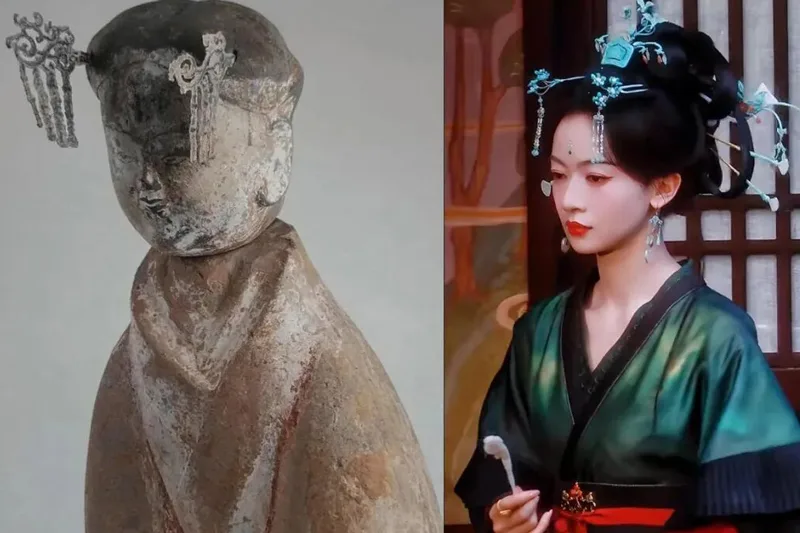
How did such ornaments stay in place? The key was the long pin or hairpin foot. Some examples reached more than twenty centimeters. A woman would slide the foot diagonally into a tightly coiled bun, deep enough for hair to clamp it from all sides. Friction did the rest. The hanging parts were usually made from fine silver chains or thin gold sheets, so they were light. Their weight did not drag the pin downward. Even when a woman walked, bowed, or danced, the ornament remained stable. This was not a loose clip resting on the surface. It was locked into the architecture of the hairstyle itself. That is why later copies often fail when they use short, heavy pins.
Western Han noblewomen often wore high, heavy buns, sometimes built with false hair. That volume mattered. A side ornament could sit at the edge of the bun, where thick strands held it without ruining the silhouette. It also filled the empty space beside the forehead. In a modern photo, the result may look strange because we are used to seeing decoration centered above the face. In its original setting, the dangling piece balanced a tall hairstyle. It moved with the body but stayed anchored. The “horns” were not random. They solved a visual and mechanical problem at once.
Status and Style
Why did elite women choose this design? One reason was rank. Gold and silver branches, chains, and tiny pendants required costly materials and skilled labor. A farming family could not afford them. Placing such work at the most visible part of the face, beside the forehead, made wealth easy to read from a distance. The ornament announced that its wearer did not need to work in fields or hurry through streets. It belonged to a life of ceremony, servants, and controlled movement. In that context, the side pieces were less about hiding the face than about framing it with proof of status.
Beauty ideals also played a role. Western Han noblewomen wore wide, flowing robes for formal occasions, and they moved at a slow, measured pace. Light pendants swayed gently with each step. That small motion created a restrained elegance, not a flashy display. The effect depended on stillness as much as movement. If the wearer rushed, the charm would break. If she walked calmly, the chains whispered beside her cheeks. This fit an aesthetic that valued poise, layers, and subtle rhythm. The ornament was not meant to sparkle aggressively. It was meant to tremble just enough to be noticed.
Later dynasties did not continue the exact form. After the Wei and Jin periods, step-sway ornaments grew larger. Some became crowns or flowering-tree structures that covered the whole bun, with more beads and richer materials. Tang and Song women often preferred frontal flower hairpins and caps, drawing attention to the top of the head or the center of the forehead. By the Yuan and Ming periods, hair jewelry had expanded into many kinds of pins, combs, and sets. With so many options, the Western Han side-hanging style faded from common use. It survived in tombs, paintings, and figurines, waiting for modern eyes to notice it again.
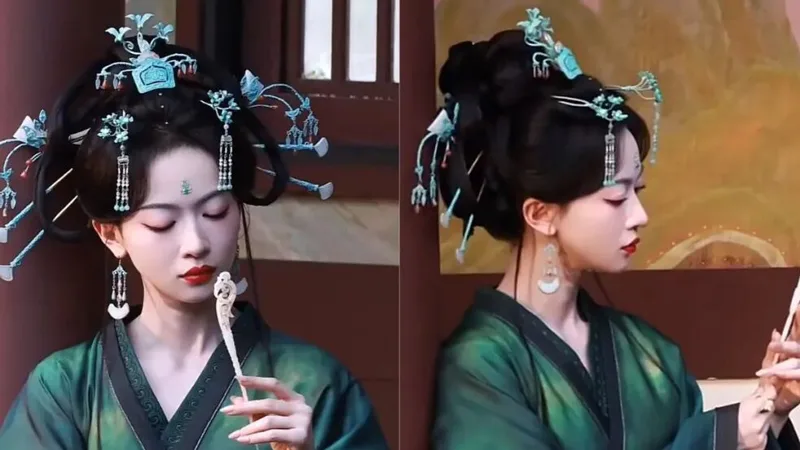
Feng Bu Qi does not copy the past exactly. The production keeps the core Western Han feature, those dangling pieces beside the forehead, then adjusts them for camera work. The team uses hairpins that grip the bun more firmly. It also changes the length of the drops and the density of the tassels so they read clearly on screen. The result can feel odd to viewers who know later Chinese hair fashion. Yet the oddity is the point. These “horns” are not a fantasy mistake. They are a distant fashion rebuilt for television, with ancient mechanics shaped for a modern camera. Seen this way, the horns are not a flaw; they are a clue.