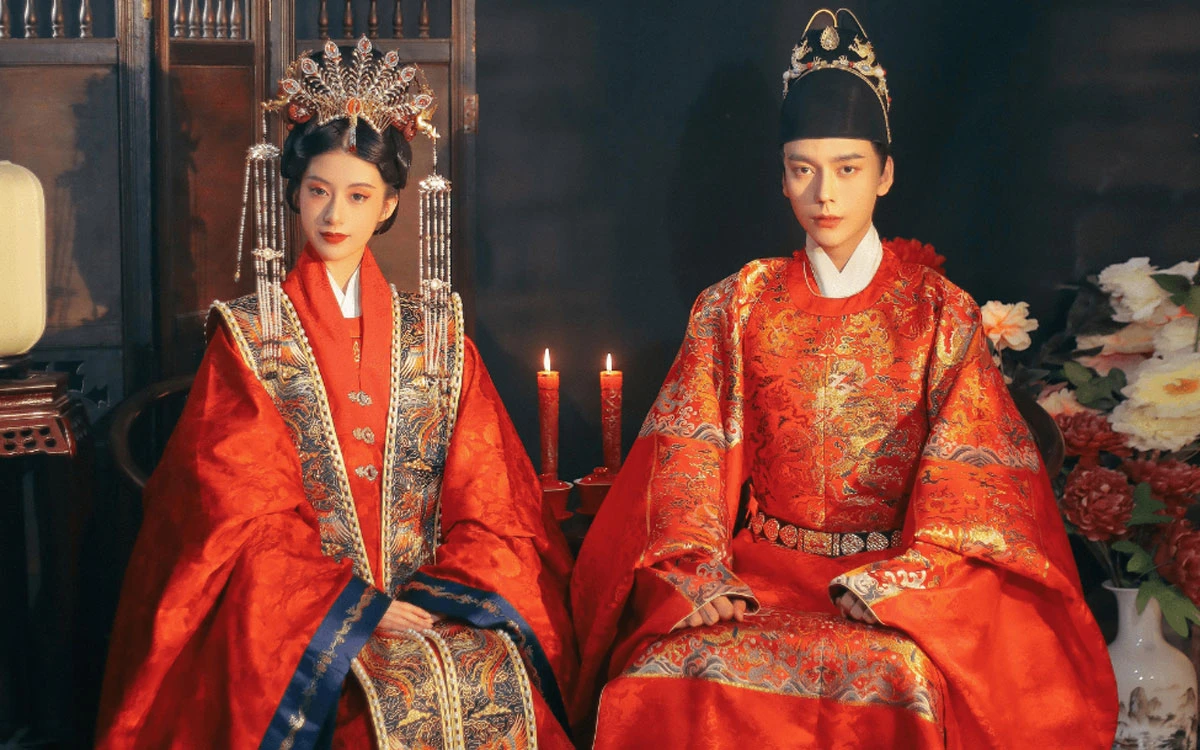
Sixty couples from Chongqing and neighbouring Sichuan took part in the third Sichuan-Chongqing collective wedding on October 11, at Ciqikou Ancient Town in Shapingba District, Chongqing. The event doubled as the launch of the city’s 2026 marriage-custom reform publicity week. Shapingba’s converged media centre and the Chongqing Morning Post reported the ceremony. Dressed in traditional wedding robes, the couples entered one pair at a time and moved through a full sequence of rites, and the morning ended with a vow read in unison before a crowd that included a number of foreign visitors who had stopped to watch.
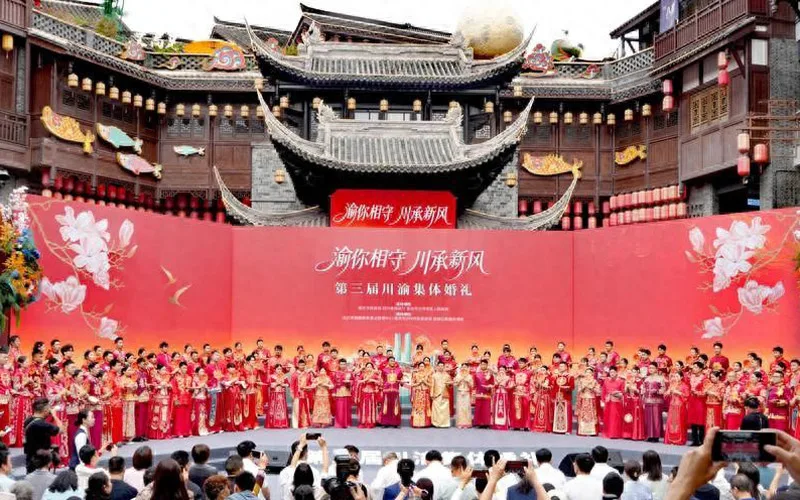
Hosting was split across three levels of government, with the Chongqing Civil Affairs Bureau, the Sichuan Provincial Department of Civil Affairs and the Shapingba District People’s Government as sponsors, and the city’s marriage and adoption registration management centre, the district civil affairs bureau and the Ciqikou sub-district office handling the arrangements. The slogan paired the two places: Chongqing and Sichuan keeping faith together, Sichuan carrying the new custom forward.
How the Ceremony Ran
The rites followed an order that is now standard at Chinese-style collective weddings. Each couple began with the fan-lowering rite, in which the bride’s face is uncovered, then joined hands for the hand-holding rite, bowed to each other, and closed with a rite of thanks. Only after the sequence did the couples recite their vow together, naming the sun, moon and stars as witnesses to a life shared and promising never to part. Ritual, in this format, is doing the work that a civil ceremony does elsewhere: it gives sixty households a public record at the same time and at the same cost.
Between the rites, two couples were invited to tell their stories. A groom who had worked as a firefighter described long separations and the uncertainty of changing careers, and said his wife’s steadiness convinced him she was the person he would protect for life. A bride said she and her husband met as university classmates in Gansu, held on through years of living apart, and closed with a line about the years ahead: you in every season, you at every meal, growing old together.
Two Marriages That Have Run Fifty-Nine Years
Two couples from the golden-wedding generation were brought on stage to bless the newcomers with what they had learned. Fu Jiayu, 82, and Sun Zhongyong, 88, have been married 59 years, and they were introduced as the day’s most-quoted example. Sun Zhongyong’s advice was practical: respect and support your partner, share the everyday work, and forgive each other without keeping score.
Fu Jiayu added the part that is easier to say than to do. Couples should love and care for each other, she said, stay calm when disagreements come, and above all never wound the other person’s self-respect; talk things over, be tolerant, and complain less. Both were presented as a counterweight to the assumption that a collective wedding is a young people’s event, which is why the organisers seated them in front of the sixty pairs rather than beside them.
Where the Reform Programme Goes Next
A charity component ran alongside the rites, part of a campaign to move charitable culture into households. Under the theme “do loving things with the person you love,” some couples donated idle belongings to an on-site charity sale whose proceeds go to a community charitable fund, others scanned codes at project boards, bought from the sale stalls or took part through welfare lottery scratch cards. Sweets were handed out at the close, and the district framed the whole morning as an argument that a simpler wedding can still be a generous one.
The publicity week runs from October 11 to 17 across Chongqing, with advice desks on scaled-back ceremonies and reformed customs. Behind it sits a working mechanism: the city’s civil affairs bureau has issued 16 reform measures jointly with 12 municipal departments, Dazu District has been recognised as a national marriage-custom reform pilot area, and ten districts and counties including Dadukou and Dianjiang have become municipal-level pilot areas.
Chongqing has also built 24 city-level marriage registration venues designed for the occasion, among them the Beibin Road riverfront, the lakeside point in Yunyang, the Binhu site in Fengjie and Baima Park in Wuxi, each pairing a landscape with wedding culture and Chinese aesthetics. Ciqikou’s own version is a registration venue built inside the old town, supported by a local wedding-services alliance and a model the district calls registration plus tourism plus services, and the Shapingba civil affairs bureau said it will keep deepening the reform by drawing on Bashu family culture and improving marriage and family counselling.