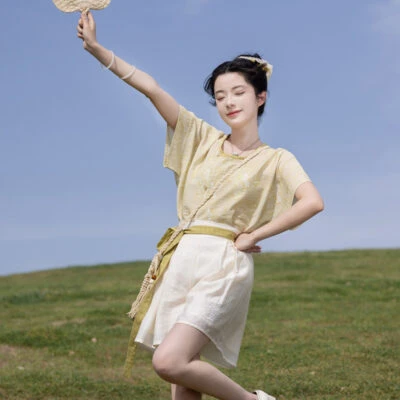
Chi Xia (池夏) is a Chinese Hanfu-inspired label founded in 2019 and operated by Hefei Chixia Culture Media Co., Ltd. in Hefei, Anhui. Its clothes borrow the collar, sleeve and pleat logic of historical dress, then cut it for ordinary days: commuting, campus, travel, photographs. That single decision sets the tone for everything else in the range.
Positioned Between Costume and Daily Wear
Calling Chi Xia a Hanfu brand is accurate up to a point. The company describes its output as Hanfu-element fashion, meaning garments that keep a Jiaoling collar, a Duijin placket or a Mamianqun pleat panel while shortening the hem, lightening the lining and dropping the layered under-robes that make full historical dress impractical on a bus. The reference stops at the silhouette, and the construction follows modern retail: hidden zips, snap closures, single-layer linings for warm months, sleeve widths that fit inside a coat.
Ming, Tang, Song and Jin Cuts
Four dynastic vocabularies recur across the catalogue. Ming-style pieces lean on the Aoqun pairing and the horse-face pleat. Tang-style pieces use a high-waisted Ruqun with a short jacket. Song-style pieces centre on the narrow Beizi and its long parallel panels, while Jin-style pieces take a looser, wider cut with heavier trims. Buyers who need a garment that survives close reading at a period event usually want a reproduction house instead; buyers who want a pleated skirt to wear to a lecture are the audience this label designs for.
Signature Series to Know
Chi Xia releases in named collections rather than one continuous line. Xiari Xunfeng, the 24 Solar Terms cycle, Huaxin, Liaozhai, Shangui, Jinling Shier Chai and Shanhai each carry a separate motif set, and a piece is normally sold under both its series name and an individual title. Several titles keep reappearing in resale listings and reviews: Youyuan Jingmeng, a Ming-style three-piece set; Fenghua Yin, a Mamianqun from the Shanhai series; Zhen Yanyu, a Song-style Beizi with a pleated skirt made in collaboration with Sanrio; Shaiqiu Yao in the Jin style; and Jiuwei, a Mamianqun finished with an imitation Luodian silver weave. Browse all Hanfu brands we carry to compare the label against its peers.
Fabric and Finishing
Woven gold, Zhuanghua weaving and embroidery appear across the higher-priced pieces, and the imitation Luodian finish on Jiuwei is the most technically ambitious surface in the range. Lower-priced items use printed polyester or a cotton blend, which is standard for this segment. Read the fabric line in each product description rather than judging from the photo: brocade reads heavier and stiffer on the body, printed fabric drapes softer and creases less but loses motif depth at close range.
Before You Order
Sizing runs on the label’s own chart, and Hanfu-inspired cuts leave more room at the waist than Western ready-to-wear. Measure bust, waist and height, then match against the chart for that specific item, because the same brand can size differently between a Ming-style Aoqun and a Song-style Beizi. For a first purchase, a single-layer Mamianqun with a plain or lightly patterned skirt is the lowest-risk entry: it pairs with a modern shirt, needs no under-layer and survives a full day of walking. Start with the Mamianqun collection if the pleated skirt is the part you actually want to wear.
Questions Buyers Ask
Is Chi Xia an original Hanfu brand?
Yes. It is a registered label operated by Hefei Chixia Culture Media Co., Ltd., with its own design team and a practice of commissioning independent designers for guest collections.
Where does Chi Xia operate from?
Hefei, in Anhui Province. The company was registered there in 2019 and sells through its own online storefronts rather than through wholesale channels.
Does Chi Xia make reproduction Hanfu or Hanfu-inspired clothing?
Hanfu-inspired. The company positions the range as Hanfu-element fashion built for daily wear, so collars, plackets and pleat panels are historical while hems, linings and closures are modern.
What is the Chi Xia Mamianqun known for?
Two titles carry most of the reputation: Fenghua Yin from the Shanhai series, and Jiuwei with its imitation Luodian silver weave. Both use the standard horse-face pleat construction, where flat panels sit at the front and back and the pleats run along the sides.
Which piece suits a first-time buyer?
A single-layer Mamianqun. It works with clothes already in the wardrobe, needs no coordinating top and carries less sizing risk than a full three-piece set.
What should I check before ordering a set?
The fabric line, the closure type and the item-specific size chart. Printed fabric photographs almost identically to brocade at thumbnail size, and a Ming-style set and a Song-style set from the same label can sit on different charts.