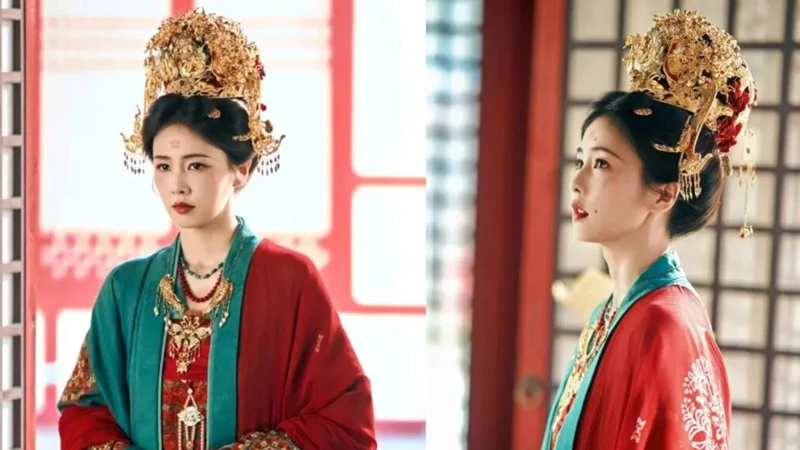
Why Did Bai Lu Wear Red and Green on Her Wedding Day in The First Jasmine (莫离) ? The answer lies not in a costume department error, but in a fascinating journey through Chinese dynastic history. For modern viewers, red is the undisputed color of Chinese weddings.
Yet, when Bai Lu’s character appears in the historical drama The First Jasmine dressed in a striking combination of red and green, it challenges our contemporary expectations. This wasn’t a stylistic whim; it was a deliberate and historically accurate nod to the Tang Dynasty (618–907 AD). By exploring the evolution of wedding attire from the Tang to the Ming and Qing Dynasties, we can uncover why this vibrant, contrasting palette was once the height of bridal fashion and why it gradually gave way to the pervasive red we know today.
Tang Dynasty Origin
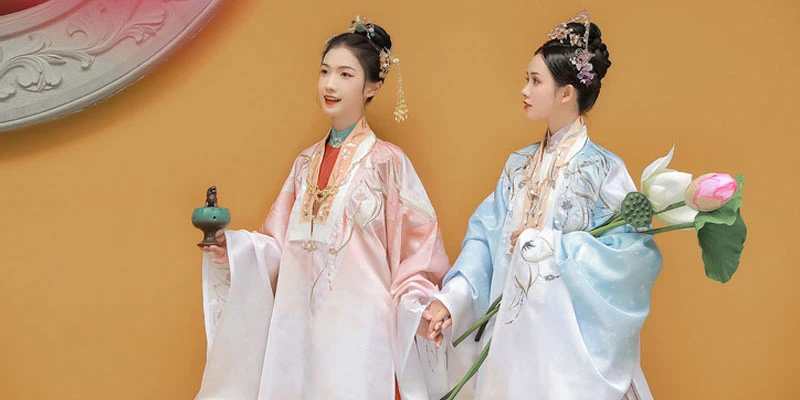
The vibrant red and green wedding attire worn by Bai Lu’s character in The First Jasmine is a direct reflection of the Tang Dynasty’s fashion sensibilities. The costume team behind the drama did not invent this combination; they meticulously recreated the ceremonial attire of the era. During this golden age of Chinese history, the main color for a bride’s formal robe was qing (青), a term that encompassed a spectrum of blues, greens, and teals. It was paired with a vibrant, fiery red inner skirt. This was not merely an aesthetic choice but a formality. The official Da Tang Kai Yuan Li (大唐开元礼), a foundational text on Tang rituals, dictated that the wives of officials and nobility wear such qing-colored garments for grand ceremonies.
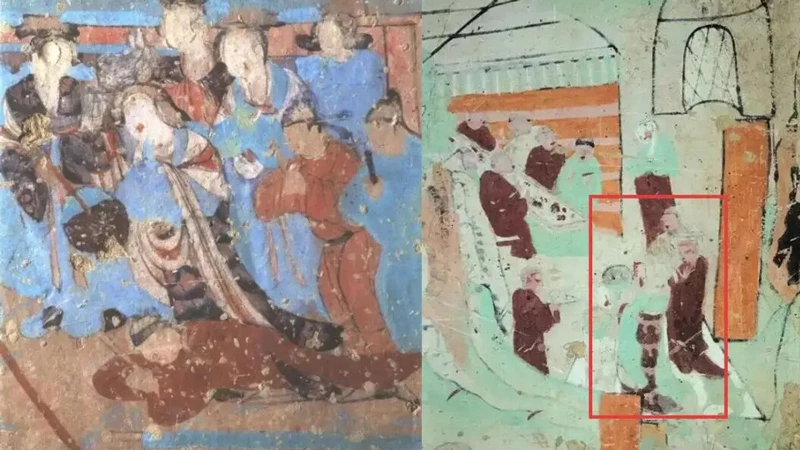
The modern eye might find this combination jarring, but to the Tang people, it was the epitome of grandeur. Their society was open, prosperous, and favored bold, saturated colors. The striking contrast between the cool qing and the warm red was perceived as a powerful and opulent statement, perfectly mirroring the empire’s own confident and expansive spirit. This was a standard embraced by both the imperial court and the common folk, albeit with differences in the complexity of the embroidery and the quality of the fabric. For a commoner’s wedding, the “privilege of status elevation” allowed the bride to temporarily wear this noble color, elevating her status on her special day.
This tradition, however, was not static. While the Tang established the red-and-green pair as the standard for the upper class, the real-world depiction varied. In the Dunhuang (敦煌) murals, for instance, we see brides in ceremonial scenes wearing qing gowns that differ in shade—some leaning towards deep blue, others towards a grassy green or a teal. This illustrates that qing was a broad category, not a single, fixed pigment. This flexibility allowed for a degree of personal expression and regional variation within the bounds of the established code.
Ming Dynasty Shift
The road to the all-red wedding dress was long and winding. It wasn’t until the Ming Dynasty (1368–1644 AD) that red fully supplanted qing as the primary color for bridal attire. The Ming rulers, seeking to establish a distinct cultural identity after the Mongol-led Yuan Dynasty, formalized new sumptuary laws. These laws officially decreed that the main color for a bride’s formal dress would be red. This was a watershed moment. The standard outfit transitioned to a red jacket and skirt, paired with the iconic Fengguan (凤冠), a phoenix coronet, and Xiapei (霞帔), a long, embroidered cape.
It is crucial to understand that the phrase “red man, green woman”, a popular saying that describes a well-dressed crowd, actually originates from this earlier Tang and Song Dynasty custom. However, the Ming Dynasty’s policy effectively dismantled this centuries-old standard. The shift was profound. It replaced the cool, elegant qing with a warm, assertive red that symbolized joy, good fortune, and vitality. The Qing Dynasty (1644–1912 AD) maintained this for Han Chinese women, even as Manchu women wore their own distinct red ceremonial robes. Over time, the Manchu and Han traditions intermingled, and the bright red wedding dress became the universal symbol of matrimonial celebration in China.
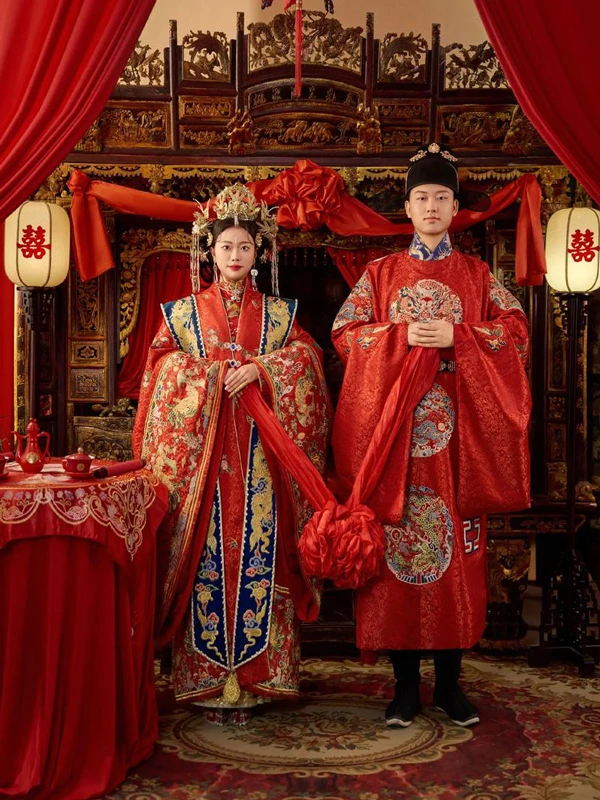
This historical evolution explains the confusion and curiosity surrounding Bai Lu’s costume in The First Jasmine. We are so accustomed to the Ming and Qing red tradition that the Tang-era green appears novel, even odd. However, the costume design is not an error but a masterclass in historical storytelling. By choosing to adhere to the Tang Dynasty’s color palette, the show visually reinforces its setting and immerses the audience in the aesthetic and cultural values of that period. It’s a testament to the fact that “tradition” is not a monolithic concept but a living, evolving tapestry.
Qing Dynasty Mix
With the arrival of the Qing Dynasty, the Chinese wedding dress entered a final phase of its evolution. The Manchu rulers, who founded the dynasty, introduced their own distinct style of formal dress, often in the same auspicious red hue. For Manchu brides, this meant a red banner robe with specific Manchu hairstyles and headdresses. Simultaneously, the Han Chinese population largely retained the Ming Dynasty traditions of the red jacket, skirt, phoenix coronet, and embroidered cape. This created a fascinating coexistence of two distinct yet harmonious red-clad bridal styles within the same empire.
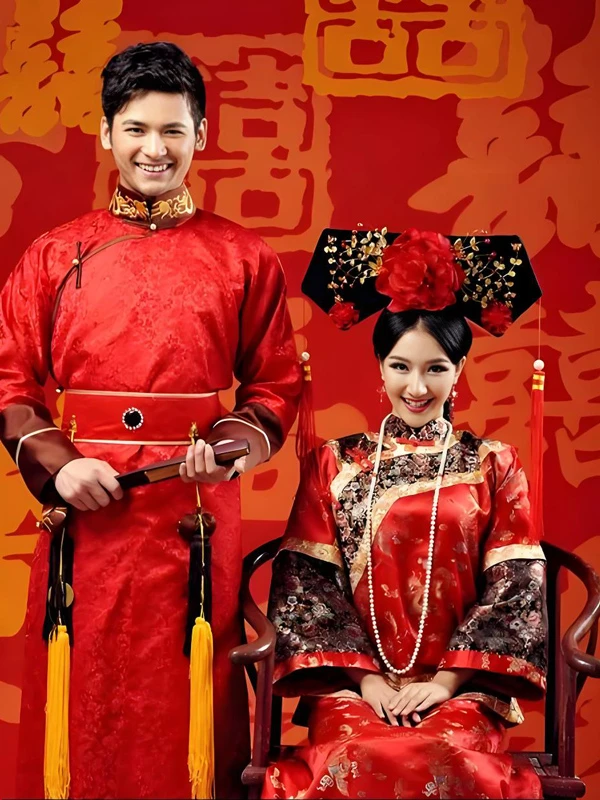
Over the centuries, as Han and Manchu cultures merged and influenced each other, the differences gradually blurred. The red wedding dress, already deeply embedded in the Han psyche and formalized by the state, became the universal standard. The Qing Dynasty’s contribution was not a rejection of the Ming’s red, but its reinforcement. The “red” was now inextricably linked not just to joy and status but to a pan-Chinese identity for brides. It transcended class divisions, becoming the ultimate symbol of respectability and celebration for a daughter leaving her family.
Ultimately, Bai Lu’s red-and-green ensemble is a vibrant reminder that what we consider “traditional” is often just the most recent chapter in a long and dynamic story. The visual impact of her costume stems from a time when the wedding dress code was entirely different, a time when a bride’s main ceremonial color was as cool and deep as a forest or the sea, contrasting with the warmth of her red underlayers. The qing robe was not just a dress; it was a statement of prestige, a privilege, and a reflection of the grand, colorful, and open spirit of the Tang Dynasty.