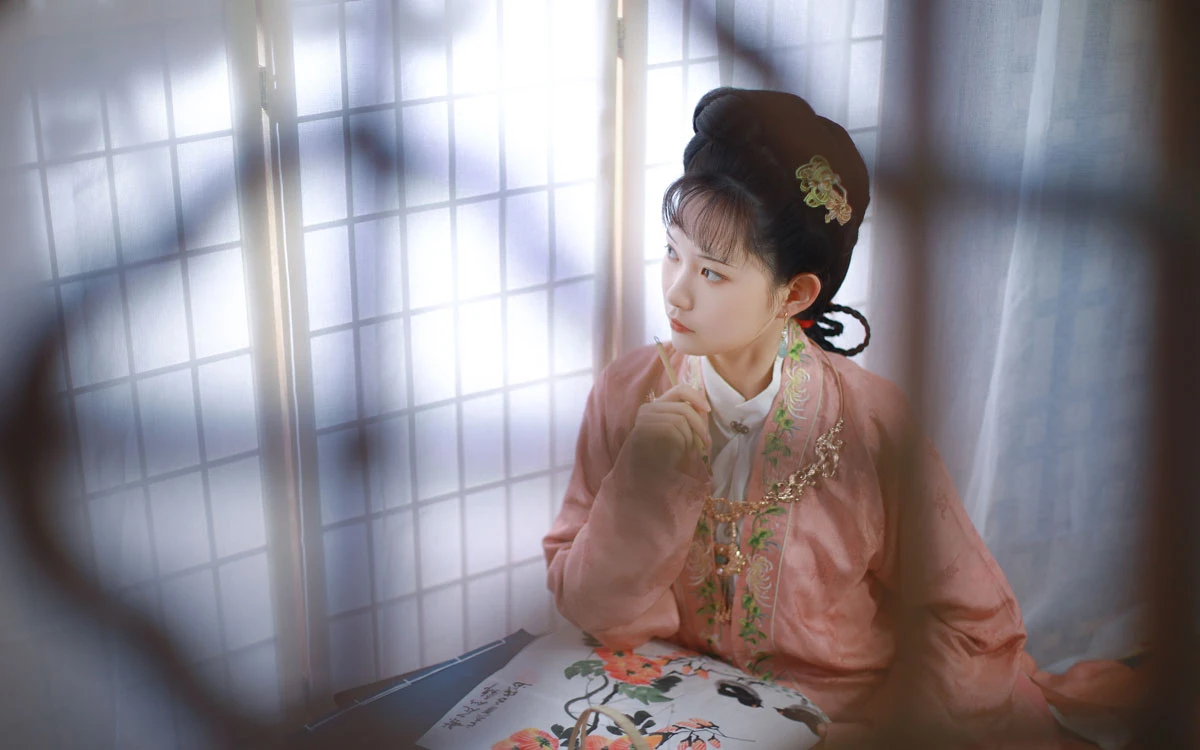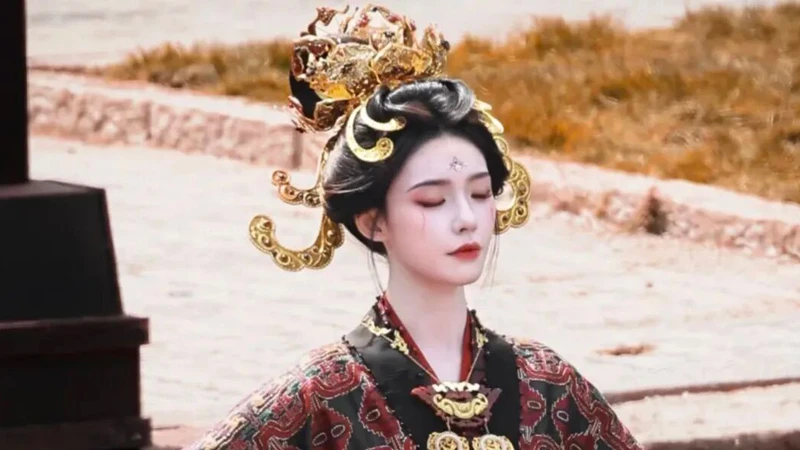
When Zhang Linghe (张凌赫) and Lin Yun (林允) were spotted on the set of their new historical drama Gui Luan (归鸾), it wasn’t just their chemistry that caught the audience’s attention. It was her hair. Specifically, it was the pair of exquisite, symmetrical ornaments dangling on either side of her elaborate headdress. They looked like little tails or wings, framing her face and instantly elevating her character’s aura of nobility.
For many viewers, this striking accessory was a mystery. Was it purely decorative, or did it signal something deeper about status and rank? The answer takes us on a fascinating journey through a thousand years of imperial fashion, revealing a forgotten language of power hidden in plain sight.
More Than Just a “Little Tail”
This iconic side ornament is known as Bo Bin (博鬓). Far from being a modern stylist’s whim, it was a highly regulated piece of formal attire for aristocratic women during the Sui, Tang, and Song dynasties. Think of it as a ceremonial marker of identity, a visual cue that immediately declared one’s place in the rigid social hierarchy of ancient China. It was commonly found in the formal wardrobes of noble consorts and was also frequently depicted in classic, ancient paintings of celestial beings, cementing its status as a symbol of solemnity and formal ritual.
Its design is distinctive and elegant. The main body of a Bo Bin usually hangs downwards, often past the ear, with a subtle, upward curl at the tip, resembling a tiny, stylized ear. It is typically adorned with delicate details like floral appliques and emerald leaves, and it was almost always paired with a formal crown like the phoenix crown. The historical roots of the Bo Bin are deeply ancient, with archaeological evidence tracing back to the Northern Qi dynasty, where similar ornamental fittings were discovered in the tomb of the nobleman Lou Rui (娄睿).
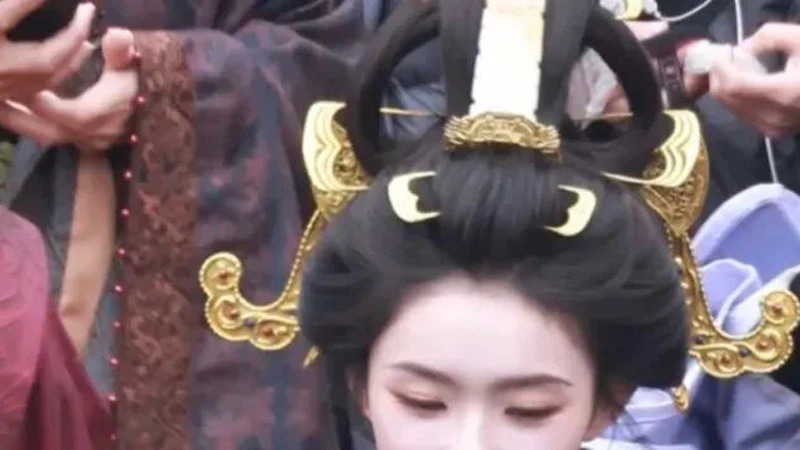
Over the centuries, the Bo Bin’s form and function evolved significantly. The most complete early example comes from the tomb of Empress Xiao (萧) of the Sui dynasty. In this form, the Bo Bin was a compact, integrated part of the crown itself, a unified component that was worn as a single, solid structure. However, by the Tang and Song eras, the design became more dynamic and varied. Court paintings from the time show crowns with more elaborate, less rigid Bo Bin, often featuring a greater number of decorative pendants.
The Golden Rules of Bo Bin
The true sophistication of the Bo Bin system lay in its strict codes. It wasn’t just about wearing it; it was about wearing the correct number. For instance, the popular drama Flourished Peony (国色芳华) featured characters with noticeably different formal headwear. This wasn’t a costume department oversight; it was a meticulous attention to historical etiquette. According to Tang dynasty regulations, all noblewomen were required to wear two Bo Bin. Their rank, however, was meticulously distinguished by the number of “flower trees” and “treasure inlays” they were allowed to display.
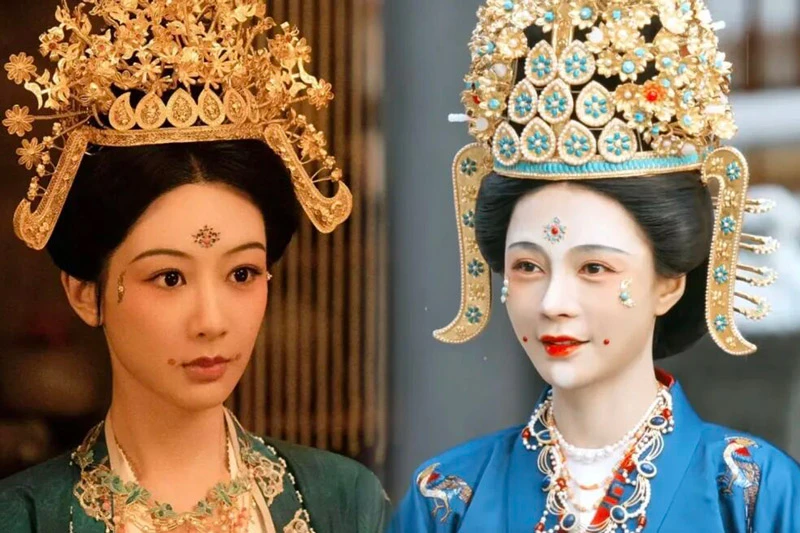
Historical texts clearly spell out these rules: Empress and the Crown Prince’s Consort were entitled to twelve and nine flower trees respectively on their two Bo Bin. Imperial and official consorts, according to their rank, received a specific number: one with nine, another with eight, and so on down to five. The decorative inlays were equally regulated, leaving no room for error or transgression. This was a society where a single hairpin could broadcast one’s entire identity.
The Song and Ming dynasties further codified this system, adding intricate dragon and phoenix motifs to the crowns, which eventually evolved into the iconic “phoenix crown” we recognize today. The History of Ming: Treatise on Carriages and Attire (明史・舆服志) explicitly states that the Empress wore three pairs of Bo Bin, while the Crown Prince’s Consort was limited to two. This codified hierarchy transformed a piece of jewelry into an unmistakable symbol of authority and birthright.
The Bo Bin’s Lasting Legacy
However, the Bo Bin’s story isn’t just one of rigid adherence to court etiquette. Ancient paintings reveal that over time, a simpler, more floral version of the Bo Bin began to be worn on its own, separate from the formal crown. This adaptation was a significant evolution, signaling its transition from a symbol of exclusive, aristocratic privilege to a more widespread fashion accessory. While the grand, crown-integrated Bo Bin remained the exclusive domain of titled noblewomen, the lighter, free-standing Bo Bin—sometimes called a “Bo Bin hairpin”—found its way into the daily adornments of the upper classes.
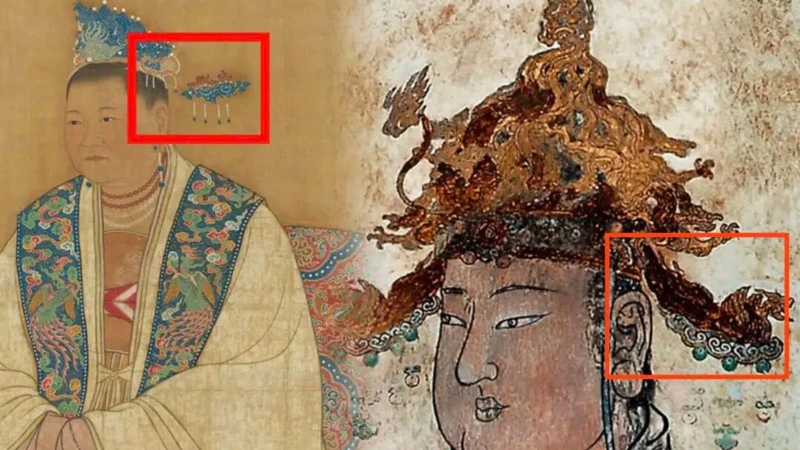
This version often featured hanging pearl tassels and was worn by noble ladies even outside of formal ceremonies, as seen in numerous Song dynasty portraits. It was a democratization of an ancient style, a way for women to subtly invoke the grace and authority of the court even in their daily lives. This gradual integration into everyday fashion showcases the dynamic nature of ancient beauty standards and their ability to evolve with the times.
It’s also important to distinguish the Bo Bin from its more famous cousin, the Bu Yao (步摇). While both are striking hair accessories, their purpose is fundamentally different. The Bu Yao is designed to sway and shimmer with every step, its name literally meaning “shake as you walk.” It’s dynamic, alluring, and embodies a lively, seductive energy. The Bo Bin, in contrast, is stately and anchored. Its position is fixed, its form more sculptural, and even with hanging pearls, the jewels are short and designed to remain still, projecting an air of gravity and composure. The Bo Bin was for moments of formal reverence; the Bu Yao was for flirtatious movement.
In Gui Luan, Lin Yun’s character skillfully incorporates this ancient element to enhance her on-screen presence. Her “little tails” are a creative interpretation of the Bo Bin, using traditional principles to frame her face and project an air of noble dignity. The true art of historical costume drama, however, lies not just in creating beautiful images but in respecting the cultural and historical depth behind the fabric and gold. By bringing the Bo Bin back to the screen, the show enriches its narrative texture and introduces modern audiences to a tangible piece of living history. It’s a testament to the incredible aesthetic sensibilities of our ancestors, and it raises a curious question for us all: would you wear a pair of these “little tails”?