For centuries, wearing layered garments in ancient China was never just about fashion or social status. It was a daily practice of self‑care, deeply intertwined with the logic of Traditional Chinese Medicine (TCM, 中医). The way a robe wrapped around the body, the tightness of a belt, even the direction of a folded collar—all these details mirrored principles that also governed herbal formulas and acupuncture.
This article does not claim that donning a historical costume cures illness. Instead, it invites you to see clothing as a movable micro‑environment, one that interacts with your vital substances just as food or exercise does. By examining three shared logics between Hanfu and TCM, we will discover that ancient Chinese thinkers treated the human body and its coverings as parts of a single, flowing system.
That system prized adaptability over rigidity, context over fixed rules, and function over mere appearance. Whether you are a history enthusiast or simply curious about holistic health, the following insights might change how you choose your outfit tomorrow.
Layered Defense
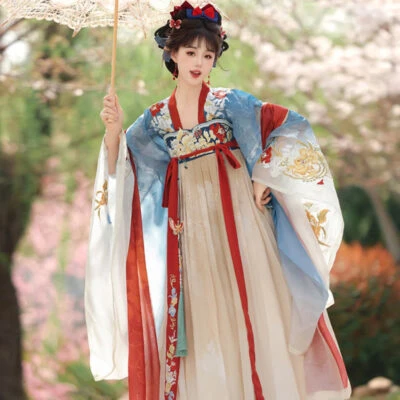
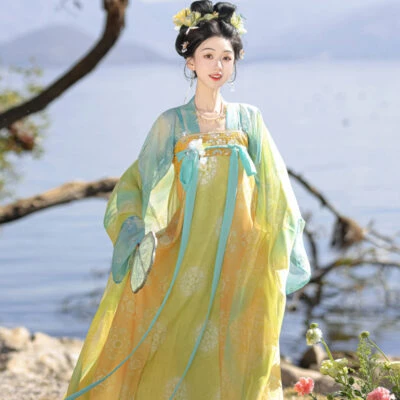
The classic Hanfu ensemble consists of multiple layers—an inner garment, a middle robe, and an outer coat. Modern observers often interpret this as a response to cold weather or as a marker of ritual formality. Yet TCM sees a deeper rationale. The innermost layer, usually made of breathable hemp or silk, sits directly against the skin. Its job is to absorb sweat and allow the skin to respire, thereby supporting ying qi (营气)—the nutritive energy that circulates within the blood vessels. The outermost layer, thicker and often lined, blocks wind and chill, thus guarding wei qi (卫气), the defensive energy that patrols the body’s surface. In this view, each layer performs a distinct physiological role, not unlike the way a formula uses different herbs to protect and nourish simultaneously.
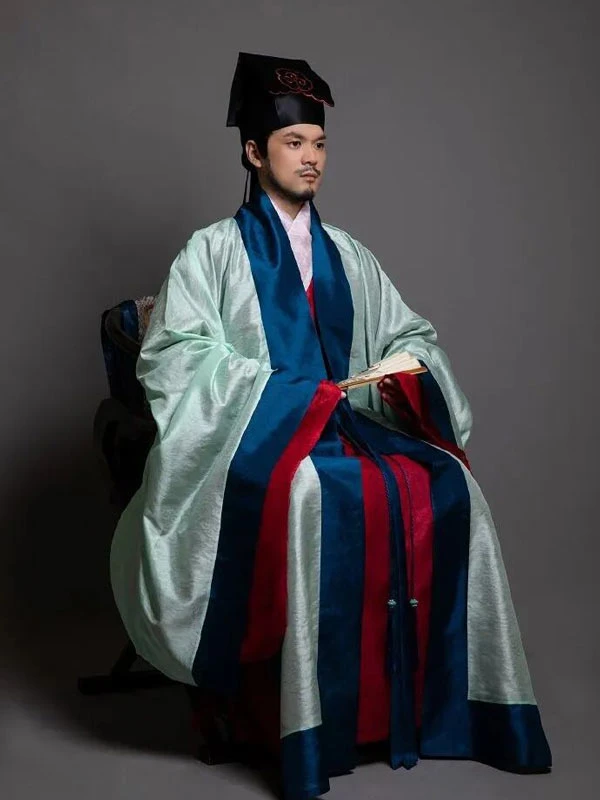
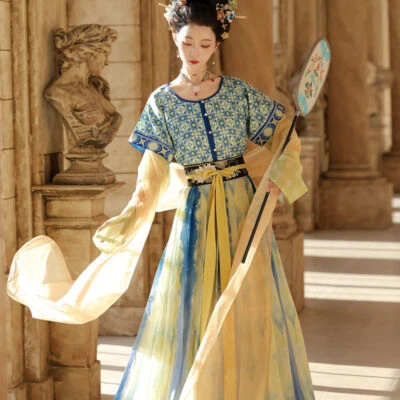
Consider the waistband. Hanfu typically uses a soft sash rather than a stiff buckle. Tying it around the waist is not merely for a sleek silhouette; it gently compresses the area where the Dai Mai (带脉, belt vessel) runs—a meridian that circles the lower torso like a hoop. In acupuncture theory, the Dai Mai restrains all the longitudinal channels. A moderate, non‑constricting pressure from the sash is believed to encourage the proper ascending and descending of qi (气) within the torso. Too tight, and you obstruct flow; too loose, and you lose the supportive effect. This reflects a central TCM axiom: seek smooth passage, never blockade. The same principle appears in the design of the Shenyi (深衣), a formal robe whose continuous curved hem winds around the body, mimicking the cyclical pathways of meridians—never a straight line, always a returning spiral.
Shared Logic
Beyond structural details, Hanfu construction and TCM prescription share three epistemological habits. First, both prioritize function over material. A herbalist does not judge a root by its color or weight alone, but by its action—warming, cooling, dispersing, or consolidating. Similarly, a tailor chooses fabric and cut based on what the wearer needs: a short under‑robe with slanted shoulders reduces bunching under the armpits for freedom of movement, while a capacious outer coat with added side panels allows generous overlapping for wind protection. The same raw silk could serve either purpose, depending on the intended effect.
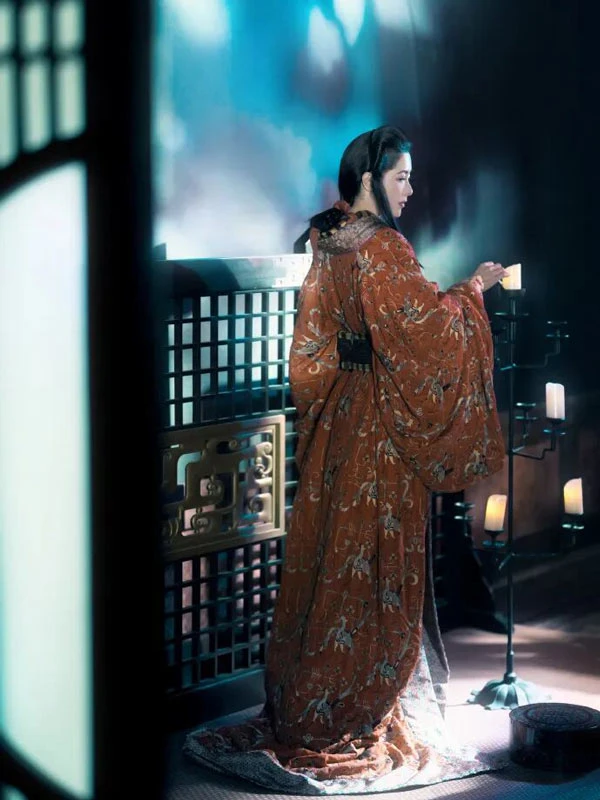
Second, both systems focus on essence rather than surface symptoms. TCM does not treat a cough with a universal cough‑stopper; it asks whether the cough stems from cold, heat, dryness, or deficiency. Likewise, when examining an excavated garment from the Mashan Chu Tomb (马山楚墓), experts note that the inner wear is short and fitted, while the outer wear is voluminous—opposite strategies for different functional zones. The tailor did not copy a single template; he responded to the body’s varying needs across layers. Third, both disciplines adapt rules to context. A classical formula may be modified by adding or subtracting herbs based on the patient’s constitution and the season. In the same spirit, Hanfu’s crossed‑collar (交襟) could be cut without shoulder seams in one instance, yet with shoulder seams in another, solely because the occasion or the wearer’s physique demanded a different drape.
Adaptive Modification
In TCM, the term Hua Cai (化裁) comes from the Book of Changes (易经), meaning to modify according to changing circumstances. It is the core skill of a seasoned practitioner: when combining two classic formulas into a new compound prescription, he must re‑evaluate the roles of each ingredient—which is the sovereign, which the minister, which the assistant, and which the envoy. This is not random tinkering; it is a thoughtful re‑balancing. The same logic applies to garment making. Historical records and excavated artifacts show that ancient tailors never adhered to a single, sacred pattern. They altered sleeve widths, adjusted hem lengths, and varied the angle of collar folds based on the user’s gender, age, and even the season of burial.
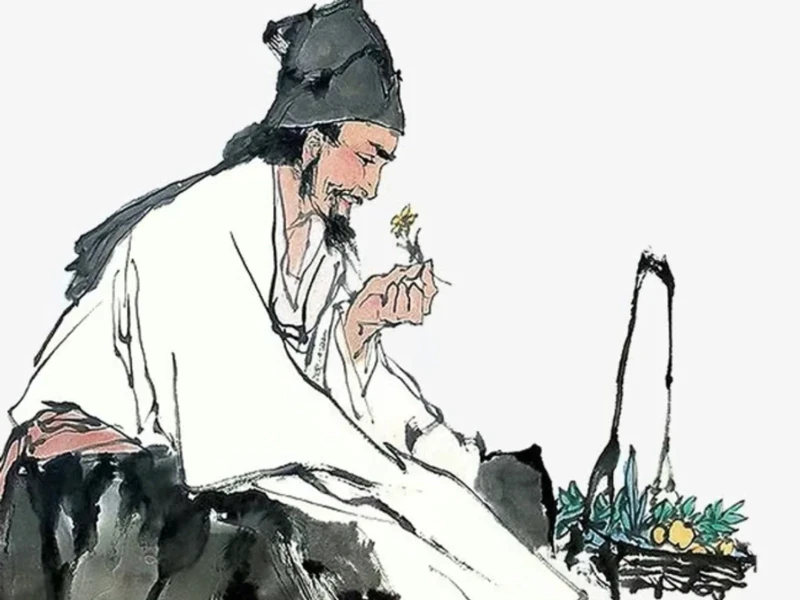
Take the case of a common cold. In TCM, two patients with identical sneezing and fever may receive completely different herbal prescriptions—one might need a warming herb like ginger, another a cooling one like mint. Why? Because their internal imbalances differ. Similarly, two identical‑looking Hanfu robes from the same dynasty might have entirely different cutting details. One might have extra fabric tucked at the armpit to increase the sweeping overlap of the front panel, while another might omit that extra piece to reduce bulk for a lighter undergarment. Both are valid; both are “correct” within their specific use cases. This is the essence of Hua Cai—not blind imitation of antiques, nor reckless innovation, but sensitive adjustment to real‑world needs.
This mindset also protects us from two extremes: slavish replication of every ancient stitch, or outright dismissal of historical wisdom. A TCM doctor never throws away a toxic herb; he processes and doses it carefully to harness its power. Likewise, a thoughtful Hanfu enthusiast does not reject a modern sewing machine or synthetic fabric, but asks how these tools can serve the original functional goals—breathability, warmth, and unrestricted movement.
The ancient tailor and the ancient healer were both pragmatists. They observed that bodies differ, climates shift, and social rituals evolve. What remained constant was the principle of fitting the means to the end. So when you next tie a sash or choose a jacket, remember: you are not just dressing; you are performing a small act of adaptive modification, tuning your personal micro‑climate just as a physician tunes a formula.