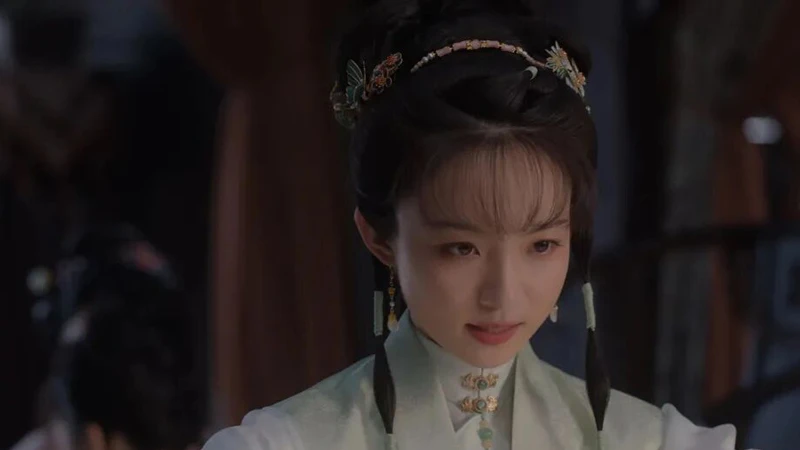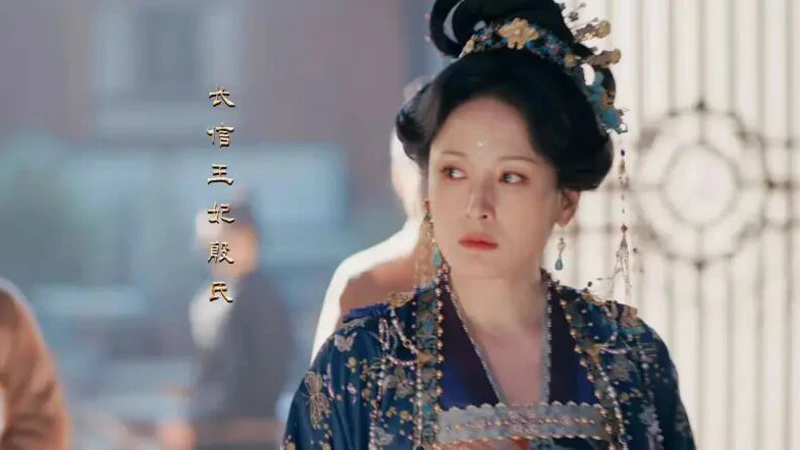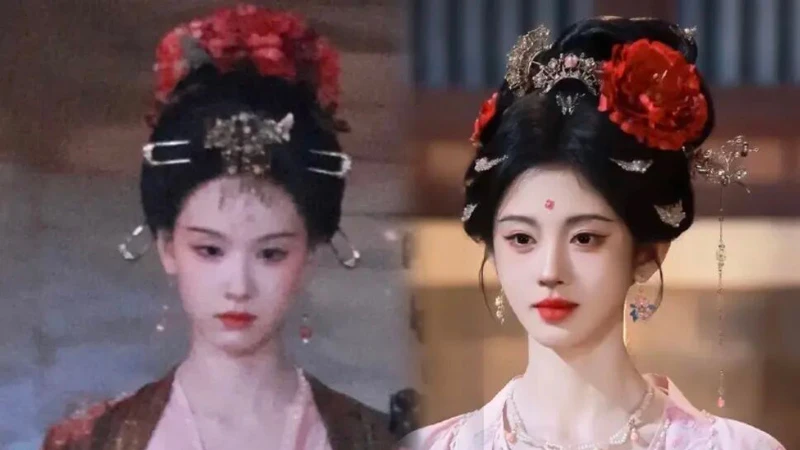
Two actresses, two flower crowns, and one heated online debate. Recent set photos from upcoming Chinese period dramas have revealed the Zan Hua (簪花) hairstyles of Ju Jingyi (鞠婧祎) and Chen Duling (陈都灵). While both looks are stunning, netizens quickly noticed a glaring difference: Chen’s flowers seem to overwhelm her head, while Ju’s appear perfectly proportioned. Why does one feel “off” and the other so harmonious? The answer lies not in the flowers themselves, but in a thousand-year-old painting, a forgotten Tang dynasty secret about hair height, and the tricky art of balancing visual weight. Let’s dive into what makes a Zan Hua work—and why even modern costume designers sometimes get it wrong.
The Tall Hair Secret
Chen Duling’s styling immediately drew comparisons to Zhou Fang’s (周昉) masterpiece, Court Ladies Wearing Flowered Headdresses (v). This painting, believed to date from the Five Dynasties period (no earlier than late Tang dynasty), has been copied by countless film and TV productions. Yet almost none have truly captured its essence. Why? The secret lies in the Eji (峨髻), a towering hairdo that literally means “lofty and soaring.” Unlike ordinary high buns, the Eji rises to a height at least equal to the wearer’s face length—sometimes even taller. In the painting and contemporary figurines, you can see that the hair dominates the head, creating a majestic silhouette.
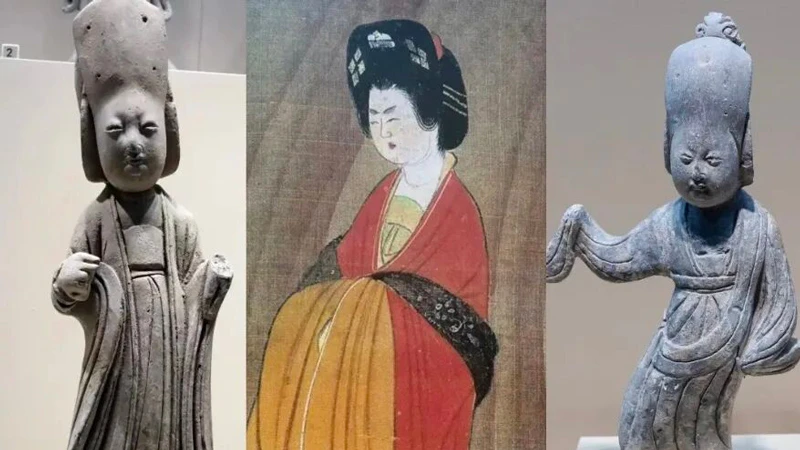
When a modern actress wears a scaled-down version, the proportion collapses. Chen’s bun, while high by everyday standards, simply isn’t tall enough to support the large, elaborate flowers placed on top. The result is a “big flower, small head” effect that feels visually cramped. One fan even digitally edited Chen’s photo, adding height to the bun and inserting a U-shaped hairpin on each side. Immediately, the whole look balanced out. The extra height gave the flowers room to breathe, while the side pins widened the composition horizontally. That’s the magic of Eji: it’s not just about being tall—it’s about creating a stable visual triangle with the flowers and pins.
Without that height, the hairstyle loses its anchor. The flowers appear to float awkwardly, and the wearer’s face gets visually compressed. This is why Tang dynasty aristocrats loved the Eji: it exaggerated their stature, added an air of untouchable elegance, and served as a canvas for their extravagant flower arrangements. It was a deliberate, almost theatrical exaggeration—a way to flaunt wealth and leisure. When you cut that height, you’re left with a half-hearted nod to history, not a faithful recreation.
Flower Power and Balance
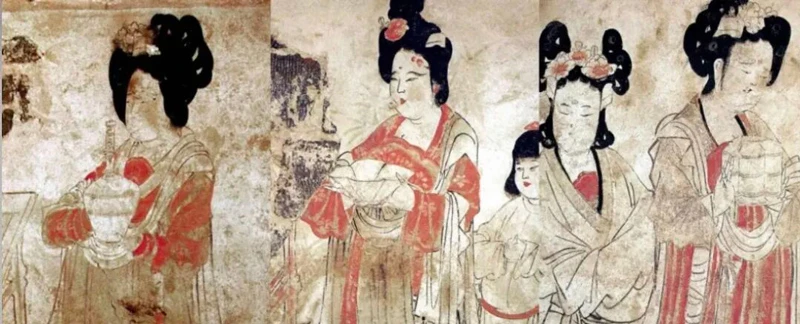
Ju Jingyi’s Zan Hua, in contrast, follows a different historical blueprint. Her style is a common Song dynasty and Tang everyday look: a central bun with hair parted clearly in the front, which widens the visual field horizontally. This is the same approach seen in recent drama costumes for The Story of Pearl Girl (珠帘玉幕) and Perfect Match (五福临门). The parted front hair frames the face softly, while the bun sits securely on top. Here, the flowers are smaller, more numerous, and placed at angles that follow the head’s natural curves. Ju’s team also paid attention to flower color: lighter, brighter blooms give her a lively, approachable vibe, while darker tones would have made her look solemn.
Flower size and number are equally critical. In Zhou Fang’s painting, the ladies wear peonies and lotuses so large they almost dwarf the Eji—but because the Eji is massive, the proportions feel intentional and luxurious. For a more modest bun, tiny flowers or scattered blossoms work better. This is where many modern adaptations fail. Designers often grab oversized silk flowers without adjusting the hair volume underneath. The result is a top-heavy look that screams “costume party” rather than “historical drama.” Chen Duling’s flowers, while beautiful individually, are simply too large for her bun’s height. A smaller cluster or a single medium bloom might have saved the balance.
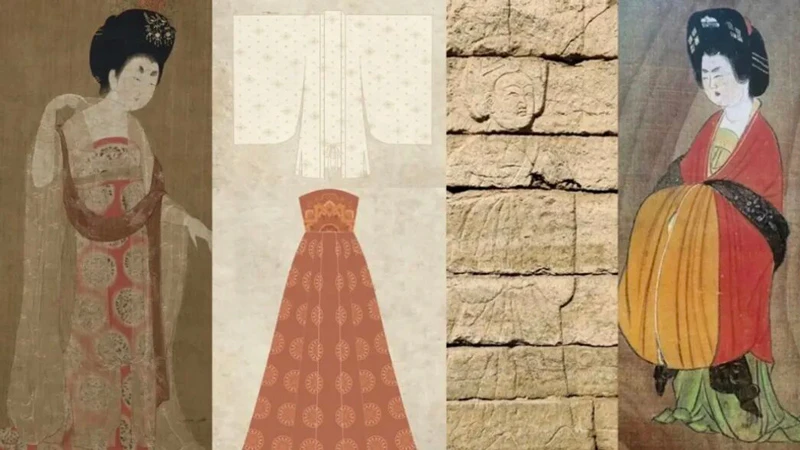
There’s also the question of the Huanji (鬟髻)—the looped or twin buns that flank the main Eji. In traditional paintings, these side buns add complexity and distribute visual weight. Without them, a high bun can look lonely. Ju’s styling incorporates subtle side volume; Chen’s does not. That absence makes the large central flower even more conspicuous. When you add a U-shaped pin or two, as the fan edit showed, the eye travels horizontally, creating a sense of grounded stability. It’s a small fix, but it proves that good period styling is a math problem: height + width + flower scale = harmony.
Echoes Through Time
Why does this Tang dynasty look refuse to fade away? Because it’s the undisputed ancestor of nearly every Tang-inspired drama costume from the 1980s to today. From classic 1990s series to recent hits, the Zan Hua-plus-Eji combination has appeared again and again. It’s not just nostalgia—it’s that Zhou Fang’s composition is nearly perfect. The way the flowers interact with the hair, the way the wide-sleeved robe and the corset skirt complete the silhouette—it’s a complete visual language. Modern designers keep returning to it because audiences instantly recognize it as “authentically Tang,” even if they can’t articulate why.
That said, every era adds its own twist. Chen’s costume, for example, pairs the Zan Hua with a narrow-waisted skirt and a large-sleeved robe—a hybrid that blends Tang flamboyance with Song restraint. Ju’s outfit follows a more straightforward Tang-Song fusion. Neither is strictly “wrong.” Historical fashion was never static; even in the Tang dynasty, styles varied by region, class, and decade. The real issue is internal consistency. If you borrow the Eji’s flower-on-top concept, you must also borrow its towering height. If you prefer a lower bun, then scale down the flowers and add side pins. The painting gives you the recipe; you can adjust the ingredients, but you can’t skip the main one.
So, who wore it better? Both actresses look beautiful, but for different reasons. Ju Jingyi’s team played it safe and smart, choosing a proven, balanced formula that flatters her face shape. Chen Duling’s team aimed for a more daring, historically ambitious look—and stumbled on proportion. Yet that stumble is valuable. It shows that period drama costumes are moving closer to classical aesthetics, even if the journey has bumps. Each imperfect on-screen Zan Hua is a step toward deeper understanding. And that, perhaps, is the real takeaway: traditional dress isn’t a museum piece to be copied exactly, but a living art form that demands respect for its geometry. When you get the math right, the flowers don’t just sit on the hair—they bloom.