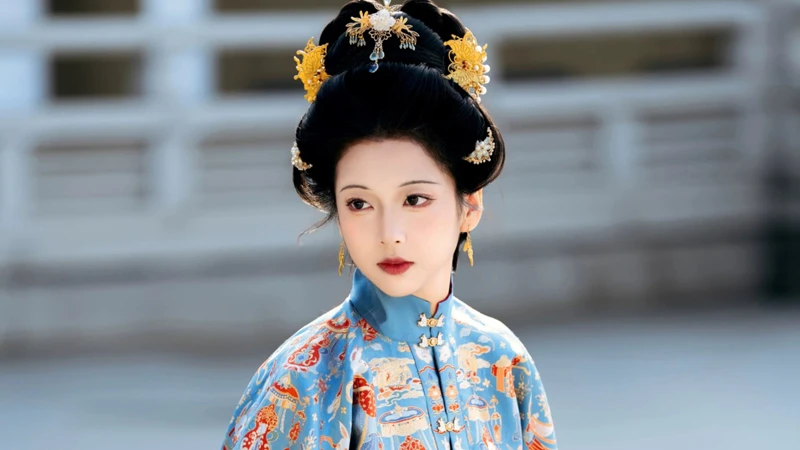
What Secrets Lay Beneath a Ming Woman’s Sleeve? During China’s Ming Dynasty (明朝, 1368–1644), clothing reached a peak of refinement after two millennia of evolution. From strict rank markings to luxurious materials, every stitch told a story of identity, power, and daily life. Unlike the flowing robes of Tang or the subtle layers of Song, Ming attire stood out for its dignified tradition and vibrant colors. It became the ultimate expression of Han Chinese dress. But what did a woman’s wardrobe actually reveal? Let’s lift the veil on three key aspects: ceremonial grandeur, everyday wear, and the tiny details that shaped her world.
Crown & Scarf
For noblewomen, known as Ming Fu (命妇, titled ladies), ceremonial dress was strictly regulated. She wore two main categories: Li Fu (礼服, ritual robes) and Chang Fu (常服, regular court attire). The most striking piece was the Feng Guan (凤冠, phoenix crown). Made from a metal wire frame and decorated with kingfisher feathers, jade phoenixes, and pearl tassels, it originated in the Qin-Han period as an exclusive accessory for empresses and grand empresses. During Ming times, it split into two forms: one for imperial consorts featuring dragons alongside phoenixes, and another for ordinary noblewomen that used pearl Zhu (珠翟) and floral hairpins instead. Yet both were casually called “phoenix crowns.”
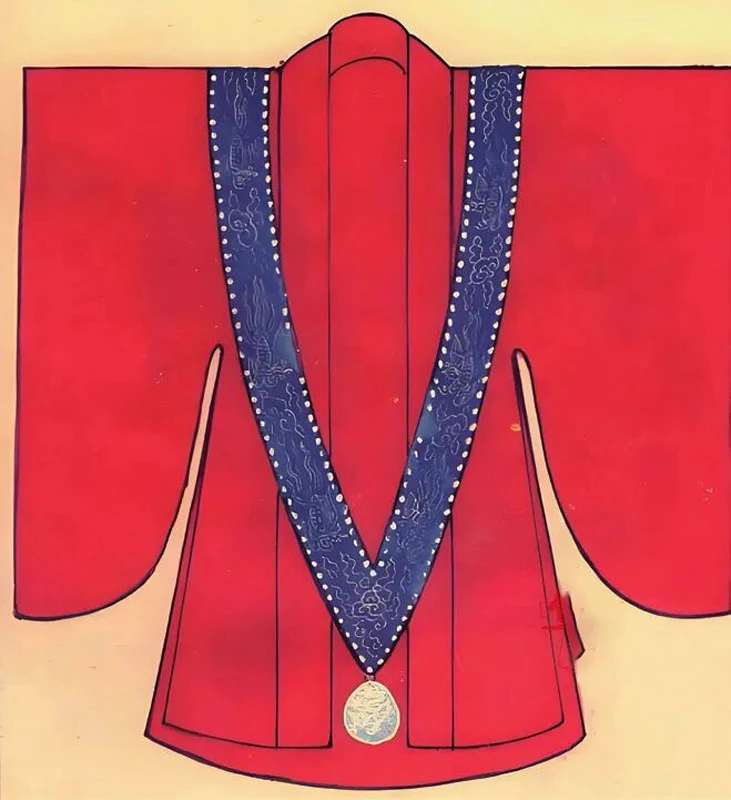
Paired with the crown came the Xia Pai (霞帔, rosy cloud scarf), a brocade ribbon draped from the shoulders down to the chest. Its name first appeared in the Sui-Tang era, inspired by its resemblance to sunset clouds. By the Song Dynasty, it had become part of the empress’s ceremonial attire. The Ming version displayed embroidered patterns on both ends, which were cut into triangles, with gold or jade pendants hanging below. These patterns served as clear rank badges. A noblewoman’s social standing could be read instantly from her Xia Pai—no words needed.
Weddings brought these symbols to life. Even though regulations reserved Feng Guan and Xia Pai for titled ladies, wealthy common brides often wore them on their big day. It was a proud, if unofficial, display of status and joy. The crown and scarf weren’t just beautiful; they were armor for the soul, announcing to the world: she belongs.
Everyday Elegance
For daily life, Ming women—both noble and common—wore a variety of garments that echoed Tang and Song traditions. Key pieces included the Bei Zi (褙子, long jacket), which came in wide-sleeve and narrow-sleeve versions. The wide-sleeve type had decorative borders running all the way from collar to hem, while the narrow-sleeve type trimmed only the collar and cuffs, with the collar border stopping at chest level. Another popular item was the Bi Jia (比甲, sleeveless jacket), a front-opening, sleeveless garment with side slits. Though its name appeared in the Song-Yuan period, the style had existed earlier. Young married women, servants, and even daughters of scholars favored it.
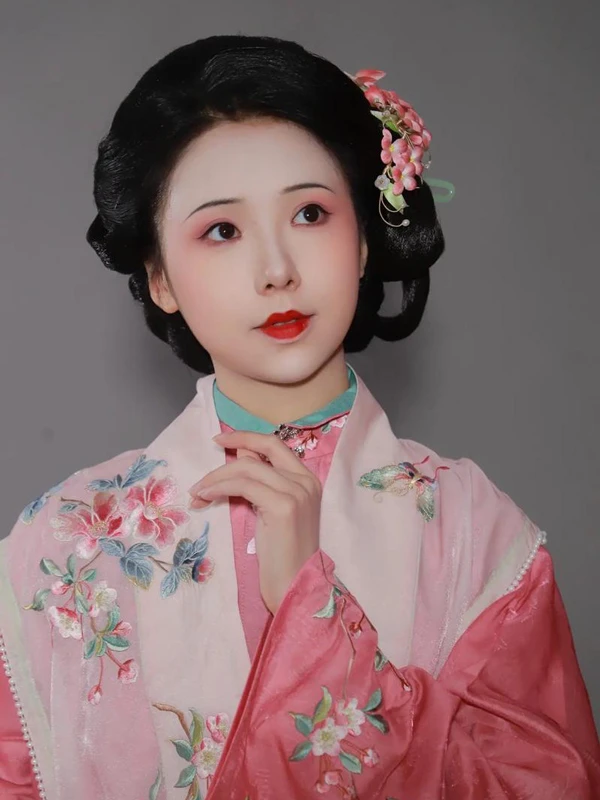
The Ru Qun (襦裙, short jacket and long skirt) remained a staple, just as in Tang times. The upper jacket had a crossed collar and long sleeves. The skirt initially used six panels, later expanding to eight, with many fine pleats that rippled like water when she walked. By the late Ming, skirt decoration grew more elaborate. Some skirts had ten panels with dense pleats; each pleat was dyed a different color, creating a shifting moonlight effect in a gentle breeze. This was called Yuehua Qun (月华裙, moonlight skirt). A silk cord belt, known as Gong Tao (宫绦), hung down to the ground with several knots, often threaded with a jade pendant to weigh down the skirt—much like the jade ring belt of the Song.
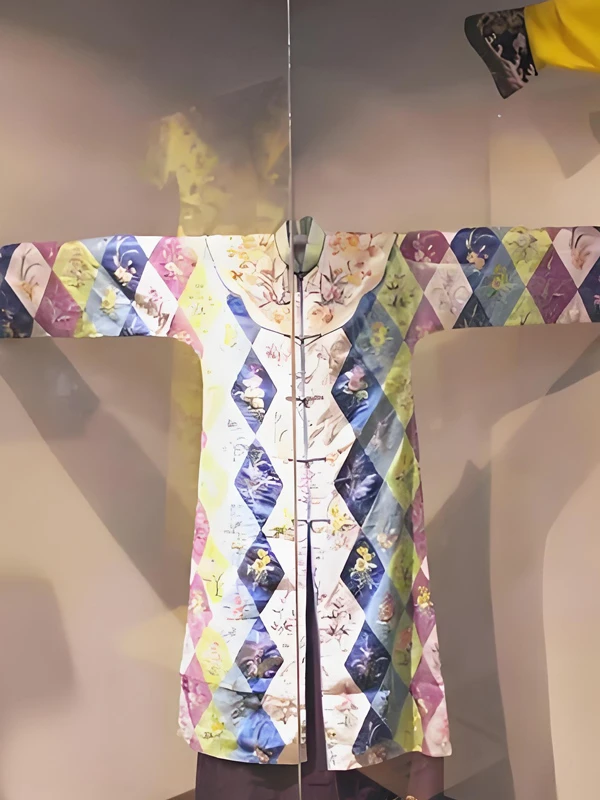
Perhaps the most inventive was the Shui Tian Yi (水田衣, rice-paddy dress), made from patchworks of colorful silk scraps. Because the mismatched pieces resembled flooded rice fields, it got its name. Simple yet striking, it was beloved by ordinary women. The Tang poet Wang Wei had already described “cutting clothes to imitate rice paddies.” Early Ming versions were orderly: all patches cut into uniform rectangles and sewn in neat rows. Later, women grew bolder, using odd-shaped pieces of different sizes. No two rice-paddy dresses were ever the same—each was a personal collage of leftover luxury.
Hair & Feet
Hairstyles in early Ming changed little from Song-Yuan norms. But during the Jia Jing (嘉靖, 1522–1566) era, variety exploded. Women began combing their hair into a flat, round bun called Tao Xin Ji (桃心髻, peach-heart bun), topping it with gemstone flowers. Soon buns grew taller, fixed with gold or silver wires, resembling a man’s gauze cap and dotted with jade beads. Another revival was the Duo Ma Ji (堕马髻, fallen-horse bun) from the Han Dynasty—hair rolled upward into a large chignon drooping behind the head. You can spot this style frequently in Ming paintings of beautiful women.
Head ornaments showed off wealth and taste. Fresh flowers twisted around the bun remained popular well into the Republican era. For the rich, there were hairpins with names like “gold-and-jade plum blossom,” “gold-twisted wire top-clasping hairpin,” or “rhinoceros-horn and jade large hairpin.” Young women preferred narrow Tou Ku (头箍, headbands), while the elderly wore wide ones. The wealthy inlaid theirs with gold and jade; the poor embroidered theirs with colorful threads. This headband likely evolved from the Song Bao Tou (包头, head wrap), now a narrow strip tied across the forehead, called Diao Fu E (貂覆额, marten forehead cover), with various buns showing above.
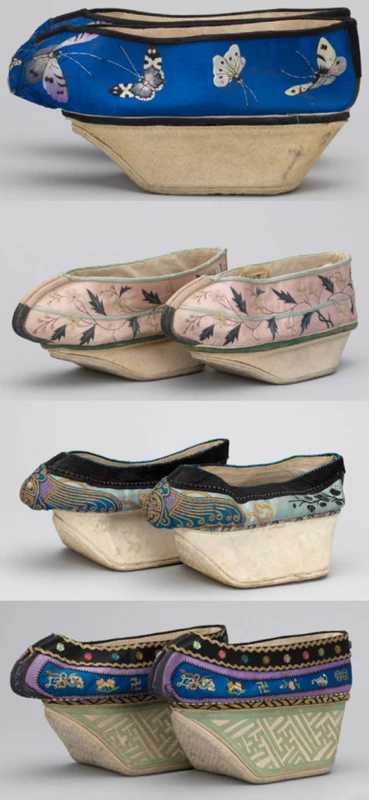
Then there were the feet. The Ming continued the earlier practice of foot binding, and it grew even more intense. The bound foot wore a special shoe: the Gong Xie (弓鞋, bow shoe). Made with a high sole of camphor wood, it came in two types. If the wooden sole was exposed, it was called outer high sole, with decorative names like “apricot leaf,” “lotus seed,” or “water lily.” If hidden inside, it was inner high sole, also known as “Taoist crown.” Elderly women usually wore flat-soled shoes called fragrant sole. Every step a Ming woman took—whether in a phoenix crown or a rice-paddy dress—was a step shaped by centuries of tradition, status, and silent rules.


How interesting! That’s the first i read about 水田衣, I knew it as 百家衣, I had no idea it was fashionable at some time.
水田衣 is also 百家衣—so cool it was fashionable back then!