
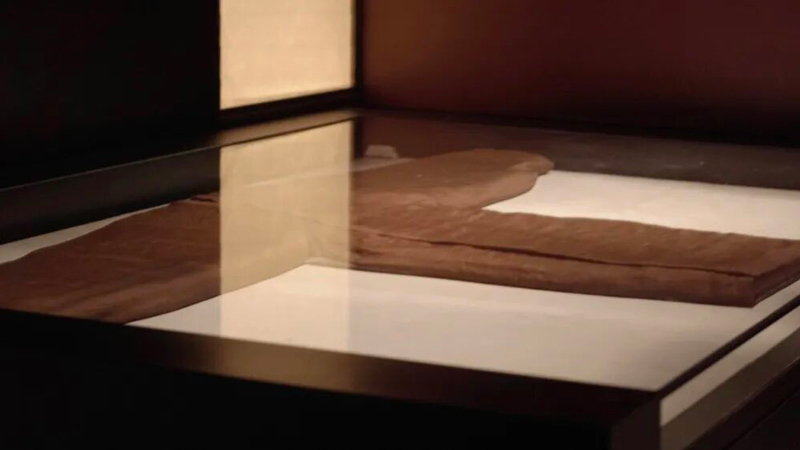
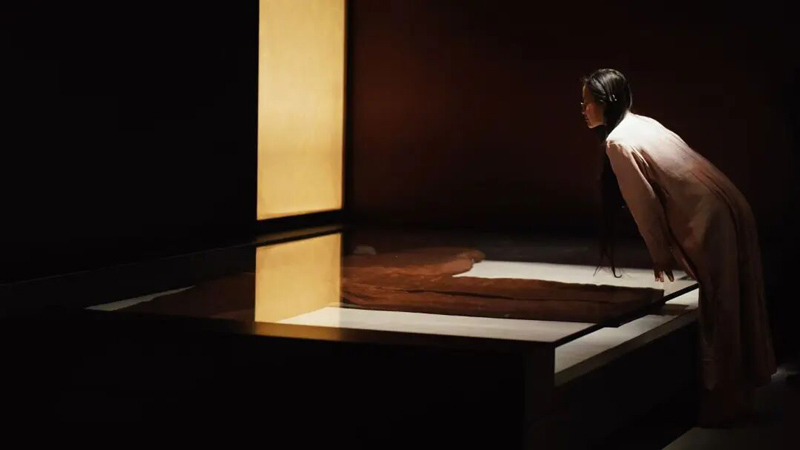
Hubei Provincial Museum houses an artifact that routinely stops visitors in their tracks. They gather around a display case, craning their necks, and the question inevitably arises: was this colossal piece of textile a garment for a giant, or did someone mistakenly place a quilt in the ancient textiles exhibit? This initial confusion is the perfect entry point into a story about a garment that challenges our modern assumptions about clothing, scale, and the very philosophy of how fabric interacts with the human form.
This is not a blanket but a robe—a reconstructed masterpiece known as the Small Diamond Pattern Brocade Cotton-Padded Robe. Its dimensions are staggering: a length of 200 centimeters and a sleeve span of 345 centimeters. For context, a standard single-size quilt in a modern home is roughly 150 by 200 centimeters. This robe, meant to be worn, is larger than the bedding we sleep under. It’s a relic from the Mashan Chu Tomb (马山楚墓), where it served as the outermost and largest garment for its occupant. More than just a conversation starter about size, it acts as a breathtaking canvas showcasing the intricate diamond-weave patterns and the luminous quality of pre-Qin dynasty silk craftsmanship.
An Ingenious Cut: The Hidden Secret
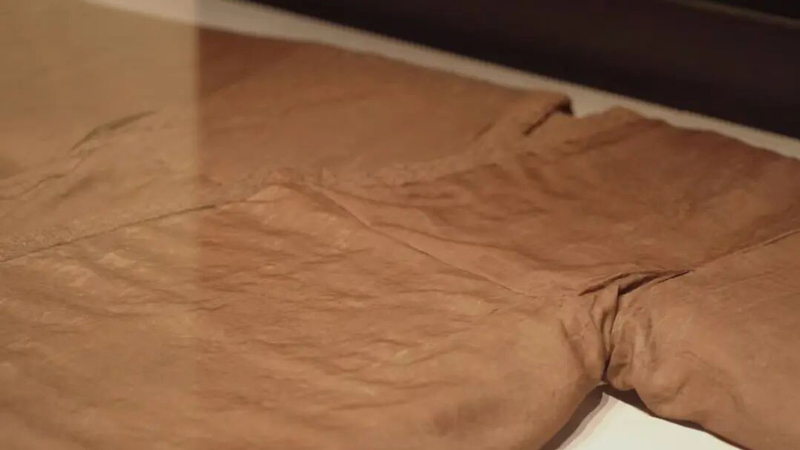
The sheer scale of the robe is only half the story; its true genius lies in an element invisible to a casual glance. Nestled in the armpits on both sides are two square-ish inserts. Archaeological reports refer to them as "small waists." This was not a simple alteration but a revolutionary design choice. It represents an early, sophisticated attempt to merge the principles of two-dimensional pattern cutting with the three-dimensional reality of a living, moving human body. This seemingly minor addition transformed the garment from a flat piece of fabric into a structure with a defined waist proportion.
This "small waist" insert served a dual purpose that modern clothing rarely considers. Firstly, it sculpted the robe’s silhouette, preventing it from being a shapeless sack. Secondly, it created the necessary architectural space for the front panels to elegantly wrap around the back of the wearer. Without it, the flowing Hanfu aesthetic of deep, overlapping layers would be impossible. It was a solution that was as much about geometry as it was about aesthetics, a design philosophy that prioritized how fabric behaves in motion, not just how it hangs at rest.
This structural innovation is the key difference between an authentic historical garment and many of its modern imitations. Recently, there has been a surge in popularity for “Warring States robes,” with many commercially available versions drawing inspiration from this very artifact. However, a closer look reveals that most of these reproductions omit the "small waist" insert. They shorten the length, reduce the sleeve span, and alter the collar structure. While visually reminiscent, they lack the structural integrity and the profound interactive experience that the original design intended to create.
A Drape That Defines an Era
When donned correctly, the effect of this robe was transformative. Secured not by buttons or ties but by a simple belt, the garment would have come alive. The long hem would trail gracefully, and the voluminous sleeves would fold and stack upon themselves, creating a cascade of fabric. Imagine the figures painted on contemporary lacquerware—elegant, elongated forms moving with a serene, flowing gait. This garment was the physical embodiment of that aesthetic ideal, a state of being where the clothing became an extension of the wearer’s presence.
The experience of wearing it would have been fundamentally different from wearing modern clothing. Today, we expect a garment to fit our body precisely. This robe operated on an opposite principle: it offered a structure within which the body could exist with a new kind of freedom. The wearer didn’t just put on a piece of clothing; they stepped into a defined space. This interaction—where the garment shapes the posture and the movement, allowing for "secondary shaping" after it is worn—represents a design philosophy that prioritized the creation of an aura and a sense of dignified ease over mere physical conformity.
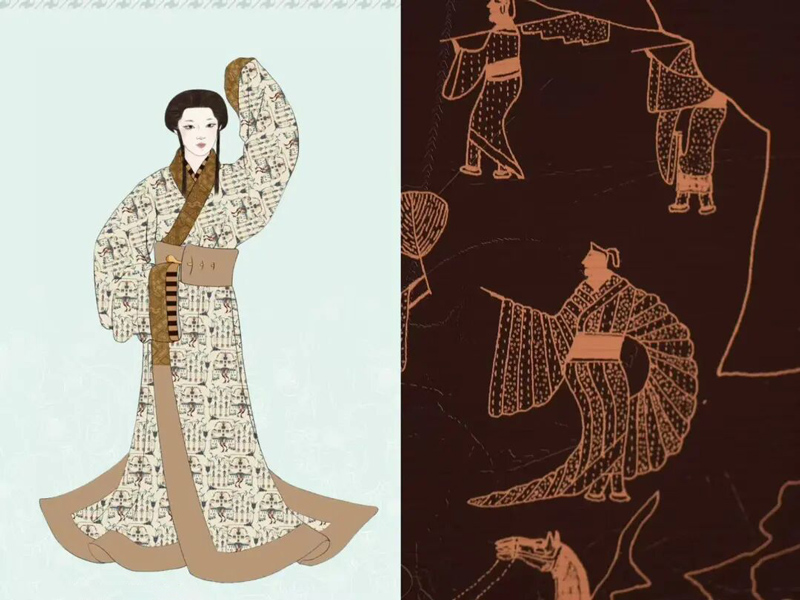
For me, this era represents a high point in the history of Chinese clothing. My personal preference has always been for the robes of the Qin and Han dynasties, and even further back to the Shang and Zhou periods. Among these, the finds from the Mashan Chu Tomb and the later Mawangdui Han Tomb (马王堆汉墓) stand out as the most remarkable. There is a specific reason for this fascination. In the periods after the Eastern Han dynasty, garment styles began to show a trend toward being more controlled, more fitted, and less voluminous.
Clothing as a State of Mind
This shift toward more restrained forms makes the earlier garments like the one from Mashan all the more special. They represent a period before the standardization of silhouette, a time when clothing was conceived as a generous envelope for the self. It’s not just about the size; it’s about the philosophy it embodies. A garment of this scale and construction does not restrict; it invites. It offers a "tolerant state of mind," a physical manifestation of a cultural moment that valued grandeur, ritual, and a flowing, unconfined elegance.
This garment was a canvas for personal expression in a way that is difficult for us to grasp today. Because it was not tailored to a specific body shape but instead provided a framework for self-assembly, each wearing could be slightly different. The way the layers were arranged, the precise location of the belt, the cascade of the fabric—these were choices that allowed the wearer to shape their own presence. It was a sophisticated interplay between the fixed structure of the garment and the individual agency of the person inside it.
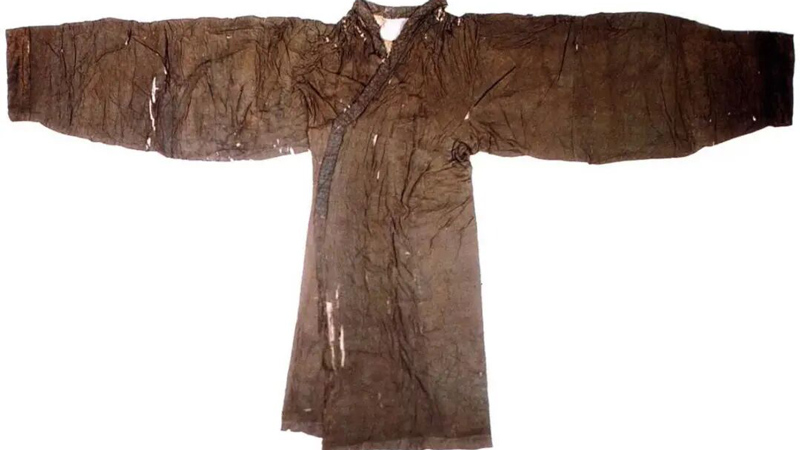
Ultimately, the massive robe in the Hubei Provincial Museum is more than a historical artifact; it is a powerful reminder of how clothing can shape not just our appearance, but our experience of the world. Its size challenges our modern ideas of practicality, while its construction reveals a forgotten genius in fabric engineering. The next time a visitor asks if it is a quilt, the more profound answer is that it is something far more rare: a perfect example of an era when clothes were designed to offer not just warmth and modesty, but also the space to move, to exist, and to be.
