
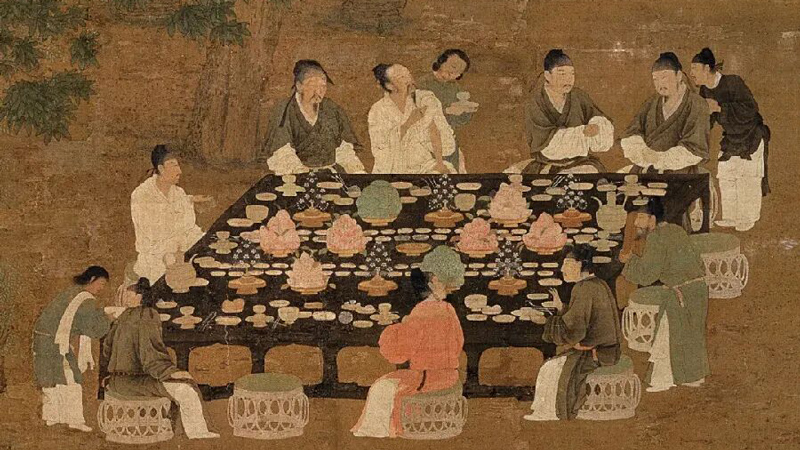
Kuai Zi (筷子), those two slender sticks of wood, bamboo, or metal, are more than just a meal’s opening act. For over five thousand years, they have been the unsung heroes of the Chinese table, a tool so deceptively simple that its mastery feels like a secret passed down through generations. To the uninitiated, the act of holding them steady with just a thumb, index, and middle finger seems like a form of culinary sorcery. But look closer, and you’ll see that these seemingly ordinary utensils are, in fact, a microcosm of Chinese philosophy, history, and the very essence of human connection.
The Philosophy of Two as One
“Waiter, bring a pair of Kuai Zi.” This common refrain in restaurants across China reveals a linguistic nuance that is deeply philosophical. Why “a pair” and not “two sticks”? The answer lies in the ancient concept of “he er wei yi (合二为一)” – the idea that two halves combine to form a greater whole. In Chinese thought, one plus one always amounts to more than two. It’s a principle that governs relationships, the cosmos, and even the simple act of eating.
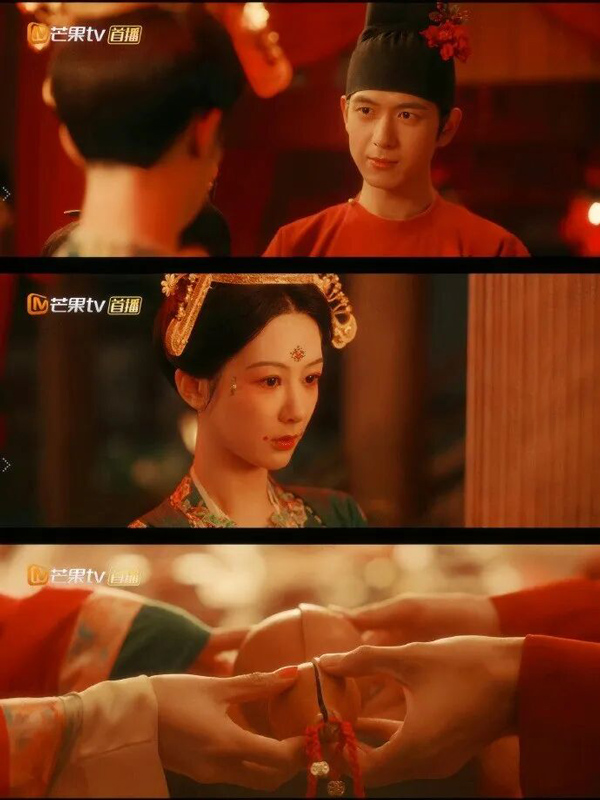
This concept of unity is beautifully illustrated in ancient rituals. The Book of Rites (礼记) describes the “he jin (合卺)” ceremony, where a gourd was split into two halves. A bride and groom would each drink wine from their own half, symbolizing their union. It was a pledge to share life’s bitterness and sweetness as one. In this same spirit, the two sticks of a Kuai Zi are inseparable. One alone is useless, but together, they become an extension of the hand, a tool of cooperation.
Their function is a masterclass in applied physics. The point where the two sticks cross becomes a fulcrum, creating a simple lever that allows for a symphony of movements: picking, stirring, clamping, and even prying. It is a testament to the ingenuity of turning a natural principle into a daily necessity. The ancient text Huai Nan Zi (淮南子) states, “When Yin and Yang combine, all things are born.” A pair of Kuai Zi, representing this very duality, embodies the power that arises from harmony. To use them well requires a state of calm; haste will only send your food flying.
A Name Woven with Wishes
The Chinese have a talent for imbuing everyday objects with auspicious meanings, and Kuai Zi are no exception. Its very name is a story of hope. In a famous poem, Li Bai (李白) lamented, “I drop my chopsticks, unable to eat; I draw my sword and look around, my heart confused.” He used the word “zhu (箸),” the ancient term for these utensils. But “zhu” sounded similar to another word meaning “to stop” or “to lodge,” which was considered bad luck for those who made their living on the water.
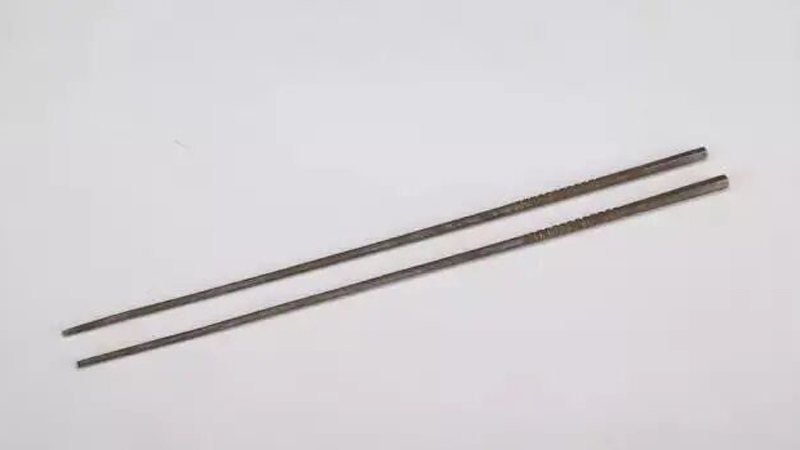
As recorded in the Shuyuan Zaji (菽园杂记) of the Ming Dynasty, boatmen began to call them “kuai,” meaning “fast,” wishing for swift and safe journeys. This simple desire for speed soon spread. Newlyweds adopted the term, hoping for a “quick” arrival of children, a “quick” expansion of their family. Over time, the word evolved into a double-syllable term, and eventually, the bamboo radical was added, giving us the modern word “Kuai Zi” – literally, “fast bamboo.” The name itself became a vessel for blessings, a daily incantation for speed, safety, and prosperity.
Beyond its name, the materials and form of Kuai Zi have also reflected social status and personal values. The philosopher Mo Zi (墨子) advised, “One must first have enough to eat, and then seek beauty.” Yet, history shows that the pursuit of beauty in these tools began early. Han Feizi (韩非子) records that King Zhou of Shang (商纣王), known for his extravagance, favored ivory chopsticks. This simple preference was seen as a sign of impending decadence. In contrast, a story from the Taiping Guangji (太平广记) tells of Emperor Ming of Qi who used bamboo Kuai Zi at a banquet. When asked why, a minister wisely replied that he was avoiding the corrupting luxury of ivory, and that his bamboo chopsticks were a symbol of a peaceful and virtuous reign.
Form, Function, and Fortune
Every dimension of a traditional Kuai Zi carries a hidden meaning. Their classic length of seven cun and six fen (approximately 25 centimeters) was no accident. It was a deliberate reminder of the seven emotions (joy, anger, sorrow, fear, love, hate, desire) and six desires (sight, hearing, smell, taste, touch, thought) that define the human experience. To eat with them was to acknowledge one’s humanity. For centuries, their shape varied, but after the Ming Dynasty, a standardized design emerged: a square tip at the holding end and a round tip at the eating end. This design subtly embodies the ancient Chinese cosmological concept of “tian yuan di fang” – a round heaven and a square earth.
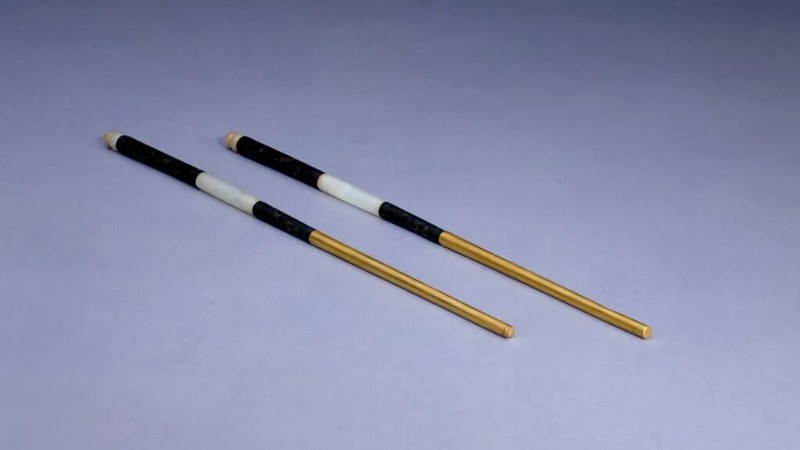
This seemingly simple design choice dictated a code of etiquette. When serving guests, the square end, representing “earth,” would be placed facing up, while the round, “heavenly” end touched the table. To do the opposite would be to invert the natural order, a grave discourtesy. The shape also carried spiritual weight. Because Kuai Zi resemble incense sticks, it is considered a profound taboo to stand them upright in a bowl of rice. This act, known as “gong kuai” (offering chopsticks), mimics the incense sticks burned for the deceased and is thus associated with funerary rites, a stark reminder of the line between the living and the dead.
From the simple bamboo in the hands of a commoner to the gold-tipped treasures found in the tomb of Emperor Wanli (万历), Kuai Zi have been a constant companion. They have been gifted as a symbol of integrity, as Emperor Xuanzong (玄宗) of Tang did, using their straightness to praise a minister’s upright character. They are the first tools a child uses to taste the world’s complexities—the sour, sweet, bitter, and spicy—and the familiar instruments an elder uses to savor the simple joy of a family gathered. More than just a utensil, Kuai Zi are the bridge that connects the immense landscape of Chinese cuisine to the personal, intimate experience of a meal. Every time we pick them up, we are not just eating; we are participating in a tradition that has shaped a culture for millennia, holding in our hands the very backbone of that heritage.
