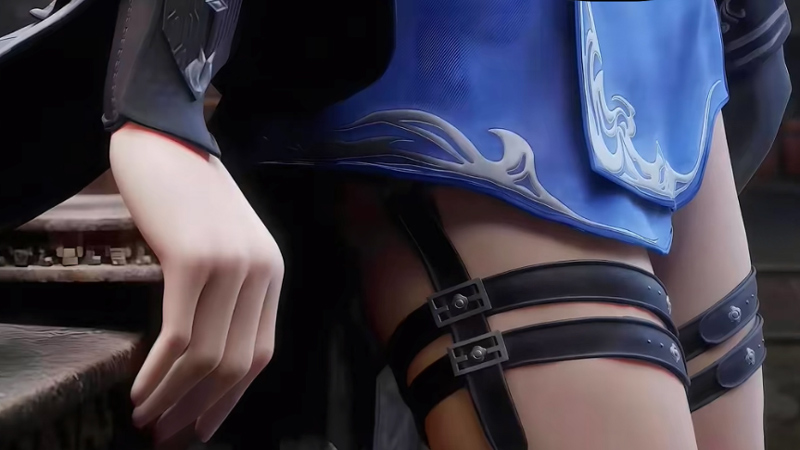
Fans of the animated series The Demon Hunter (沧元图) can’t stop talking about a peculiar detail on the character Li Shaoying (李少英): her thigh strap. Is it merely a decorative afterthought, or does it serve a greater purpose in defining who she is? This article peels back the layers of this subtle design choice, exploring how it transitions from a visual enhancer to a narrative symbol.
By examining its role in aesthetics, combat identity, and cultural context, we uncover why this small accessory is a masterstroke in character building—one that proves no detail is ever truly insignificant.
Filling the Visual Gap with Purpose
At first glance, the thigh strap on Li Shaoying’s leg is an undeniable boost to her visual appeal. The character is crafted to embody a blend of regal elegance and martial sharpness—her double bun hairstyle paired with a golden forehead chain, flowing purple robes, and long, defined legs. Without the strap, that streamlined leg line might feel incomplete or visually abrupt, disrupting the outfit’s layered sophistication. The accessory acts as a subtle anchor, drawing the eye and creating a balanced silhouette that feels intentional rather than accidental.
Its design is deliberately understated, avoiding the flashiness of bulkier ornaments. This restraint mirrors Li Shaoying’s own demeanor as the “Frost Night Lady” —cool, composed, and precise. The strap doesn’t scream for attention; instead, it quietly reinforces her dual identity as a princess of Dazhou (大周) and a core disciple of Yuanchu Mountain (元初山). It whispers nobility and capability, proving that effective character design prioritizes synergy over excess. The accessory becomes a part of her, not an addition to her.
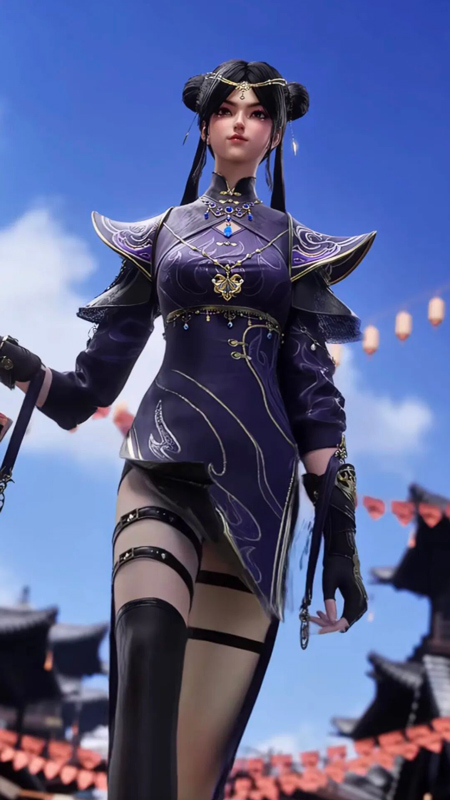
This principle of visual cohesion is what sets memorable designs apart. In a medium where every pixel counts, the thigh strap serves as a punctuation mark on Li Shaoying’s aesthetic sentence. It completes her look without overwhelming it, ensuring that viewers register her presence as cohesive and striking. By filling a potential void, it transforms a good design into a great one, where even negative space is utilized with intention.
Echoing a Fighter’s Spirit
To dismiss the thigh strap as mere ornamentation would be to overlook its deeper resonance with Li Shaoying’s combat identity. Known as the “Dark Shura Queen” among fans, she is far from a delicate royal. Her fighting style revolves around the “Shuang Ye” (霜夜) technique—a mastery over frost and shadow that enables stealth, speed, and sudden strikes. Armed with a chain sword and a nine-section whip, she moves with a fluidity that demands unencumbered agility. The thigh strap, snug and streamlined, visually echoes this need for freedom of movement.

It functions as a silent nod to her physical readiness. Much like a warrior’s belt or bracer, it hints at a body trained for action—lean, efficient, and unburdened by unnecessary flourishes. The strap doesn’t restrict; it suggests the opposite: a character built for high-intensity maneuvers. In scenes where she glides through darkness or freezes foes with her power, the accessory reinforces the illusion of a being whose very attire is optimized for the fight. It’s a design cue that tells the audience, without words, that this woman is lethal.
This connection between attire and ability is a classic storytelling tool. In martial arts tales, a hero’s gear often reflects their skills—a tight sash for a swift swordsman, padded gloves for a brawler. Li Shaoying’s thigh strap follows this tradition, acting as a visual shorthand for her agility. It bridges the gap between what we see and what we know about her capabilities, making her combat prowess feel inherent to her design rather than an external trait. The strap, in essence, becomes a part of her arsenal.
Redefining Details Beyond Stereotypes
Thigh straps, like many design elements, carry baggage from various cultural contexts. Historically, they’ve been interpreted through lenses ranging from practical wear to symbolic markers in different societies. When such items enter character design, they risk being pigeonholed into narrow meanings. However, Li Shaoying’s accessory defies easy categorization. It isn’t a relic of outdated tropes but a thoughtfully integrated component of her identity. The design team at The Demon Hunter has reclaimed it as a tool for characterization, not a crutch for cliché.

This approach highlights a broader trend in animation: the elevation of minutiae. Small details like the strap’s placement, material, and simplicity all contribute to a richer portrait of Li Shaoying. They speak to her world—a blend of royal grandeur and martial discipline—without needing exposition. The strap doesn’t just look good; it feels right for her. It aligns with her backstory as a princess who fights, a scholar of frost who stalks shadows. By grounding the accessory in her reality, the creators avoid hollow aesthetics and deliver meaning through form.
Ultimately, Li Shaoying’s thigh strap is a case study in why details matter. It reminds us that character design is a language, where every line and accessory can communicate volumes. Stripped of external assumptions, the strap is simply hers—a piece of the “Frost Night Lady” that encapsulates her grace and grit. The next time you watch The Demon Hunter, let your eye linger on that small band. It’s not just holding up her look; it’s holding a piece of her story, waiting to be appreciated.