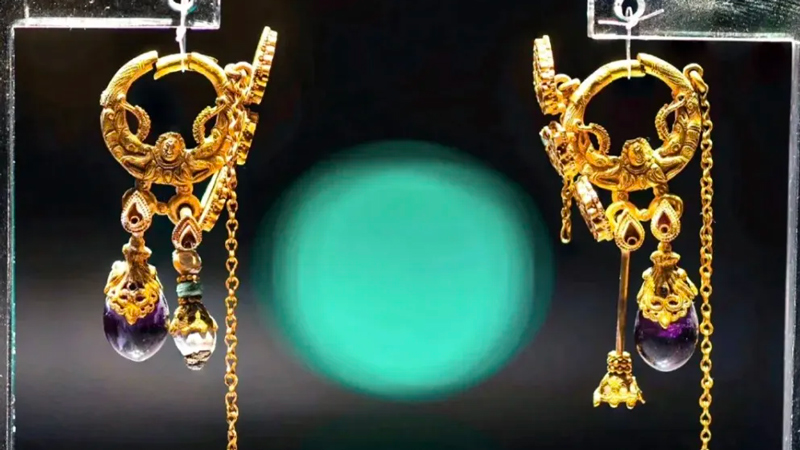
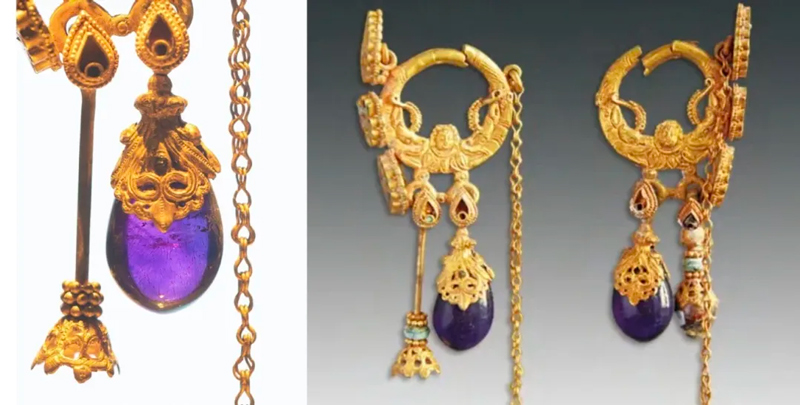
In the quiet halls of the Datong Museum (大同博物馆), a pair of earrings whispers tales from a millennium ago. Crafted during the Northern Wei Dynasty, these ornaments are more than mere jewelry; they are portals to an era of vibrant cultural exchange. Discovered in a tomb along Heng'an Street, the earrings feature intricate designs that blend local artistry with distant influences. Their modern appeal is startling, with clasp mechanisms and elegant chains that mirror contemporary fashion. Yet, they hail from a time when the Silk Road connected empires, and craftsmanship was a language of power and identity. This piece, attributed to a woman named Han Farong, encapsulates a story of fusion and elegance, waiting to be unraveled.
Artisan Craftsmanship
The earring's design begins with the Linked Bead Pattern, a motif of small, connected circles symbolizing celestial bodies and divine authority. Skilled artisans carved this into the gold ring, framing two dragons that coil around a central lotus. Within the lotus, a serene human face peers out, a detail that merges spiritual symbolism with artistic grace. Below, teardrop-shaped gems—agate, turquoise, and pearls—dangle from finely worked gold settings. Each element, from the millet-grain textures to the circular turquoise mounts, showcases a hands-on approach that machines could never replicate. This level of precision, achieved through engraving and inlay, set a standard that influences jewelers even today.
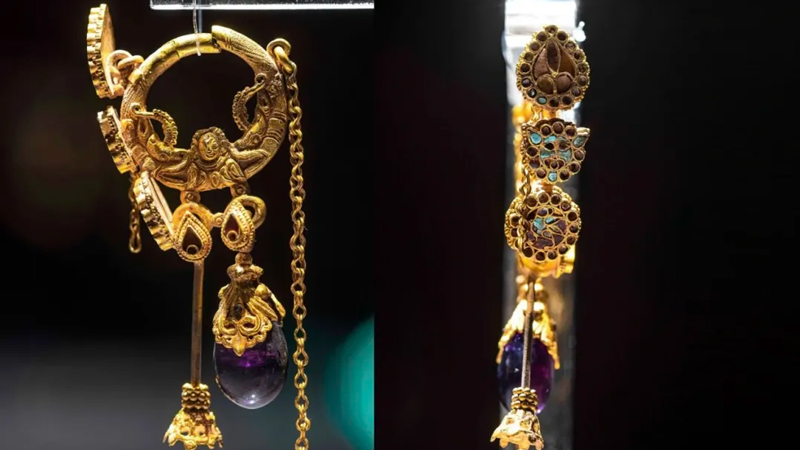
Further examination reveals the use of the Honeysuckle Pattern, a scrolling design common along the Silk Road, etched into the hollow-out gold backing. This motif, paired with the symmetrical "human subduing dragons" imagery, reflects techniques shared with Central Asian regions like Bactria. The chains, possibly used to secure the earring to the hair or ear, demonstrate a practical ingenuity aimed at balancing the heavy pure gold weight. Such thoughtful construction highlights how artisans prioritized both beauty and wearability, blending form and function in a way that feels remarkably current.
What stands out is the seamless integration of diverse materials and symbols. The dragons human face are not just decorations but narratives of belief and status. This earring serves as a testament to the Northern Wei's advanced metallurgy, where every hammer stroke and gem placement conveyed meaning. It’s a masterpiece that challenges our assumptions about ancient technology, proving that innovation in design is timeless.
Cultural Connections
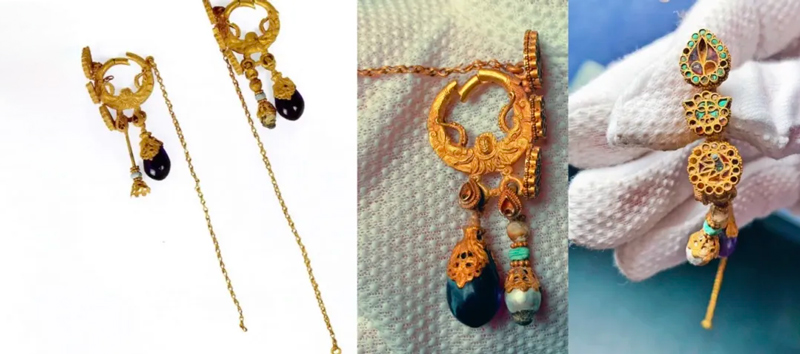
The earring’s origin story is tied to the tomb of Han Farong (韩法容), unearthed in 2011 with an epitaph linking her to the prestigious Cui family. This union hints at her possible roots in the Xiongnu nobility, marrying into a Han Chinese clan during an age of ethnic integration. The Northern Wei period, following the turmoil of the Eight Princes' War, saw Pingcheng—modern-day Datong—emerge as a capital where cultures converged. Artifacts like this earring embody the era's spirit, where Central Asian motifs met local traditions, creating a unique aesthetic language.
Historical records, such as the Wei Shu·Xiyu Zhuan (魏书·西域传), note that envoys from states like Kucha and Sogdia brought gifts to the Northern Wei court, fostering a cross-continental dialogue. The earring’s Linked Bead Pattern, for instance, shares similarities with designs from Persia and beyond, illustrating how trade routes acted as conduits for artistic ideas. This object isn’t just an accessory; it’s a relic of diplomacy and daily life, showing how women like Han Farong navigated a world in flux.
Today, the earring’s legacy endures in how we view cultural fusion. It reminds us that beauty often arises from exchange, not isolation. As it sits in the museum, it invites viewers to ponder the hands that made it and the journeys it witnessed—a small but powerful emblem of a connected ancient world.